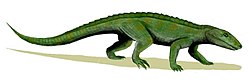
| Sebecids | |
|---|---|
 | |
| Skull of Sebecus icaeorhinus | |
 | |
| Skeleton of Ogresuchus | |
Scientific classification  | |
| Kingdom: | Animalia |
| Phylum: | Chordata |
| Class: | Reptilia |
| Clade: | Archosauria |
| Clade: | Pseudosuchia |
| Clade: | Crocodylomorpha |
| Clade: | † Notosuchia |
| Clade: | † Sebecia |
| Family: | † Sebecidae Simpson, 1937 |
| Subgroups | |
| |
| Synonyms | |
| |
Sebecidae is an extinct family of prehistoric terrestrial sebecosuchian crocodylomorphs, known from the Late Cretaceous and Cenozoic of Europe, South America and the Caribbean. They were the latest surviving group of non-crocodilian crocodylomorphs.
The oldest known member once attributed to the group is Ogresuchus furatus known from the Upper Cretaceous (Maastrichtian) Tremp Formation (Spain). [2] But however in a 2026 study suggest that it was no longer a sebecid, but a possible atoposaurid. [3] Other records of the group are known from the Eocene of Europe. [4] Sebecids were diverse, abundant and broadly distributed in South America (mostly in Argentina, Brazil and Bolivia) during the Cenozoic, from the Paleocene until the Middle Miocene. [5] The youngest known sebecids identified as cf. Sebecus sp. are reported from the Late Miocene-Early Pliocene strata of the Dominican Republic. [6]
This group included many medium- and large-sized genera, from Sebecus to the giant 6-metre-long (20 ft) Barinasuchus from the Miocene. [7] They are thought to have served as apex terrestrial predators of their ecosystems. [8]