Related Research Articles

John Herbert Dillinger was an American gangster of the Great Depression. He led a group known as the "Dillinger Gang", which was accused of robbing 24 banks and four police stations. Dillinger was imprisoned several times but escaped twice. He was charged, but not convicted, of the murder of an East Chicago, Indiana, police officer who shot Dillinger in his bullet-proof vest during a shootout; it was the only time Dillinger was charged with homicide.

Bank robbery is the crime of stealing money from a bank, specifically while bank employees and customers are subjected to force, violence, or a threat of violence. This refers to robbery of a bank branch or teller, as opposed to other bank-owned property, such as a train, armored car, or (historically) stagecoach. It is a federal crime in the United States.

Lester Joseph Gillis, known by the alias George Nelson and Baby Face Nelson, was an American bank robber. He became partners with John Dillinger, helping him escape from prison in Crown Point, Indiana. Nelson and the remaining gang members were labelled as public enemy number one. He was given the nickname Baby Face Nelson due to his small stature and somewhat youthful appearance, although few dared call him that to his face. Criminal associates instead called him "Jimmy".

Melvin Horace Purvis II was an American law enforcement official and Federal Bureau of Investigation (FBI) agent. Given the nickname "Little Mel" because of his short, 5 ft 4 in (163 cm) frame, Purvis became noted for leading the manhunts that captured or killed bank robbers such as Baby Face Nelson, John Dillinger, and Pretty Boy Floyd, but his high public profile was resented by local law enforcement. Purvis asserted he had killed Floyd single-handed, others variously claimed that Floyd had been already wounded, or even that Purvis had ordered Floyd summarily shot dead for refusing to provide information.

Kate Barker, better known as Ma Barker and sometimes known as Arizona Barker and Arrie Barker, was the mother of several American criminals who ran the Barker-Karpis gang during the "public enemy era" when the exploits of gangs of criminals in the Midwest gripped the American people and press. She traveled with her sons during their criminal careers.

Charles Arthur Floyd, nicknamed Pretty Boy Floyd, was an American bank robber. He operated in the West and Central states, and his criminal exploits gained widespread press coverage in the 1930s. He was seen positively by the public because it was believed that during robberies he burned mortgage documents, freeing many people from their debts. He was pursued and killed by a group of Bureau of Investigation (BOI) agents led by Melvin Purvis. Historians have speculated as to which officers were at the event, but accounts document that local officers Robert "Pete" Pyle and George Curran were present at his fatal shooting and also at his embalming. Floyd has continued to be a familiar figure in American popular culture, sometimes seen as notorious, other times portrayed as a tragic figure, even a victim of the hard times of the Great Depression in the United States.
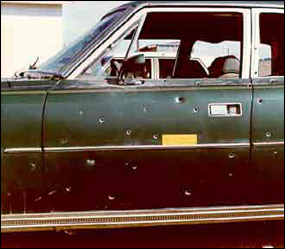
A shootout, also called a firefight or gunfight, is a gun battle between armed groups. A shootout often, but not always, pits law enforcement against criminal groups; it can also involve two groups outside of law enforcement, such as rival groups. A military term for a shootout in a combat situation would always be considered a battle, rather than a shootout. Shootouts are often portrayed in action films and Western films.
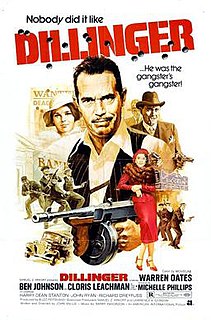
Dillinger is a 1973 American gangster film about the life and criminal exploits of notorious bank robber John Dillinger. It stars Warren Oates as Dillinger, Ben Johnson as his pursuer, FBI Agent Melvin Purvis, and Cloris Leachman as the "Lady in Red" who made it possible for Purvis to kill Dillinger. It also features the first film performance by the singer Michelle Phillips as Dillinger's moll Billie Frechette. The film, narrated by Purvis, chronicles the last few years of Dillinger's life as the FBI and law enforcement closed in. The setting is Depression era America, from 1933 to 1934, with largely unromanticized depictions of the principal characters. It was written and directed by John Milius for Samuel Z. Arkoff's American International Pictures.

"Public enemy" is a term which was first widely used in the United States in the 1930s to describe individuals whose activities were seen as criminal and extremely damaging to society, though the phrase had been used for centuries to describe pirates, vikings, highwaymen, bandits, mobsters, and similar outlaws.

Public Enemies is a 2009 American biographical crime drama film directed by Michael Mann, who co-wrote the screenplay with Ronan Bennett and Ann Biderman. It is an adaptation of Bryan Burrough's non-fiction book Public Enemies: America's Greatest Crime Wave and the Birth of the FBI, 1933–34. Set during the Great Depression, the film chronicles the final years of the notorious bank robber John Dillinger as he is pursued by FBI agent Melvin Purvis, Dillinger's relationship with Billie Frechette, as well as Purvis' pursuit of Dillinger's associates and fellow criminals Homer Van Meter and Baby Face Nelson.

Homer Virgil Van Meter was an American criminal and bank robber active in the early 20th century, most notably as a criminal associate of John Dillinger and Baby Face Nelson.

John "Red" Hamilton was a Canadian criminal and bank robber active in the 1920s–1930s, most notably as an associate of John Dillinger. He is best known for his lingering death and secret burial after being mortally wounded during a robbery.
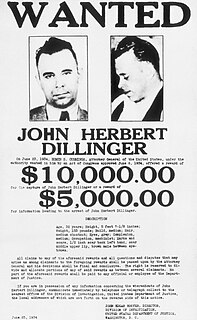
The Dillinger Gang was the name given to a group of American Depression-era bank robbers led by John Dillinger. The gang gained notoriety for a successful string of bank robberies, using modern tools and tactics, in the Midwestern United States from September 1933 to July 1934. During this crime spree, the gang killed 10 and wounded 7. They managed to pull off three jail breaks which wounded two guards and killed a sheriff.

John Paul Chase was an American bank robber and Depression-era outlaw. He was a longtime criminal associate of the Karpis-Barker Gang and most notably Baby Face Nelson who later brought him into the John Dillinger gang. FBI Director J. Edgar Hoover once referred to Chase as "a rat with a patriotic-sounding name". Chase and Nelson continued to rob banks with John Dillinger until Dillinger's death in July 1934. After the death of Nelson in November 1934, Chase fled back to California where he was arrested a month later on December 27, 1934. Chase was sent to Alcatraz where he became one of the longest-serving inmates;.
Robert G. "Big Bob" Brady was an American bank robber and Depression-era outlaw. A well-known Oklahoma bandit during the 1920s and 1930s, Brady was associated with Wilbur Underhill, Harvey Bailey and Jim Clark.

Russell Lee "Boobie" Clark was an American thief, bank robber and prison escapee. He is best known as the "good natured" member of the John Dillinger gang and participated in armed holdups with them in a three-month crime spree across the Midwestern United States from October 1933 until his capture in January 1934.

Thomas Leonard Carroll was an American bank robber and Depression-era outlaw. A boxer-turned-criminal, he committed numerous robberies during the 1920s and 1930s as well as being a longtime member of the Dillinger gang.

Harold Eugene "Eddie" Green was an American bank robber and Depression-era outlaw during the 1930s, best known as a member of the John Dillinger gang. He was also associated with Frank "Jelly" Nash, Volney Davis and the Barker-Karpis Gang in his early career.

Herman Edward "Ed" Hollis was an American law enforcement official and Federal Bureau of Investigation (FBI) special agent. As an FBI special agent in the 1930s, Hollis worked with agents Melvin Purvis, Samuel P. Cowley and others fighting bank robbers, gangsters and organized crime in the Chicago area during the Great Depression. Hollis is best known for having been killed in the line of duty during an intense shootout with Chicago-area bank robber Lester Gillis, a.k.a. Baby Face Nelson, at the Battle of Barrington in 1934. Hollis was also one of the three FBI special agents who shot John Dillinger near the Biograph Theater earlier that year, resulting in Dillinger's death. One controversial account also implicates Hollis in the death of Pretty Boy Floyd. Hollis served as a special agent for the FBI's field offices in Kansas City, Cincinnati, and Chicago for over seven years; at the time of his death, he was 31 years old.
References
- ↑ Document Kyushu Yakuza Wars, "Person, Isoji Koga" (p.228), Masaki Yasuda, December 1990, Seinen-shokan ISBN 4-7918-0496-1 (in Japanese)