 |
| |||
|---|---|---|---|
| |
| |||
|---|---|---|---|
Murder, Inc. was an organized crime group, active from 1929 to 1941, that acted as the enforcement arm of the Italian-American Mafia, the Jewish Mob, and other closely connected organized crime groups in New York City and elsewhere. The group was composed of Jewish-American and Italian-American gangsters, and members were mainly recruited from poor and working-class neighborhoods in Manhattan and from the Brooklyn neighborhoods of Brownsville, East New York, and Ocean Hill. It was initially headed by Louis "Lepke" Buchalter and later by Albert "The Mad Hatter" Anastasia. Murder, Inc. was believed to be responsible for between 400 and 1,000 contract killings, until the group was exposed in 1941 by former group member Abe "Kid Twist" Reles. Murder, Inc. committed hundreds of murders on behalf of the National Crime Syndicate during 1929 through 1941. In the trials that followed, many members were convicted and executed, and Abe Reles himself died after suspiciously falling from a window. Thomas E. Dewey first came to prominence as a prosecutor of Murder, Inc. and other organized crime cases.
Frank Abbandando, nicknamed "The Dasher", was a New York City contract killer who committed many murders as part of the infamous Murder, Inc. gang. His preferred killing method was to stab his victims through the heart with an ice pick. After a trial and conviction for murdering a Brooklyn loan shark, he was executed in the electric chair at Sing Sing on February 19, 1942.
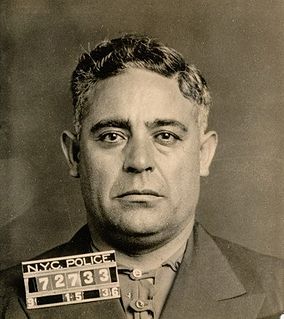
Louis Capone was a New York organized crime figure who became a supervisor for Murder, Inc. Louis Capone was not related to Al Capone, the boss of the Chicago Outfit. Capone was convicted of murder in 1941, and sentenced to death. He was electrocuted at Sing Sing Prison on March 4, 1944.
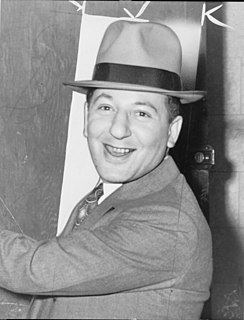
Louis Buchalter, known as Louis Lepke or Lepke Buchalter, was an American mobster and head of the Mafia hit squad Murder, Inc., during the 1930s. Buchalter was one of the premier labor racketeers in New York City during that era.

Abraham "Kid Twist" Reles was a New York Jewish mobster who was a hit man for Murder, Inc., the enforcement contractor for Meyer Lansky's National Crime Syndicate.
The National Crime Syndicate was the name given by the press to the multi-ethnic, loosely connected American confederation of several criminal organizations. It mostly consisted of and was led by the closely interconnected Italian-American Mafia and Jewish mob; to a lesser extent, it also involved other criminal organizations such as the Irish Mob and African-American organized crime groups. Hundreds of murders were committed by Murder, Inc. on behalf of the National Crime Syndicate during the 1930s and 1940s.
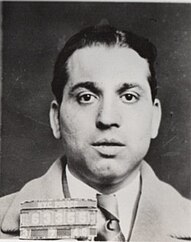
Harry "Happy" Maione was a New York mobster who served as a hitman for Murder, Inc. during the 1930s. Maione was called "Happy" because his face displayed an eternal scowl.
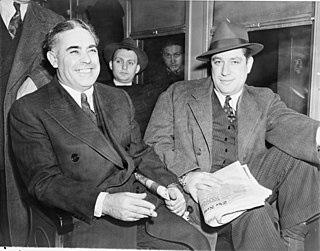
Emanuel "Mendy" Weiss was an American organized crime figure. He was an associate of the notorious Louis Buchalter and part of Buchalter's criminal organization known as Murder, Inc. during the 1930s and up to the time of his arrest for murder in 1941, for which he was convicted and, in 1944, executed. The Federal Bureau of Narcotics claimed that Weiss and his partner in crime Philip "Little Farvel" Cohen were heavily involved in narcotics trafficking. Although he was indicted on multiple drug charges, Weiss was never sentenced for any of these crimes.

Vernon C. Miller was a freelance Prohibition gunman, bootlegger, bank robber and former sheriff in Huron, South Dakota, who, as the only identified gunman in the Kansas City massacre, was found beaten and strangled to death shortly after the incident.
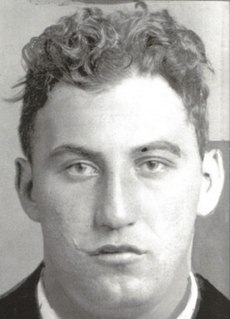
Meyer (1908–1931), Irving (1904–1931) and William Shapiro (1911–1934), collectively known as the Shapiro Brothers were the leaders of a group of Jewish-American mobsters from New York City and based in Williamsburg. Well established in the local garment industry, long dominated by Jacob "Gurrah" Shapiro and Louis "Lepke" Buchalter since the 1927 death of Jacob "Little Augie" Orgen, the two began to move against them in the summer of 1931. As the two sides battled for the garment industry in Brooklyn, Irving and Meyer Shapiro were killed by Joseph and Louis Amberg; Irving was gunned down near his apartment on July 11, and Meyer was found shot to death in the basement of a tenement building on Manhattan's Lower East Side on September 17, 1931. Three years later, on orders from Buchalter, Willie Shapiro was finally killed by Murder, Inc. members Martin "Bugsy" Goldstein and Abe "Kid Twist" Reles, supposedly being buried alive in a sandpit in the marshland of Canarsie by Reles, the Amberg brothers, and Frank Abbandando and Harry Maione on the night of July 20, 1934.
The Atlantic City Conference held between 13–16 May 1929 was a historic summit of leaders of organized crime in the United States. It is considered by most crime historians to be the earliest organized crime summit held in the US. The conference had a major impact on the future direction of the criminal underworld and it held more importance and significance than the Havana Conference of 1946 and the Apalachin meeting of 1957. It also represented the first concrete move toward a National Crime Syndicate.
Jacob "Yasha" Katzenberg was an organized crime figure in New York who supplied narcotics to mobsters including Charles "Lucky" Luciano, Waxey Gordon, Charles "King" Solomon, Harry "Nig" Rosen, the Torrio–Capone organization as well as mobsters in Detroit, Kansas City and St. Louis.