Related Research Articles

Vito Genovese was an Italian-born American mobster who mainly operated in the United States. Genovese rose to power during Prohibition as an enforcer in the American Mafia. A long-time associate and childhood friend of Lucky Luciano, Genovese took part in the Castellammarese War and helped shape the rise of the Mafia and organized crime in the United States. He would later lead Luciano's crime family, which was renamed the Genovese crime family in his honor.
The Havana Conference of 1946 was a historic meeting of United States Mafia and Cosa Nostra leaders in Havana, Cuba. Supposedly arranged by Charles "Lucky" Luciano, the conference was held to discuss important mob policies, rules, and business interests. The Havana Conference was attended by delegations representing crime families throughout the United States. The conference was held during the week of December 22, 1946 at the Hotel Nacional. The Havana Conference is considered to have been the most important mob summit since the Atlantic City Conference of 1929. Decisions made in Havana resonated throughout US crime families during the ensuing decades.
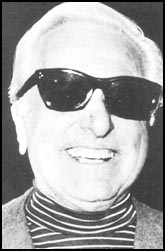
John"Handsome Johnny"Roselli, sometimes spelled Rosselli, was an influential mobster for the Chicago Outfit who helped that organization control Hollywood and the Las Vegas Strip. In the early 1960s, Roselli was recruited by the Central Intelligence Agency (CIA) in a plot to assassinate Cuban leader Fidel Castro. Roselli is believed and suspected by the Federal Bureau of Investigation (FBI) to have played a major role in the assassination of the 1963 U.S. President John F. Kennedy.
The Sicilian Mafia, also simply known as the Mafia and frequently referred to as Cosa Nostra by its members, is an Italian, Mafia-terrorist-type organized crime syndicate and criminal society originating in the region of Sicily, dating to the 19th century. It is a loose association of criminal groups that share a common organisational structure and code of conduct, and present themselves to the public under a common brand. The basic group is known as a "family", "clan", or cosca. Each family claims sovereignty over a territory, usually a town or village or a neighbourhood (borgata) of a larger city, in which it operates its rackets. Its members call themselves "men of honour", although the public often refers to them as mafiosi. The Mafia's core activities are protection racketeering, the arbitration of disputes between criminals, and the organizing and oversight of illegal agreements and transactions. By the 20th century, following wide-scale emigration from Sicily, mafiosi established gangs in North and South America which replicate the traditions and methods of their Sicilian ancestors.

Frank Ralph Nitto, known as Frank Nitti, was an Italian-born American gangster in Chicago. One of Al Capone's top henchmen, Nitti was in charge of all money flowing through the operation. Nitti later succeeded Capone as boss of the Chicago Outfit.

Anthony Joseph Accardo, also known as "Joe Batters" and "Big Tuna", was an American longtime mobster. In a criminal career that spanned eight decades, he rose from small-time hoodlum to the position of day-to-day boss of the Chicago Outfit in 1947, to ultimately becoming the final Outfit authority in 1972. Accardo moved the Outfit into new operations and territories, greatly increasing its power and wealth during his tenure as boss.
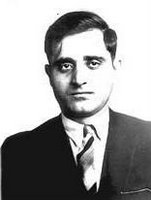
Paul De Lucia, known as Paul Ricca, was an Italian-American mobster who served as the nominal or de facto leader of the Chicago Outfit for 40 years. In 1958, he was named by a Senate crime investigating subcommittee "the country's most important criminal". Ricca died on October 11, 1972.

The Chicago Outfit is an Italian-American organized crime syndicate based in Chicago, Illinois, which dates from the 1910s. It is part of the larger Italian-American Mafia and originated in South Side, Chicago.

Charles Joye "Cherry Nose" Gioe was a lieutenant in the Chicago Outfit criminal organization and a partner in the Hollywood extortion scandals of the 1940s.

Calogero "Don Calò" Vizzini was a historical Sicilian Mafia boss of Villalba in the Province of Caltanissetta, Sicily. Vizzini was considered to be one of the most influential and legendary Mafia bosses of Sicily after World War II until his death in 1954. In the media, he was often depicted as the "boss of bosses" – although such a position does not exist in the loose structure of Cosa Nostra.
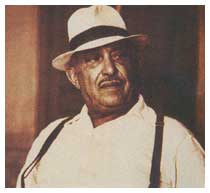
Giuseppe Genco Russo was an Italian mafioso, the boss of Mussomeli in the Province of Caltanissetta, Sicily.
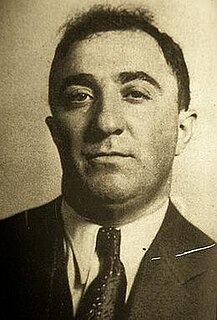
Louis "Little New York" Campagna was an American gangster and mobster and a high-ranking member of the Chicago Outfit for over three decades.
The New Orleans crime family was an Italian-American Mafia crime family based in the city of New Orleans. The family had a history of criminal activity dating back to the late nineteenth century. The family reached its height of influence under Carlos Marcello, one of the world's richest and most powerful crime bosses during the mid-twentieth century, and at its height had over 300 made members and around 3,000 criminal associates. However, a series of setbacks during the 1980s reduced its clout, and law enforcement dismantled most of what remained shortly after Marcello's death in 1993. In spite of this, it is believed that some elements of the organization remain active in New Orleans today.
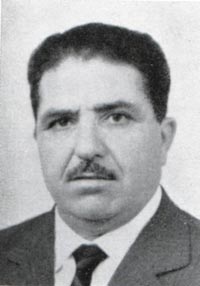
Michele Pantaleone was a respected journalist and expert on the Sicilian Mafia and one of the first to shed light on the links between organized crime and political power.

Nicola Gentile, also known as Nick Gentile, was a Sicilian mafioso and an organized crime figure in New York City during the 1920s and 1930s. He was also known for publishing his memoirs which, violating the mafiosi code known as omerta, revealed many details of the Sicilian and American underworld. Gentile was born in Siculiana, a small village on the south coast of Sicily in the province of Agrigento. He immigrated to the United States arriving in New York at age 18, in 1903. Gentile fled the country in 1937 while out on $15,000 bail after an arrest for heroin trafficking and returned to Sicily to become a boss in the Sicilian Cosa Nostra. In the US, he was known as "Nick" and in Sicily as "Zu Cola".
Francesco Paolo Varsallona or Varsalona was a Sicilian bandit who operated on the island around the turn of the 20th century. He is considered to be the last great bandit of the pre-fascist era. He hailed from Castronovo and was the son of a bandit that had belonged to the notorious band of Angelo Pugliese, better known as "Don Peppino il Lombardo", credited with introducing kidnapping people for money in Sicily.
References
- ↑ Hoodlums & History [ permanent dead link ], Time Magazine, August 5, 1966, review of the book "The Mafia and Politics" by Michele Pantaleone.
- 1 2 The Mafia Restored: Fighters for Democracy in World War II Archived 2011-04-17 at the Wayback Machine , The Politics of Heroin in Southeast Asia, Alfred W. McCoy.
- ↑ Lupo, History of the Mafia, p. 187