Alaskan nationalism asserts that Alaska is a distinct nation. Alaska has been one of the fifty states of the United States of America since 1959. Alaska's legal status within the United States has been disputed at times, most recently by a movement launched by Joe Vogler and the Alaskan Independence Party (AIP). Generally, the debate has surrounded the legal status of Alaska relative to the United States, and its international standing.
Alaska became a territory of the United States in 1867, when it was purchased from the Russian Empire. Events in the 20th century such as World War II and the Cold War led to the decision to admit Alaska as a state. President Dwight D. Eisenhower signed the Alaska Statehood Act into law on July 7, 1958, which paved the way for Alaska's admission into the Union on January 3, 1959.
The vote for statehood was held in 1958. Voters approved the measure by a 6 to 1 margin. [1] The United Nations decolonization committee later removed Alaska from the United Nations list of Non-Self-Governing Territories.
The debate is considered by some to resemble academic discourse being argued by several other activist groups in the United States, most notably arguments over the legal status of Hawaii and the legal status of Texas. [2] [3] The situation most closely resembles that of Hawaii, as the Hawaiian statehood vote also lacked an option for independence.
Joe Vogler began arguing about the validity of the statehood vote in 1973. Early in that year, he began circulating a petition seeking support for secession of Alaska from the United States. The Alaska magazine published a piece at that time in which Vogler claimed to have gathered 25,000 signatures in three weeks.
During the 1970s, Vogler founded the Alaskan Independence Party and Alaskans For Independence. The AIP and AFI, as Vogler explained, were intended to function as strictly separate entities, AIP primarily to explore whether the 1958 vote by Alaskans authorizing statehood was legal, and AFI primarily to actively pursue Alaska's secession from the United States.
During the 2010s, some Russian groups have advocated for the return of all or part of Alaska to Russia (which once controlled the territory as Russian America). In 2013, an ultra-conservative Russian Orthodox group, the Pchyolki ("Little Bees"), argued that President Obama's support of gay marriage invalidated the original sale, since "We see it as our duty to protect their [Orthodox Alaskans'] right to freely practice their religion, which allows no tolerance to sin." [4] In 2014, the mayor of Yakutsk cited documents from the 19th century deeding Spruce Island to the Russian Orthodox Church "for eternity". (Spruce Island was home to Herman of Alaska, a missionary to Native Alaskans who is one of the most-loved Orthodox Christian saints.)
American media reports interpreted the Yakutsk mayor's words as a claim that Spruce Island still belonged to Russia, not the United States. It could also be interpreted as asserting that the Russian Church should own the island under U.S. law. The Russian government does not claim Spruce Island, and neither does the Russian Orthodox Church, which ceded its administrative control over Alaska's holy sites when it granted autocephaly to the Orthodox Church in America in 1970. [5]

Alaska is a state located in the Western United States on the northwest extremity of North America. A semi-exclave of the U.S., it borders the Canadian province of British Columbia and the territory of Yukon to the east and share a maritime border with the Russian Federation's Chukotka Autonomous Okrug to the west, just across the Bering Strait. To the north are the Chukchi and Beaufort seas of the Arctic Ocean, while the Pacific Ocean lies to the south and southwest.
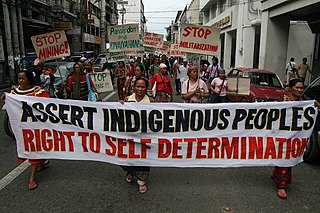
The right of a people to self-determination is a cardinal principle in modern international law, binding, as such, on the United Nations as authoritative interpretation of the Charter's norms. It states that peoples, based on respect for the principle of equal rights and fair equality of opportunity, have the right to freely choose their sovereignty and international political status with no interference.
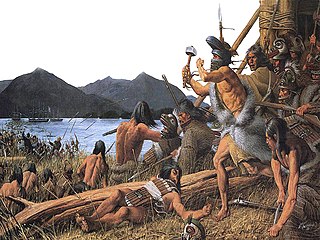
The Russian colonization of North America covers the period from 1732 to 1867, when the Russian Empire laid claim to northern Pacific Coast territories in the Americas. Russian colonial possessions in the Americas are collectively known as Russian America. Russian expansion eastward began in 1552, and in 1639 Russian explorers reached the Pacific Ocean. In 1725, Emperor Peter the Great ordered navigator Vitus Bering to explore the North Pacific for potential colonization. The Russians were primarily interested in the abundance of fur-bearing mammals on Alaska's coast, as stocks had been depleted by over hunting in Siberia. Bering's first voyage was foiled by thick fog and ice, but in 1741 a second voyage by Bering and Aleksei Chirikov made sight of the North American mainland.

Unalaska is the chief center of population in the Aleutian Islands. The city is in the Aleutians West Census Area, a regional component of the Unorganized Borough in the U.S. state of Alaska. Unalaska is located on Unalaska Island and neighboring Amaknak Island in the Aleutian Islands off mainland Alaska. The population was 4,254 at the 2020 census, which is 81% of the entire Aleutians West Census Area. Unalaska is the second largest city in the Unorganized Borough, behind Bethel.
The Alaskan Independence Party (AKIP) is an Alaskan nationalist political party that advocates an in-state referendum which would include the option of Alaska becoming an independent country. The party also advocates positions similar to those of the Constitution Party, Republican Party and Libertarian Party, supporting gun rights, privatization, home schooling, and limited government.
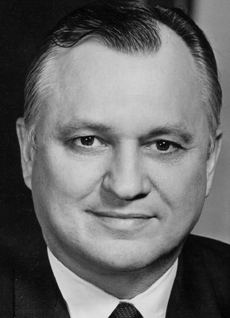
Walter Joseph Hickel was an American businessman, real estate developer, and politician. He worked as a construction worker and eventually became a construction company owner/operator during Alaska's territorial days. Following World War II, Hickel became heavily involved with real estate development, building residential subdivisions, shopping centers and hotels. Hickel entered politics in the 1950s during Alaska's battle for statehood and remained politically active for the rest of his life.

"51st state", in post-1959 American political discourse, is a phrase that refers to areas or locales that are—seriously or facetiously—considered candidates for U.S. statehood, joining the 50 states that presently compose the United States. The phrase has been applied to external territories as well as parts of existing states which would be admitted as separate states in their own right.
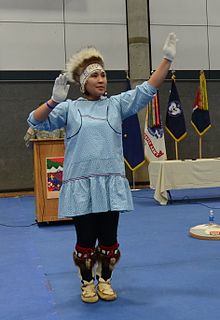
Alaska Natives or Alaskan Natives are indigenous peoples of Alaska and include Iñupiat, Yupik, Aleut, Eyak, Tlingit, Haida, Tsimshian, and a number of Northern Athabaskan cultures. They are often defined by their language groups. Many Alaska Natives are enrolled in federally recognized Alaska Native tribal entities, who in turn belong to 13 Alaska Native Regional Corporations, who administer land and financial claims.

The history of Alaska dates back to the Upper Paleolithic period, when foraging groups crossed the Bering land bridge into what is now western Alaska. At the time of European contact by the Russian explorers, the area was populated by Alaska Native groups. The name "Alaska" derives from the Aleut word Alaxsxaq, meaning "mainland".

The Alaska Statehood Act was signed by President Dwight D. Eisenhower on July 7, 1958, allowing Alaska to become the 49th U.S. state on January 3, 1959.
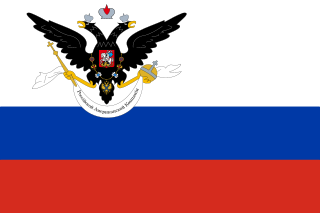
Russian America was the name for the Russian Empire's colonial possessions in North America from 1799 to 1867. It consisted mostly of present-day Alaska in the United States, but also included small outposts in California and three forts in Hawaii. Settlements were concentrated in Alaska, including the capital, Novo-Arkhangelsk, which is now Sitka.

John Bruce "Jack" Coghill was a politician and businessman who was the lieutenant governor of Alaska from 1990 to 1994 under Governor Walter Hickel. Both were members of the Alaskan Independence Party.
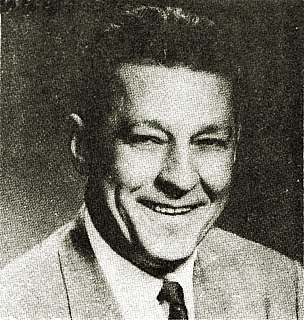
Joseph E. Vogler was the founder of the Alaskan Independence Party. He was also chair or gubernatorial nominee during most of the party's existence. He was also known, originally in his adopted hometown of Fairbanks, Alaska, and later statewide, as a frequent participant in governmental and political affairs and frequent litigant in court. Curiously enough, he was known to many non-political observers for his fashion sense, in particular his ubiquitous wearing of fedoras and bolo ties.

Spruce Island is an island in the Kodiak Archipelago of the Gulf of Alaska in the US state of Alaska. It lies just off the northeast corner of Kodiak Island, across the Narrow Strait. Spruce Island has a land area of 46.066 km2 and a population of 242 as of the 2000 census, mostly in its only city, Ouzinkie, in the southwestern part of the island.
John E. Manders was Mayor of Anchorage, Alaska from 1945 to 1946 and a leading voice among opponents of Alaskan statehood.

Serbian Americans or American Serbs, are Americans of Serb ethnic ancestry. As of 2013, there were about 190,000 American citizens who identified as having Serb ancestry. However, the number may be significantly higher, as there were some 290,000 additional people who identified as Yugoslavs living in the United States.
The timeline of Eastern Orthodoxy in North America represents timeline of the historical development of religious communities, institutions and organizations of Eastern Orthodox Christianity in North America.

The legal status of Texas is the standing of Texas as a political entity. While Texas has been part of various political entities throughout its history, including 10 years during 1836–1846 as the independent Republic of Texas, the current legal status is as a state of the United States of America.

The number of elections in Alaska varies by year, but typically municipal elections occur every year, plus primary and general elections for federal and state offices occur during even-numbered years. Alaska has a gubernatorial election every four years. Members of the state's United States congressional delegation run for election or re-election at the times set out in the United States Constitution. Primary elections assist in choosing political parties' nominees for various positions. On a regional basis, elections also cover municipal issues. In addition, a special election can occur at any time.