All About H. Hatterr (1948) is a novel by G. V. Desani chronicles an Anglo-Malay man's adventures in search of wisdom and enlightenment. "As far back as in 1951," Desani later wrote, "I said H. Hatterr was a portrait of a man, the common vulgar species, found everywhere, both in the East and in the West".[citation needed]
The writer I have placed alongside Narayan, G.V. Desani, has fallen so far from favour that the extraordinary All About H. Hatterr is presently out of print everywhere, even in India. Milan Kundera once said that all modern literature descends from either Richardson's Clarissa or Sterne's Tristram Shandy, and if Narayan is India's Richardson then Desani is his Shandean other. Hatterr's dazzling, puzzling, leaping prose is the first genuine effort to go beyond the Englishness of the English language. His central figure, 'fifty-fifty of the species,' the half-breed as unabashed anti-hero, leaps and capers behind many of the texts in this book. Hard to imagine Allan Sealy's Trotter-Nama without Desani. My own writing, too, learned a trick or two from him.
The mad English of All About H. Hatterr is a thoroughly self-conscious and finely controlled performance, as Anthony Burgess points out in its preface:
But it is the language that makes the book, a sort of creative chaos that grumbles at the restraining banks. It is what may be termed Whole Language, in which philosophical terms, the colloquialisms of Calcutta and London, Shakespearean archaisms, bazaar whinings, quack spiels, references to the Hindu pantheon, the jargon of Indian litigation, and shrill babu irritability seethe together. It is not pure English; it is, like the English of Shakespeare, Joyce and Kipling, gloriously impure.[citation needed]
Comments Amardeep Singh, Assistant Professor of English at Lehigh University on the novel's mad English:
One of the reasons many people are afraid of this novel is its reputation for slang-ridden obscurity. Actually, it's not that obscure -- certainly not as difficult as Ulysses (and not even on the same astral plane as Finnegans Wake). Moreover, the obscurity is generally literary, not linguistic. In the first 100 or so pages of the novel, I counted a total of ten Hindi words in the text. And most of those are 'Hobson-Jobson' words like topi (hat), which would have been readily familiar to readers in 1948...
Anthony Burgess, in his preface to the 1969 edition of the novel, is also careful to disavow the métèque label that dogged late colonialAfrican writers like Amos Tutuola. F. W. Bateson coined Métèque as a way of referring to writers for whom English was a second or third language, who don't respect (or don't know) 'the finer rules of English idiom and grammar'.
It's not that such writing can't produce interesting effects. But successful forays into slang or, even further, dialect English, are rarely interesting to fluent English speakers unless they are carefully controlled -- by a writer who is quite confident (and of course competent) in the language. The writer may have a memory of learning English, but he or she cannot still be learning English at the time of the writing of the novel. Conrad, Nabokov, and even the contemporary writer Jonathan Safran Foer (Everything Is Illuminated) knew exactly what they were doing. So did Desani.
The mad English of All About H. Hatterr is a thoroughly self-conscious and finely controlled performance.[citation needed]
The novel appeared in The Telegraph's 2014 list of the 10 all-time greatest Asian novels.[2]
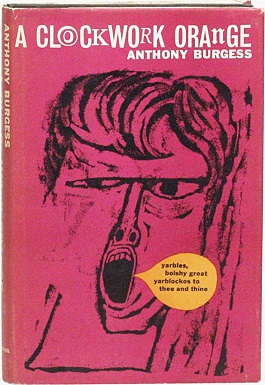
A Clockwork Orange is a dystopian satirical black comedy novella by English writer Anthony Burgess, published in 1962. It is set in a near-future society that has a youth subculture of extreme violence. The teenage protagonist, Alex, narrates his violent exploits and his experiences with state authorities intent on reforming him. The book is partially written in a Russian-influenced argot called "Nadsat", which takes its name from the Russian suffix that is equivalent to '-teen' in English. According to Burgess, the novel was a jeu d'esprit written in just three weeks.
Rhyming slang is a form of slang word construction in the English language. It is especially prevalent among Cockneys in England, and was first used in the early 19th century in the East End of London; hence its alternative name, Cockney rhyming slang. In the US, especially the criminal underworld of the West Coast between 1880 and 1920, rhyming slang has sometimes been known as Australian slang.
Internet slang is a non-standard or unofficial form of language used by people on the Internet to communicate to one another. An example of Internet slang is "lol" meaning "laugh out loud." Since Internet slang is constantly changing, it is difficult to provide a standardized definition. However, it can be understood to be any type of slang that Internet users have popularized, and in many cases, have coined. Such terms often originate with the purpose of saving keystrokes or to compensate for small character limits. Many people use the same abbreviations in texting, instant messaging, and social networking websites. Acronyms, keyboard symbols, and abbreviations are common types of Internet slang. New dialects of slang, such as leet or Lolspeak, develop as ingroup Internet memes rather than time savers. Many people also use Internet slang in face-to-face, real life communication.
A slang is a vocabulary of an informal register, common in everyday conversation but avoided in formal writing. It also often refers to the language exclusively used by the members of particular in-groups in order to establish group identity, exclude outsiders, or both. The word itself came about in the 18th century and has been defined in multiple ways since its conception, with no single technical usage in linguistics.
Nadsat is a fictional register or argot used by the teenage gang members in Anthony Burgess's dystopian novel A Clockwork Orange. Burgess was a linguist and he used this background to depict his characters as speaking a form of Russian-influenced English. The name comes from the Russian suffix equivalent of -teen as in thirteen. Nadsat was also used in Stanley Kubrick's film adaptation of the book.
John Anthony Burgess Wilson, who published under the name Anthony Burgess, was an English writer and composer.
Rasipuram Krishnaswami Narayanaswami, better known as R. K. Narayan, was an Indian writer and novelist known for his work set in the fictional South Indian town of Malgudi. He was a leading author of early Indian literature in English along with Mulk Raj Anand and Raja Rao.
In linguistics, a neologism is any newly formed word, term, or phrase that has achieved popular or institutional recognition and is becoming accepted into mainstream language. Most definitively, a word can be considered a neologism once it is published in a dictionary.
Siddhartha: An Indian novel is a 1922 novel by Hermann Hesse that deals with the spiritual journey of self-discovery of a man named Siddhartha during the time of the Gautama Buddha. The book, Hesse's ninth novel, was written in German, in a simple, lyrical style. It was published in the United States in 1951 by New Directions Publishing and became influential during the 1960s. Hesse dedicated the first part of it to the French writer Romain Rolland and the second part to Wilhelm Gundert, his cousin.
A cant is the jargon or language of a group, often employed to exclude or mislead people outside the group. It may also be called a cryptolect, argot, pseudo-language, anti-language or secret language. Each term differs slightly in meaning; their uses are inconsistent. Richard Rorty defines cant by saying that "'Cant', in the sense in which Samuel Johnson exclaims, 'Clear your mind of cant,' means, in other words, something like that which 'people usually say without thinking, the standard thing to say, what one normally says'." In Heideggerian terms it is what "das Man" says.
The Vendor of Sweets (1967), by R. K. Narayan, is the biography of a fictional character named Sri K. V. Jagan who is a sweet vendor of Malgudi. The story beautifully reflects his conflict with his estranged son and how he finally leaves for renunciation, overwhelmed by the sheer pressure and monotony of his life.
Govindas Vishnoodas Desani (1909–2000), known as G.V. Desani, was a British-Indian journalist, lecturer, writer and educator. Desani is best known for his novel All About H. Hatterr, first published in Great Britain in 1948, which cast an absurdist, comedic light on the plight of a common man in a multicultural, pan-ethnic world.
Frank Chin is an American author and playwright. He is considered to be one of the pioneers of Asian-American theatre.
Indian English literature (IEL), also referred to as Indian Writing in English (IWE), is the body of work by writers in India who write in the English language but whose native or co-native language could be one of the numerous languages of India. Its early history began with the works of Henry Louis Vivian Derozio and Michael Madhusudan Dutt followed by Rabindranath Tagore and Sri Aurobindo. R. K. Narayan, Mulk Raj Anand and Raja Rao contributed to the growth and popularity of Indian English fiction in the 1930s. It is also associated, in some cases, with the works of members of the Indian diaspora who subsequently compose works in English.
Fruit, fruity, and fruitcake, as well as its many variations, are slang or even sexual slang terms which have various origins. These terms have often been used derogatorily to refer to LGBT people. Usually used as pejoratives, the terms have also been re-appropriated as insider terms of endearment within LGBT communities. Many modern pop culture references within the gay nightlife like "Fruit Machine" and "Fruit Packers" have been appropriated for reclaiming usage, similar to queer.
This is a list of works by the English writer Anthony Burgess.
Short Message Service (SMS) language, textism, or textese is the abbreviated language and slang commonly used in the late 1990s and early 2000s with mobile phone text messaging, and occasionally through Internet-based communication such as email and instant messaging.
In the dystopian novel Nineteen Eighty-Four (1984), by George Orwell, Newspeak is the fictional language of Oceania, a totalitarian superstate. To meet the ideological requirements of Ingsoc in Oceania, the Party created Newspeak, which is a controlled language of simplified grammar and limited vocabulary designed to limit a person's ability for critical thinking. The Newspeak language thus limits the person's ability to articulate and communicate abstract concepts, such as personal identity, self-expression, and free will, which are thoughtcrimes, acts of personal independence that contradict the ideological orthodoxy of Ingsoc collectivism.
The Essential Tagore is the largest collection of Rabindranath Tagore's works available in English. It was published by Harvard University Press in the United States and Visva-Bharati University in India to mark the 150th anniversary of Tagore's birth. Fakrul Alam and Radha Chakrabarthy edited the anthology. Among the notable contributors who translated Tagore's works for this anthology are Amitav Ghosh, Amit Chaudhuri, Sunetra Gupta, Syed Manzoorul Islam, and Kaiser Haq. Martha Nussbaum, a philosopher, writer and critic proposed the book as the 'Book of the Year' in the New Statesman published on November 21, 2011.
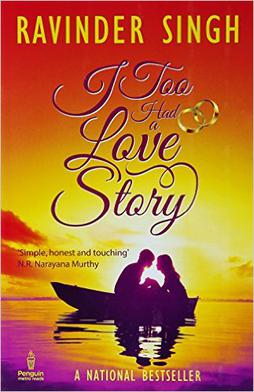
I Too Had a Love Story is an English autobiographical novel written by Ravinder Singh. This was the debut novel of the author and was first published in 2008 by Srishti Publishers, in 2012 it was republished by Penguin India. The book remained in the best-seller’s list in India even after 6 years of its first publication.
This page is based on this Wikipedia article Text is available under the CC BY-SA 4.0 license; additional terms may apply. Images, videos and audio are available under their respective licenses.