
Logging is the process of cutting, processing, and moving trees to a location for transport. It may include skidding, on-site processing, and loading of trees or logs onto trucks or skeleton cars. In forestry, the term logging is sometimes used narrowly to describe the logistics of moving wood from the stump to somewhere outside the forest, usually a sawmill or a lumber yard. In common usage, however, the term may cover a range of forestry or silviculture activities.
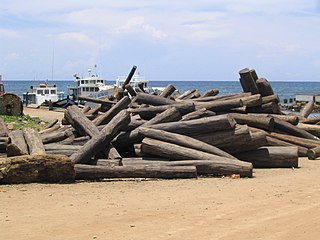
Illegal logging is the harvest, transportation, purchase, or sale of timber in violation of laws. The harvesting procedure itself may be illegal, including using corrupt means to gain access to forests; extraction without permission, or from a protected area; the cutting down of protected species; or the extraction of timber in excess of agreed limits. Illegal logging is a driving force for a number of environmental issues such as deforestation, soil erosion and biodiversity loss which can drive larger-scale environmental crises such as climate change and other forms of environmental degradation.
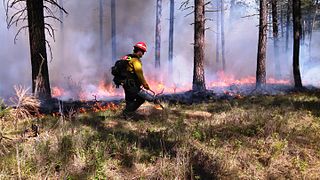
A controlled or prescribed (Rx) burn is the practice of intentionally setting a fire to change the assemblage of vegetation and decaying material in a landscape. The purpose could be for forest management, ecological restoration, land clearing or wildfire fuel management. A controlled burn may also refer to the intentional burning of slash and fuels through burn piles. Controlled burns may also be referred to as hazard reduction burning, backfire, swailing or a burn-off. In industrialized countries, controlled burning regulations and permits are usually overseen by fire control authorities.

Panicum virgatum, commonly known as switchgrass, is a perennial warm season bunchgrass native to North America, where it occurs naturally from 55°N latitude in Canada southwards into the United States and Mexico. Switchgrass is one of the dominant species of the central North American tallgrass prairie and can be found in remnant prairies, in native grass pastures, and naturalized along roadsides. It is used primarily for soil conservation, forage production, game cover, as an ornamental grass, in phytoremediation projects, fiber, electricity, heat production, for biosequestration of atmospheric carbon dioxide, and more recently as a biomass crop for the production of ethanol and butanol.

A firebreak or double track is a gap in vegetation or other combustible material that acts as a barrier to slow or stop the progress of a bushfire or wildfire. A firebreak may occur naturally where there is an absence of vegetation or "fuel", such as a river, lake or canyon. Firebreaks may also be man-made, and many of these also serve as roads, such as logging roads, four-wheel drive trails, secondary roads, or highways.
Cellulosic ethanol is ethanol produced from cellulose rather than from the plant's seeds or fruit. It can be produced from grasses, wood, algae, or other plants. It is generally discussed for use as a biofuel. The carbon dioxide that plants absorb as they grow offsets some of the carbon dioxide emitted when ethanol made from them is burned, so cellulosic ethanol fuel has the potential to have a lower carbon footprint than fossil fuels.
The Forest Products Laboratory (FPL) is the national research laboratory of the United States Forest Service, which is part of USDA. Since its opening in 1910, the FPL has provided scientific research on wood, wood products and their commercial uses in partnership with academia, industry, tribal, state, local and other government agencies. The laboratory is headquartered in Madison, Wisconsin. The focus of the Forest Products Laboratory is to promote healthy forests and forest-based economies through the efficient, sustainable use of the Nation's wood resources.
Energy forestry is a form of forestry in which a fast-growing species of tree or woody shrub is grown specifically to provide biomass or biofuel for heating or power generation.

Wood wool, known primarily as excelsior in North America, is a product made of wood slivers cut from logs. It is mainly used in packaging, for cooling pads in home evaporative cooling systems known as swamp coolers, for erosion control mats, and as a raw material for the production of other products such as bonded wood wool boards. In the past it was used as stuffing, or padding, in upholstery, or to fill stuffed toys. It is also sometimes used by taxidermists to construct the armatures of taxidermy mounts.

Wildfire suppression is a range of firefighting tactics used to suppress wildfires. Firefighting efforts depend on many factors such as the available fuel, the local atmospheric conditions, the features of the terrain, and the size of the wildfire. Because of this wildfire suppression in wild land areas usually requires different techniques, equipment, and training from the more familiar structure fire fighting found in populated areas. Working in conjunction with specially designed aerial firefighting aircraft, fire engines, tools, firefighting foams, fire retardants, and using various firefighting techniques, wildfire-trained crews work to suppress flames, construct fire lines, and extinguish flames and areas of heat in order to protect resources and natural wilderness. Wildfire suppression also addresses the issues of the wildland–urban interface, where populated areas border with wild land areas.
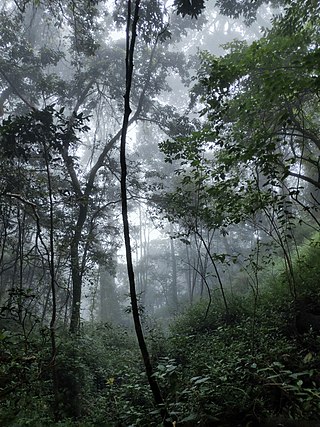
Forest management is a branch of forestry concerned with overall administrative, legal, economic, and social aspects, as well as scientific and technical aspects, such as silviculture, forest protection, and forest regulation. This includes management for timber, aesthetics, recreation, urban values, water, wildlife, inland and nearshore fisheries, wood products, plant genetic resources, and other forest resource values. Management objectives can be for conservation, utilisation, or a mixture of the two. Techniques include timber extraction, planting and replanting of different species, building and maintenance of roads and pathways through forests, and preventing fire.

In the context of energy production, biomass is matter from recently living organisms which is used for bioenergy production. Examples include wood, wood residues, energy crops, agricultural residues including straw, and organic waste from industry and households. Wood and wood residues is the largest biomass energy source today. Wood can be used as a fuel directly or processed into pellet fuel or other forms of fuels. Other plants can also be used as fuel, for instance maize, switchgrass, miscanthus and bamboo. The main waste feedstocks are wood waste, agricultural waste, municipal solid waste, and manufacturing waste. Upgrading raw biomass to higher grade fuels can be achieved by different methods, broadly classified as thermal, chemical, or biochemical.

The Sustainable Forestry Initiative (SFI) is a sustainability organization operating in the U.S. and Canada that works across four pillars: standards, conservation, community, and education. SFI was founded in 1994 by the American Forest & Paper Association (AF&PA). SFI is the world's largest single forest certification standard by area. SFI is headquartered in Ottawa and Washington, D.C.

A forest product is any material derived from forestry for direct consumption or commercial use, such as lumber, paper, or fodder for livestock. Wood, by far the dominant product of forests, is used for many purposes, such as wood fuel or the finished structural materials used for the construction of buildings, or as a raw material, in the form of wood pulp, that is used in the production of paper. All other non-wood products derived from forest resources, comprising a broad variety of other forest products, are collectively described as non-timber forest products (NTFP). Non-timber forest products are viewed to have fewer negative effects on forest ecosystem when providing income sources for local community.
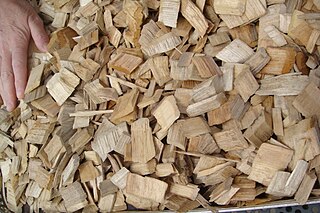
Woodchips are small- to medium-sized pieces of wood formed by cutting or chipping larger pieces of wood such as trees, branches, logging residues, stumps, roots, and wood waste.

Community forestry is a participatory model of forestry that gained prominence in the 1970s in which local communities take an active role in forest management and land use decision making. Community forestry is defined by the Food and Agricultural Organization of the United Nations as "any situation that intimately involves local people in forestry activity". Unlike centralized management systems, community forestry more strongly emphasizes the participation and collaboration of local community stakeholders, along with government and non-governmental organizations (NGOs). The level of involvement of each of these groups is dependent on the specific community forest project, the management system and the region.

Wildfires are outdoor fires that occur in the wilderness or other vast spaces. Other common names associated with wildfires are brushfire and forest fire. Since wildfires can occur anywhere on the planet, except for Antarctica, they pose a threat to civilizations and wildlife alike. In terms of emergency management, wildfires can be particularly devastating. Given their ability to destroy large areas of entire ecosystems, there must be a contingency plan in effect to be as prepared as possible in case of a wildfire and to be adequately prepared to handle the aftermath of one as well.
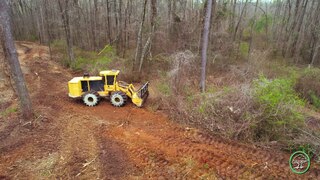
Forestry mulching is a land clearing method that uses a single machine to cut, grind, and clear vegetation.
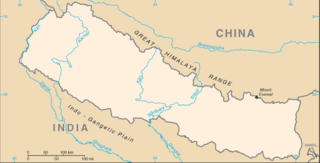
Deforestation in Nepal has always been a serious issue, which has a severe effect on the lives of poor people. In the past, Nepal was a widely forested nation. However now with the requirement for the extension of rural areas, migration of hills people to the plains, the developing regional interest for timber, and the local residents dependence on firewood as the essential source of energy, less than 30% of the nation's forest cover remains. Due to the continuous deforestation in Nepal, many people and creatures are dying. Around 70 percent of the people in Nepal work in agriculture, even if it is difficult to farm in the prevailing unfavourable weather conditions.

Forests cover almost a third of Turkey. They are almost all state-owned, and vary from temperate rainforest in the north-east to maquis in the south and west. Pine, fir, oak and beech are common.

