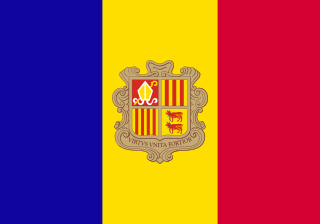
The politics of Andorra take place in a framework of a parliamentary constitutional diarchy, and a multi-party system. Executive power is exercised by the government, with the Head of Government of Andorra as chief executive. Legislative power is vested in both the government and parliament. The judiciary is independent of the executive and the legislature.
National referendums are seldom used in Canada. The first two referendums saw voters in Quebec and the remainder of Canada take dramatically opposing stands, the third saw most of the voters take a stand dramatically opposed to that of the politicians in power.
There are two types of elections in Andorra: parliamentary elections and local elections. The 28 members of the General Council of the Valleys are elected in parliamentary elections for a maximum term of four years. In the local elections, the council members of the seven parishes of Andorra are elected for a four-year term.

Brazil elects on the national level a head of state—the president—and a legislature. The president is elected to a four-year term by absolute majority vote through a two-round system. The National Congress has two chambers. The Chamber of Deputies has 513 members, elected to a four-year term by proportional representation. The Federal Senate has 81 members, elected to an eight-year term, with elections every four years for alternatively one-third and two-third of the seats. Brazil has a multi-party system, with such numerous parties that often no one party has a chance of gaining power alone, and so they must work with each other to form coalition governments.

Elections in San Marino gives information on election and election results in San Marino.

The General Council is the unicameral parliament of Andorra. It is sometimes referred to as the General Council of the Valleys because it was the historical name and to distinguish it from similarly named bodies in the Val d'Aran and in France.
The Constitution of Andorra is the supreme law of the Principality of Andorra. It was adopted on 2 February 1993 and given assent by the Andorran people in a referendum on 14 March 1993. According to the Constitution itself, it was to enter into force on the day of its publication in the Butlletí Oficial del Principat d'Andorra, which occurred on 28 April 1993.
Parliamentary elections were held in Andorra on 26 April 2009, the fourth under the 1993 Constitution. The elections were held at the end of the normal four-year term of the General Council, but also following months of intense pressure from Co-Prince Nicolas Sarkozy to change the country's banking secrecy laws.
Electoral reform is change in electoral systems to improve how public desires are expressed in election results. That can include reforms of:
Early parliamentary elections were held in Andorra on 3 April 2011 after the General Council of Andorra was dissolved over problems in passing important laws, including the budget and laws related to a value added tax.
A referendum on political reforms was held in Andorra on 16 January 1978. Voters were presented with two options, but the none of the above option received the most votes.

Parliamentary elections were held in Andorra on 1 March 2015. Despite losing five seats, the Democrats for Andorra retained their majority in the General Council, winning 15 of the 28 seats.

The 2015 Andorran local elections were held on 13 December. Voters elected the council members of the seven parishes.
The 1983 Andorran local elections were held on 12 December. Voters elected the council members of the seven parishes of Andorra. For first time since 1867, local elections were not hold on the same day as parliamentary elections. This was also the first time that the totality of the council seats were up for election.
The 1995 Andorran local elections were held on 3 December. Voters elected the council members of the seven parishes.
The 1999 Andorran local elections were held on 12 December. Voters elected the council members of the seven parishes.

The 2003 Andorran local elections were held on 14 December. Voters elected the council members of the seven parishes.

The 2007 Andorran local elections were held on 2 December. Voters elected the council members of the seven parishes.

A referendum on electoral reform took place by mail-in ballot between October 22 and December 7, 2018, in the Canadian province of British Columbia. This was British Columbia's third referendum on electoral reform since 2005.

The 2019 Andorran parliamentary elections will be held on Sunday, 7 April 2019, to elect all 28 seats of the General Council.