
James Henry Breasted was an American archaeologist, Egyptologist, and historian. After completing his PhD at the University of Berlin in 1894, he joined the faculty of the University of Chicago. In 1901 he became director of the Haskell Oriental Museum at the university, where he continued to concentrate on Egypt. In 1905 Breasted was promoted to full professor, and held the first chair in Egyptology and Oriental History in the United States. In 1919 he became the founder of the Oriental Institute at the University of Chicago, a center for interdisciplinary study of ancient civilizations. Breasted was a committed field researcher, and had a productive interest in recording and interpreting ancient writings, especially from sources and structures that he feared may be lost forever.
James Bennett Pritchard was an American archeologist whose work explicated the interrelationships of the religions of ancient Palestine, Canaan, Egypt, Assyria, and Babylon. Pritchard was honored with the Gold Medal Award for Distinguished Archaeological Achievement in 1983 from the Archaeological Institute of America.

Kazimierz Józef Marian Michałowski was a Polish archaeologist and Egyptologist, art historian, member of the Polish Academy of Sciences, professor ordinarius of the University of Warsaw as well as the founder of the Polish school of Mediterranean archaeology and a precursor of Nubiology.
Duvel Moortgat Brewery is a Flemish family-controlled brewery founded in 1871. Its strong golden pale ale, Duvel, is exported to more than forty countries. Duvel is Brabantian, Ghent and Antwerp dialect for devil, the standard Dutch word being duivel[ˈdœy̯vəl].
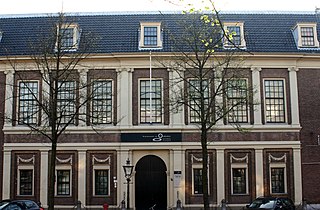
The Rijksmuseum van Oudheden is the national archaeological museum of the Netherlands. It is located in Leiden. The Museum grew out of the collection of Leiden University and still closely co-operates with its Faculty of Archaeology. The museum calls itself the national center for archaeology, and focuses on ancient Egypt, the ancient Near East, the classical world of Greece, Etruria and Rome and the early Netherlands.

Ernst Emil Herzfeld was a German archaeologist and Iranologist.
Barry John Kemp, CBE, FBA is an English archaeologist and Egyptologist. He is Professor Emeritus of Egyptology at the University of Cambridge and directing excavations at Amarna in Egypt. His widely renowned book Ancient Egypt: Anatomy of a Civilisation is a core text of Egyptology and many Ancient History courses.

Tell Fekheriye, is an ancient site in the Khabur River basin in the Al Hasakah Governorate of northern Syria. It is securely identified as the site of Sikkan, attested since c. 2000 BC. Sikkan was part of the Aramaean kingdom of Bit Bahiani in the early 1st millennium BC. In the area, several mounds, called tells, can be found in close proximity: Tell Fekheriye, Ra's al-'Ayn, and Tell Halaf, site of the Aramean and Neo-Assyrian city of Guzana. During the excavation, the Tell Fekheriye bilingual inscription was discovered at the site, which provides the source of information about Hadad-yith'i.

Tell Chuera is an ancient Near Eastern tell site in Raqqa Governorate, northern Syria. It lies between the Balikh and Khabur rivers.

Walter Andrae was a German archaeologist and architect born near Leipzig.

Donny George Youkhanna was an Iraqi-Assyrian archaeologist, anthropologist, author, curator, and scholar, and a visiting professor at Stony Brook University in New York.
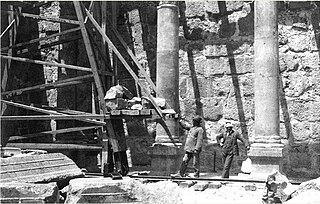
Carl Watzinger was a German-born archaeologist, who with Ernst Sellin, worked on uncovering the site of the ancient city of Jericho (1907–09), and earlier, with Heinrich Kohl (1877–1914), conducted excavations at Capernaum (1905).

Anson Frank Rainey was Professor Emeritus of Ancient Near Eastern Cultures and Semitic Linguistics at Tel Aviv University. He is known in particular for contributions to the study of the Amarna tablets, the noted administrative letters from the period of Pharaoh Akhenaten's rule during the 18th Dynasty of Egypt. He authored and edited books and articles on the cultures, languages and geography of the Biblical lands.
The Kelsey Museum of Archaeology is a museum of archaeology located on the University of Michigan central campus in Ann Arbor, Michigan, in the United States. The museum is a unit of the University of Michigan's College of Literature, Science, and the Arts. It has a collection of more than 100,000 ancient and medieval artifacts from the civilizations of the Mediterranean and the Near East. In addition to displaying its permanent and special exhibitions, the museum sponsors research and fieldwork and conducts educational programs for the public and for schoolchildren. The museum also houses the University of Michigan Interdepartmental Program in Classical Art and Archaeology.
Winfried Orthmann is a German archaeologist specialized on Near East regions.
Mamdouh Mohamed Gad Eldamaty is an Egyptian Egyptologist who has served in the government of Egypt as Minister of Antiquities from 2014 until 2016. He has also worked as Professor of Egyptology at the Department of Archaeology, Faculty of Arts, Ain Shams University in Cairo. On 15 May 2011, he became Cultural Counselor and Head of the Educational Mission at the Embassy of Egypt in Berlin. On 16 June 2014 it was announced that he was to be appointed as Minister of Antiquities, a position he held until March 2016 when he was replaced by Khaled El-Anany after a cabinet reshuffle.

Friedrich Paul Theodor Sarre was a German Orientalist, archaeologist and art historian. During his lifetime, he amassed an impressive collection of Islamic art.

Carl (Karl) Georg Ludwig Theodor Herwig Joseph Robert was a German classical philologist and archaeologist.
Wilhelm Unverzagt, was a German prehistorian and archaeologist.


