
Mayflies are aquatic insects belonging to the order Ephemeroptera. This order is part of an ancient group of insects termed the Palaeoptera, which also contains dragonflies and damselflies. Over 3,000 species of mayfly are known worldwide, grouped into over 400 genera in 42 families.

A signifer was a standard bearer of the Roman legions. He carried a signum (standard) for a cohort or century. Each century had a signifer so there were 59 in a legion. Within each cohort, the first century's signifer would be the senior one. The -fer in signifer comes from ferre, the Latin for "to bear" or "to carry".
Centuria is a Latin term denoting military units consisting of (originally) 100 men. The size of the century changed over time and from the first century B.C.E. throughout most of the empire the standard size of a centuria was 80 men.

A standard-bearer, also known as a flag-bearer is a person who bears an emblem known as a standard or military Regulation Colours, i.e. either a type of flag or an inflexible but mobile image, which is used as a formal, visual symbol of a state, prince, military unit, etc. This can either be an occasional duty, often seen as an honour, or a permanent charge ; the second type has even led in certain cases to this task being reflected in official rank titles such as Ensign, Cornet and Fähnrich.
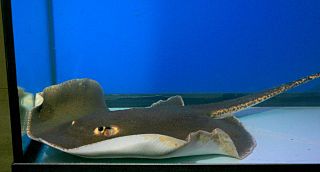
The roughback whipray is a rare species of freshwater stingray in the family Dasyatidae, found over sandy bottoms in the Mae Klong and Chao Phraya Rivers of Thailand. Growing no more than 29 cm (11 in) across, this small ray has an oval pectoral fin disc and a whip-like tail without fin folds. It closely resembles the white-edge freshwater whipray in appearance, but can be distinguished by its coloration: light gray to dark orange-brown above and white below with a dark band along the lateral margins. Another identifying feature is a "pearl organ" at the center of the back, found in individuals of all ages. All of the original specimens of the roughback whipray were found with extensive wounds to the fins and tail. The International Union for Conservation of Nature (IUCN) has assessed this species as Endangered, citing the extensive habitat degradation and heavy fishing pressure within its limited range.

Baetidae is a family of mayflies with about 1000 described species in 110 genera distributed worldwide. These are among the smallest of mayflies, adults rarely exceeding 10 mm in length excluding the two long slender tails and sometimes much smaller, and members of the family are often referred to as small mayflies or small minnow mayflies. Most species have long oval forewings with very few cross veins but the hindwings are usually very small or even absent. The males often have very large eyes, shaped like turrets above the head.

Iracundus signifer, the Decoy scorpionfish, is a species of scorpionfish native to the Western Indian and Pacific oceans. A non-migratory species, I. signifer can be observed in close association with coral reefs at depths of from 10 to 70 metres. This species grows to a length of 13 centimetres (5.1 in) TL. This species is the only known member of its genus and can be distinguished by its unique prey-luring behavior.
The stumptooth minnow is an extinct species of cyprinid fish. It was found only in Mexico.
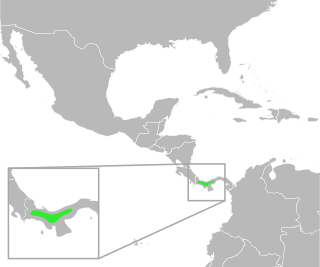
Incilius signifer is a species of toads in the family Bufonidae. It is endemic to Panama and known from the Pacific Coast to 800 m (2,600 ft) asl, west of the Canal Zone. Prior to its description in 2005, it was mixed with Incilius coccifer. Its natural habitats are tropical dry forests. It tolerates habitat modification but could be threatened by severe habitat modification.

Epalpus is a genus of flies in the family Tachinidae.
Apobaetis is a genus of mayflies in the family Baetidae. It contains at least six species.

The Pacific blue-eye is a species of fish in the subfamily Pseudomugilinae native to eastern Australia. Described by Austrian naturalist Rudolf Kner in 1866, it comprises two subspecies that have been regarded as separate species in the past and may be once again with further study. It is a common fish of rivers and estuaries along the eastern seaboard from Cape York in North Queensland to southern New South Wales, the Burdekin Gap in central-north Queensland dividing the ranges of the two subspecies.
Apobaetis etowah is a species of small minnow mayfly in the family Baetidae. It is found in Central America and North America.
Apobaetis fiuzai is a species of small minnow mayfly in the family Baetidae.
Apobaetis futilis is a species of small minnow mayfly in the family Baetidae. It is found in North America.
Apobaetis lakota is a species of small minnow mayfly in the family Baetidae. It is found in North America.
Pisciforma is a suborder of mayflies in the order Ephemeroptera. There are at least 410 described species in Pisciforma.
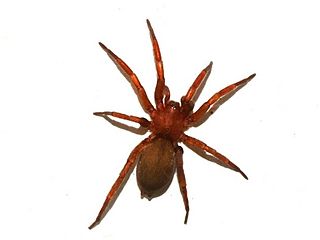
Haplodrassus signifer is a species of ground spider in the family Gnaphosidae. It is found in North America, Europe, Turkey, Israel, Caucasus, a range from Russia to Central Asia, China, and Korea.
Epalpus signifer is a species of bristle fly in the family Tachinidae. It is found in North America.
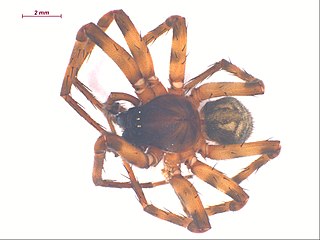
Cybaeus signifer is a species of true spider in the family Cybaeidae. It is found in the United States and Canada.

