Related Research Articles

Sea urchins, are typically spiny, globular animals, echinoderms in the class Echinoidea. About 950 species live on the seabed, inhabiting all oceans and depth zones from the intertidal to 5,000 metres. Their tests are round and spiny, usually from 3 to 10 cm across. Sea urchins move slowly, crawling with their tube feet, and sometimes pushing themselves with their spines. They feed primarily on algae but also eat slow-moving or sessile animals. Their predators include sea otters, starfish, wolf eels, triggerfish, and humans.
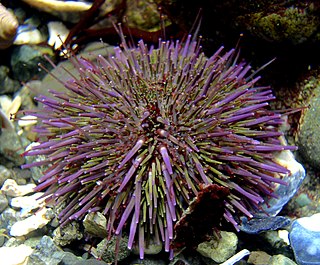
The purple sea urchin, Strongylocentrotus purpuratus, lives along the eastern edge of the Pacific Ocean extending from Ensenada, Mexico, to British Columbia, Canada. This sea urchin species is deep purple in color, and lives in lower inter-tidal and nearshore sub-tidal communities. Its eggs are orange when secreted in water. January, February, and March function as the typical active reproductive months for the species. Sexual maturity is reached around two years.

Strongylocentrotus droebachiensis is commonly known as the green sea urchin because of its characteristic green color. It is commonly found in northern waters all around the world including both the Pacific and Atlantic Oceans to a northerly latitude of 81 degrees and as far south as Maine and England. The average adult size is around 50 mm (2 in), but it has been recorded at a diameter of 87 mm (3.4 in). The green sea urchin prefers to eat seaweeds but will eat other organisms. They are eaten by a variety of predators, including sea stars, crabs, large fish, mammals, birds, and humans. The species name "droebachiensis" is derived from the name of the town Drøbak in Norway.
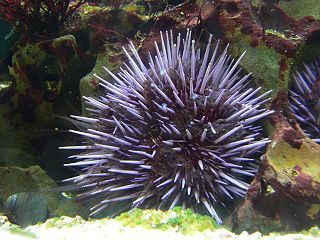
Strongylocentrotus is a genus of sea urchins in the family Strongylocentrotidae containing several species.

The Strongylocentrotidae are a family of sea urchins in the order Echinoida.
Aquimarina intermedia is a Gram-negative, heterotrophic, aerobic bacterium from the genus of Aquimarina which has been isolated from the sea urchin Strongylocentrotus intermedius from the Peter the Great Gulf in Russia.
Altererythrobacter is a bacterial genus from the family of Erythrobacteraceae.
Altererythrobacter troitsensis is a Gram-negative, aerobic, halotolerant, rod-shaped and motile bacterium from the genus of Altererythrobacter which has been isolated from the sea urchin Strongylocentrotus intermedius.
Arenibacter echinorum is a heterotrophic and aerobic bacterium from the genus of Arenibacter which has been isolated from the sea urchin Strongylocentrotus intermedius from the Sea of Japan.
Roseivirga echinicomitans is a Gram-negative, heterotrophic, strictly aerobic and non-motile bacterium from the genus of Roseivirga which has been isolat from the sea urchin Strongylocentrotus intermedius.
Echinicola is an aerobic and motile bacterial genus from the family of Cytophagaceae.
Echinicola pacifica is a heterotrophic and motile bacterium from the genus of Echinicola which has been isolated from the sea urchin Strongylocentrotus intermedius from the Troitsa Bay in the Sea of Japan.
Colwellia echini is a gram-negative, rod-shaped, and facultatively anaerobic bacterium from the genus Colwellia which has been isolated from the sea urchin Strongylocentrotus droebachiensis from Øresund in Denmark.
Mariniflexile is a genus in the phylum Bacteroidetes (Bacteria). The various species have been recovered from sea water, sea urchins, springs, brackish water, and an oyster.
Gramella echinicola is a Gram-negative and halophilic bacterium from the genus of Gramella which has been isolated from the sea urchin Strongylocentrotus intermedius from the Sea of Japan.
Gramella marina is a Gram-negative, aerobic and heterotrophic bacterium from the genus of Gramella which has been isolated from the sea urchin Strongylocentrotus intermedius.

Strongylocentrotus intermedius is a species of Sea urchin described by Alexander Agassiz in 1864.
Lutibacter holmesii is a Gram-negative, strictly aerobic, rod-shaped and non-motile bacterium from the genus of Lutibacter which has been isolated from a sea urchin from the Troitsa Bay in the Sea of Japan.
Salegentibacter mishustinae is a Gram-negative, strictly aerobic, heterotrophic and non-motile bacterium from the genus of Salegentibacter which has been isolate from a sea urchin from the Sea of Japan.
Winogradskyella echinorum is a bacterium from the genus of Winogradskyella which has been isolated from the sea urchin Strongylocentrotus intermedius.
References
- 1 2 "Arenicella". LPSN .
- ↑ "Arenicella chitinivorans Taxon Passport - StrainInfo". www.straininfo.net.
- ↑ "Arenicella chitinivorans". www.uniprot.org.
- ↑ "Details: DSM-100248". www.dsmz.de.
- ↑ Nedashkovskaya, OI; Cleenwerck, I; Zhukova, NV; Kim, SB; de Vos, P (November 2013). "Arenicella chitinivorans sp. nov., a gammaproteobacterium isolated from the sea urchin Strongylocentrotus intermedius" (PDF). International Journal of Systematic and Evolutionary Microbiology. 63 (Pt 11): 4124–9. doi:10.1099/ijs.0.051599-0. PMID 23771619.
| This Alteromonadales article is a stub. You can help Wikipedia by expanding it. |