
A flight simulator is a device that artificially re-creates aircraft flight and the environment in which it flies, for pilot training, design, or other purposes. It includes replicating the equations that govern how aircraft fly, how they react to applications of flight controls, the effects of other aircraft systems, and how the aircraft reacts to external factors such as air density, turbulence, wind shear, cloud, precipitation, etc. Flight simulation is used for a variety of reasons, including flight training, the design and development of the aircraft itself, and research into aircraft characteristics and control handling qualities.
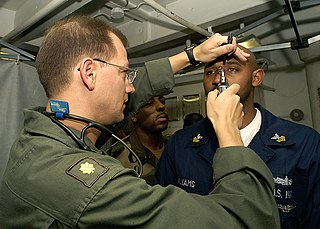
A flight surgeon is a military medical officer practicing in the clinical field of aviation medicine, which is also occasionally known as flight surgery.

The Nineteenth Air Force is an active Numbered Air Force of the United States Air Force. During the Cold War it was a component of Tactical Air Command, with a mission of command and control over deployed USAF forces in support of United States foreign policy initiatives. The command was reactivated in 1993 under Air Education and Training Command with a mission of conducting AETC's flying training.

Kirtland Air Force Base is a United States Air Force base. It is located in the southeast quadrant of the Albuquerque, New Mexico, urban area, adjacent to the Albuquerque International Sunport. The base was named for the early Army aviator Col. Roy C. Kirtland. The military and the international airport share the same runways, making ABQ a joint civil-military airport.

AAI Corporation is an aerospace and defense development and manufacturing firm, located in Hunt Valley, Maryland, US. Formerly a wholly owned subsidiary of United Industrial Corporation, AAI was acquired by Textron in 2007. It currently operates as a unit of Textron Systems and employs more than 2,000.

Military aviation comprises military aircraft and other flying machines for the purposes of conducting or enabling aerial warfare, including national airlift capacity to provide logistical supply to forces stationed in a war theater or along a front. Airpower includes the national means of conducting such warfare, including the intersection of transport and warcraft. Military aircraft include bombers, fighters, transports, trainer aircraft, and reconnaissance aircraft.

Aircrew, are personnel who operate an aircraft while in flight. The composition of a flight's crew depends on the type of aircraft, plus the flight's duration and purpose.
A naval flight officer (NFO) is a commissioned officer in the United States Navy or United States Marine Corps who specializes in airborne weapons and sensor systems. NFOs are not pilots (naval aviators), but they may perform many "co-pilot" or "mission specialist" functions, depending on the type of aircraft. Until 1966, their duties were performed by both commissioned officer and senior enlisted naval aviation observers (NAO).
The title flight officer was a military rank used by the United States Army Air Forces during World War II, and also an air force rank in several Commonwealth countries, where it was used for female officers and was equivalent to the rank of flight lieutenant. The term flight officer is sometimes used today to describe job title positions as aircrew members.
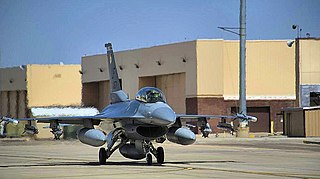
Holloman Air Force Base is a United States Air Force base established in 1942 located six miles (10 km) southwest of the central business district of Alamogordo, which is the county seat of Otero County, New Mexico, United States. The base was named in honor of Col. George V. Holloman, a pioneer in guided missile research. It is the home of the 49th Wing of the Air Education and Training Command (AETC).

The Air Force Test Center (AFTC) is a development and test organization of the United States Air Force. It conducts research, development, test, and evaluation of aerospace systems from concept to deployment. It has test flown every aircraft in the Army Air Force's and the Air Force's inventory since World War II. The center employs nearly 13,000 people, and controls the second largest base in the Air Force.

The Portuguese Air Force is the aerial warfare force of Portugal. Locally it is referred to by the acronym FAP but internationally is often referred to by the acronym PRTAF. It is the youngest of the three branches of the Portuguese Armed Forces.
The Air Operations Branch is a personnel branch of the Canadian Forces (CF). All members of the branch wear the air force uniform.

A door gunner is a crewman tasked with firing and maintaining manually directed armament aboard a military helicopter. The actual role will vary depending on the task given on a particular mission. For certain aircraft a door gunner would use a fully automatic Gatling gun placement. On many larger aircraft such as military planes a turret is used along with heavy cannons.

The United States Marine Corps Aviation (USMCA) is the aircraft arm of the United States Marine Corps. Aviation units within the Marine Corps are assigned to support the Marine Air-Ground Task Force, as the aviation combat element, by providing six functions: assault support, antiair warfare, close air support, electronic warfare, control of aircraft and missiles, and aerial reconnaissance. The Corps operates rotary-wing, tiltrotor, and fixed-wing aircraft mainly to provide transport and close air support to its ground forces. Other aircraft types are also used in a variety of support and special-purpose roles. All Marine Corps aviation falls under the influence of the Deputy Commandant for Aviation, whose job is to advise the Commandant of the Marine Corps in all matters relating to aviation, especially acquisition of new assets, conversions of current aircraft, maintenance, operation, and command.

The Polish Air Force Academy is located in Dęblin, eastern Poland. Established in 1927 during the interwar period, the Polish Air Force University is an accredited university for the undergraduate education of officers for the Polish Air Force.
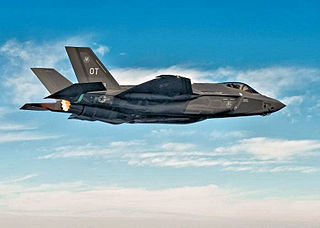
The 422d Test and Evaluation Squadron is a United States Air Force unit. It is assigned to the 53d Test and Evaluation Group, stationed at Nellis Air Force Base, Nevada. The squadron performs operational testing of all fighter aircraft and munitions entering and in operational use by Air Combat Command.

The U.S. Army Aviation Center of Excellence is the United States Army Aviation Branch's headquarters, and it's training and development center, located at Fort Novosel, Alabama. The Aviation Center of Excellence coordinates and deploys aviation operations and trains aviation officers in a variety of topics, including classroom navigation instruction, aircraft piloting, and basic combat.
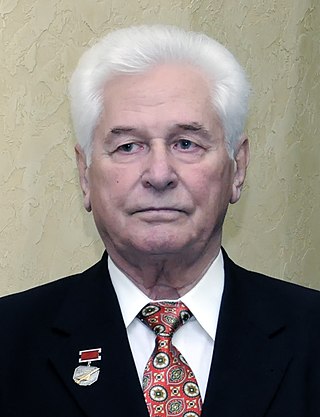
Nikolai Ivanovich Moskvitelev was an officer of the Soviet Armed Forces, having served in Soviet Naval Aviation and the Soviet Air Defence Forces, rising to the rank of Colonel General and the position of commander of the Air Defence Forces' aviation component.


