Related Research Articles

Numidia was the ancient kingdom of the Numidians in northwest Africa, initially comprising the territory that now makes up Algeria, but later expanding across what is today known as Tunisia and Libya. The polity was originally divided between the Massylii in the east and the Masaesyli in the west. During the Second Punic War, Masinissa, king of the Massylii, defeated Syphax of the Masaesyli to unify Numidia into the first Berber state in present-day Algeria. The kingdom began as a sovereign state and later alternated between being a Roman province and a Roman client state.

Gaius Marius was a Roman general and statesman. Victor of the Cimbric and Jugurthine wars, he held the office of consul an unprecedented seven times. Rising from a family of smallholders in a village called Ceraetae in the district of Arpinum, Marius acquired his initial military experience serving with Scipio Aemilianus at the Siege of Numantia in 134 BC. He won election as tribune of the plebs in 119 BC and passed a law limiting aristocratic interference in elections. Barely elected praetor in 115 BC, he next became the governor of Further Spain where he campaigned against bandits. On his return from Spain he married Julia, the aunt of Julius Caesar.
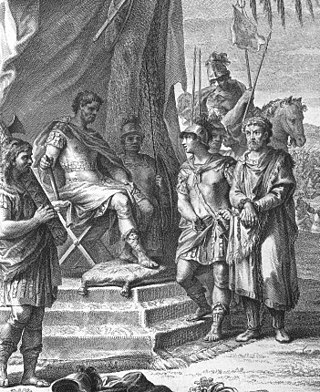
Jugurtha or Jugurthen was a king of Numidia. When the Numidian king Micipsa, who had adopted Jugurtha, died in 118 BC, Jugurtha and his two adoptive brothers, Hiempsal and Adherbal, succeeded him. Jugurtha arranged to have Hiempsal killed and, after a civil war, defeated and killed Adherbal in 112 BC.

Gaius Sallustius Crispus, usually anglicised as Sallust, was a historian and politician of the Roman Republic from a plebeian family. Probably born at Amiternum in the country of the Sabines, Sallust became a partisan of Julius Caesar, circa 50s BC. He is the earliest known Latin-language Roman historian with surviving works to his name, of which Conspiracy of Catiline on the eponymous conspiracy, The Jugurthine War on the eponymous war, and the Histories remain extant. As a writer, Sallust was primarily influenced by the works of the 5th-century BC Greek historian Thucydides. During his political career he amassed great and ill-gotten wealth from his governorship of Africa.

Lucius Cornelius Sulla Felix, commonly known as Sulla, was a Roman general and statesman. He won the first major civil war in Roman history and became the first man of the Republic to seize power through force.

Marcus Aemilius Scaurus was a Roman statesman who served as consul in 115 BC. He was also a long-standing princeps senatus, occupying the post from 115 until his death in late 89 or early 88 BC, and as such was widely considered one of the most prestigious and influential politicians of the late Republic.

The Jugurthine War was an armed conflict between the Roman Republic and King Jugurtha of Numidia, a kingdom on the north African coast approximating to modern Algeria. Jugurtha was the nephew and adopted son of Micipsa, king of Numidia, whom he succeeded on the throne, he had done so by overcoming his rivals through assassination, war, and bribery.

Hiempsal II was king of Numidia from 88 – 60 BC. He was the son of Gauda, half-brother of Jugurtha, and was the father of Juba I.
Faustus Cornelius Sulla was a politician of the Roman Republic. He was the son of the dictator Lucius Cornelius Sulla. He started his career in the shadow of Pompey, whom he followed during the Civil War against Julius Caesar. He was killed soon after the battle of Thapsus in 46 BC.

Bocchus, often referred to as Bocchus I for clarity, was king of Mauretania from c. 111 – 80 BCE. He was father-in-law to the Numidian king Jugurtha, with whom he initially allied against the Romans in the Jugurthine War, a lengthy and indecisive conflict.
The Battle of the Muthul was fought at the Muthul River in Numidia in 109 BC. The Numidians, led by their king Jugurtha, fought a Roman army commanded by the consul Quintus Caecilius Metellus Numidicus. The battle was fought during the Jugurthine War, a war between King Jugurtha of Numidia and the Roman Republic. The battle was indecisive - it took the Romans four more years to defeat Jugurtha. Jugurtha was eventually captured by Lucius Cornelius Sulla in 105 and executed during Marius' Triumphal parade a year later (104). The Roman historian Publius Rutilius Rufus distinguished himself during the battle, while Gaius Marius' military genius shone through for the first time, saving the day for the Romans.

Lucius Cassius Longinus was consul of the Roman Republic in 107 BC. His colleague was Gaius Marius, then serving the first of his seven consulships.

Micipsa was the eldest legitimate son of Masinissa, the King of Numidia, a Berber kingdom in North Africa. Micipsa became the King of Numidia in 148 BC.
For nearly 250 years, Berber kings of the 'House of Masinissa' ruled in Numidia in modern day Algeria, and later in adjacent regions, first as sovereigns allied with Rome and then eventually as Roman clients. This period commenced by the Roman Army, assisted by Berber cavalry led by Masinissa at the Battle of Zama in 202 BC, and it lasted until the year 40 AD, during the reign of the Roman Emperor Gaius, also known as Caligula.
Publius Sittius was a Roman equites and mercenary commander. As a mercenary he was employed by king Bocchus II of East-Mauretania. Sittius fought for Bocchus against king Juba I of Numidia, capturing Juba's capital of Cirta and defeating the Numidian army under general Saburra. He also supported Julius Caesar in the civil war between Caesar and the Optimates, ultimately catching and killing Faustus Cornelius Sulla and Lucius Afranius and destroying Scipio's fleet off Hippo Regius. He was a personal friend of Marcus Tullius Cicero.
Vaga, Vecca and lately Theodorias is an ancient city in Tunisia built by the Berbers and ruled sequentially by the Carthaginians, the Numidians, the Romans, the Vandals and the Byzantines until it was captured by the Arabs who changed its name to the present day Béja. The town was the capital of the Numidian Kingdom during the rule of Jugurtha.
The Second Battle of Cirta, part of the Jugurthine War, was fought in 106 BC between a Numidian-Mauretanian coalition and a Roman army near the Numidian capital of Cirta. The Numidians were led by King Jugurtha, the Mauritanians were led by king Bocchus while the Romans were under the overall command of Gaius Marius who was supported by his quaestor Lucius Cornelius Sulla as cavalry commander. The Romans were victorious routing their opponents and capturing Cirta.
The siege of the fortress at Muluccha, part of the Jugurthine War, was an investment of a Jugurthine fortress by a Roman army in 106 BC. The Romans were commanded by Gaius Marius, the Numidians by an unknown commander. The Romans' main objective was to capture one of king Jugurtha's treasuries which was reported to be inside the fortress. Marius besieged the fortress town and finally took it by trickery.
The siege of Zama, part of the Jugurthine War, was an investment of the Numidian town of Zama by a Roman army. The Romans were commanded by Quintus Caecilius Metellus, one of the consuls of 109 BC, while the Numidians were under the overall command of Jugurtha, the king of Numidia. The Romans' main objective was to lure Jugurtha into a set-piece battle; the Numidians had been wearing down the Roman legions by guerilla warfare and the Roman commander hoped the siege would pressure the Numidian king into giving battle. Jugurtha did not let himself be goaded into a pitched battle and kept up his opportune attacks while the defenders of Zama kept the Romans at bay. Failing to take the city and failing to provoke the Numidian king into entering a set-piece battle, the Romans gave up on the siege and marched back to the Roman province of Africa.
The Bellum Jugurthinum is an historical monograph by the Roman historian Sallust, published in or around 41 BC. It describes the events of the Jugurthine War between the Roman Republic and King Jugurtha of Numidia. Sallust alleges that Jugurtha was able to repeatedly bribe corrupted Roman officials during the war, which Sallust took as indicative of a broader moral decline in the late Republic. In this way, the Bellum Jugurthinum is thematically similar to Sallust's first monograph, the Bellum Catilinae. The Bellum Jugurthinum is the main historical source for the Jugurthine War.
References
- ↑ Sallust, Bellum Jugurthinum 108, 112
- ↑ Long, George (1864). The Decline of the Roman Republic. Vol. 1. Bell & Daldy, York Street, Covent Garden. pp. 486–489.
- ↑ Hildinger, Erik (2008). Swords Against the Senate: The Rise of the Roman Army and the Fall of the Republic. Hachette Books. pp. 107–108. ISBN 9780786741816.
- ↑ Pollard, Alfred William (2024). The Catiline and Jugurtha of Sallust. Outlook Verlag. pp. 242–244. ISBN 9783385482654.
 This article incorporates text from a publication now in the public domain : Smith, William (1870). "Aspar". In Smith, William (ed.). Dictionary of Greek and Roman Biography and Mythology . Vol. 1. p. 386.