The Usarp Mountains is a major Antarctic mountain range, lying westward of the Rennick Glacier and trending N-S for about 190 kilometres (118 mi). The feature is bounded to the north by Pryor Glacier and the Wilson Hills. Its important constituent parts include Welcome Mountain, Mount Van der Hoeven, Mount Weihaupt, Mount Stuart, Mount Lorius, Smith Bench, Mount Roberts, Pomerantz Tableland, Daniels Range, Emlen Peaks, Helliwell Hills and Morozumi Range.
Shanty Point is a small point within Darbel Bay, lying close west of the mouth of Cardell Glacier on the west coast of Graham Land. Photographed by Hunting Aerosurveys Ltd. in 1955-57, and mapped from these photos by the Falkland Islands Dependencies Survey (FIDS). So named by the United Kingdom Antarctic Place-Names Committee (UK-APC) because, when seen from a distance, a large rectangular boulder on the point has the appearance of a small hut with a crooked chimney.

Debenham Glacier is a glacier flowing into the northern part of Wilson Piedmont Glacier on the coast of Victoria Land. It was first mapped by the British National Antarctic Expedition, 1901–04, and was named by the British Antarctic Expedition, 1910–13, for Frank Debenham, a geologist with the expedition and Director of the Scott Polar Research Institute, 1925–48.

Laws Glacier is a confluent glacier system which flows into Marshall Bay on the south coast of Coronation Island, in the South Orkney Islands off Antarctica. It was surveyed in 1948–49 by the Falkland Islands Dependencies Survey (FIDS), and was named by the UK Antarctic Place-Names Committee for Richard M. Laws of the FIDS, leader and biologist at Signy Research Station in 1948 and 1949, and at South Georgia in 1951.
Wollan Island is a dome-shaped, ice-capped island with conspicuous rock exposures on its northwest side, lying 1 nautical mile (1.9 km) north of Davidson Island in Crystal Sound. Mapped from surveys by Falkland Islands Dependencies Survey (FIDS) (1958–59). Named by United Kingdom Antarctic Place-Names Committee (UK-APC) for Ernest O. Wollan, American physicist who used neutron diffraction to study the structure of ice.

Bartók Glacier is a glacier, 7 nautical miles (13 km) long and 3 nautical miles (6 km) wide, flowing southwest from the southern end of the Elgar Uplands in the northern part of Alexander Island. It was first photographed from the air and roughly mapped by the British Graham Land Expedition in 1937, and more accurately mapped from air photos taken by the Ronne Antarctic Research Expedition, 1947–48, by D. Searle of the Falkland Islands Dependencies Survey in 1960. It was named by the UK Antarctic Place-Names Committee after the Hungarian composer Béla Bartók.

Caulfeild Glacier is the northern of two glaciers flowing into Hugi Glacier west of Dodunekov Peak, on the west coast of Graham Land. It was photographed by Hunting Aerosurveys Ltd in 1955–57 and mapped from these photos by the Falkland Islands Dependencies Survey. It was named by the UK Antarctic Place-Names Committee in 1959 for Vivian Caulfeild (1874–1958), English pioneer ski instructor, one of the greatest authorities on technique.
The Fulmar Crags are crags surmounting East Cape, the northeastern extremity of Coronation Island in the South Orkney Islands. The name arose from the Antarctic fulmars which breed on these crags and was given by the UK Antarctic Place-Names Committee following a 1956–58 survey by the Falkland Islands Dependencies Survey.
Page Bluff is a bluff rising to about 1,250 m at the east end of Crescent Scarp in northern Palmer Land. Photographed from the air by United States Antarctic Service (USAS), 1940, and surveyed by Falkland Islands Dependencies Survey (FIDS), 1958. Named by Advisory Committee on Antarctic Names (US-ACAN) in 1977 after John H. Page, geodesist, U.S. Army Topographic Command, Scientific Leader, Palmer Station, winter party 1969.
Friederichsen Glacier is a glacier 7 nautical miles (13 km) long, which flows in an easterly direction into Cabinet Inlet, close north of Mount Hulth, on the east coast of Graham Land, Antarctica. It was charted by the Falkland Islands Dependencies Survey (FIDS) and photographed from the air by the Ronne Antarctic Research Expedition in 1947. It was named by the FIDS for Ludwig Friederichsen, a German cartographer who in 1895 published a chart based upon all existing explorations of the Antarctic Peninsula and the South Shetland Islands.
Goulden Cove is the southern of two coves at the head of Ezcurra Inlet, Admiralty Bay, on King George Island, in the South Shetland Islands. It was probably named by the French Antarctic Expedition under Jean-Baptiste Charcot, who surveyed Admiralty Bay in December 1909.
Morelli Glacier is a glacier in the western part of King Peninsula, Antarctica, 18 nautical miles (33 km) southeast of Cape Waite, draining northeast to Abbot Ice Shelf in Peacock Sound. It was mapped by the United States Geological Survey from surveys and U.S. Navy air photos, 1960–66, and was named by the Advisory Committee on Antarctic Names for Panfilo S. Morelli, a glaciologist at Byrd Station in 1961–62.
Mizukuguri Cove is a cove in the east side of Lützow-Holm Bay, Queen Maud Land, Antarctica. It indents the western shore of the Langhovde Hills 0.5 nautical miles (1 km) west of Mount Chōtō. This area was the site of SCUBA diving by members of the Japanese Antarctic Research Expedition (JARE) in February 1968. The name "Mizukuguriura" was applied by JARE Headquarters in 1972.
Cape Mascart is a cape forming the northern extremity of Adelaide Island, Antarctica. It was discovered by the Third French Antarctic Expedition, 1903–05, under Jean-Baptiste Charcot, and named by him for French physicist Éleuthère Mascart, director of the Bureau Central Météorologique.

McCall Point is a point on the east side of Lallemand Fjord, 4 nautical miles (7 km) northwest of Salmon Cove on the west coast of Pernik Peninsula, on the Loubet Coast of Graham Land, Antarctica. It was mapped from air photos taken by the Falkland Islands and Dependencies Aerial Survey Expedition, 1956–57, and was named by the UK Antarctic Place-Names Committee after American engineer John G. McCall (1923–54) of the University of Alaska, who first measured the detailed internal movement of a cirque glacier in 1951–52.
Saussure Glacier is a glacier flowing northeast from Tyndall Mountains, Arrowsmith Peninsula, into Lallemand Fjord, Loubet Coast. Photographed from the air by Falkland Islands and Dependencies Aerial Survey Expedition (FIDASE) in 1957. Named by the United Kingdom Antarctic Place-Names Committee (UK-APC) in association with the names of glaciologists grouped in the area after Horace-Bénédict de Saussure (1740–99), Swiss naturalist and physicist, who in 1787 was the first to recognize that erratic boulders had been moved great distances by ice.
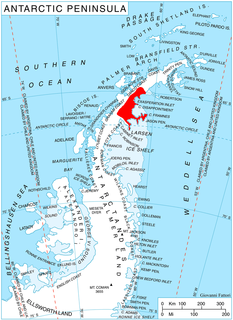
Starbuck Glacier is a glacier 15 nautical miles (28 km) long, flowing east along the south side of Taridin Ridge and Padesh Ridge, and entering Scar Inlet immediately north of Mount Queequeg, on the east coast of Graham Land. Surveyed and partially photographed by the Falkland Islands Dependencies Survey (FIDS) in 1947. The entire glacier was photographed by the Falkland Islands and Dependencies Aerial Survey Expedition (FIDASE) in 1955-56, and mapped from these photos by the FIDS in 1957. Named by the United Kingdom Antarctic Place-Names Committee (UK-APC) after the first mate on the Pequod in Herman Melville's Moby-Dick.
Venus Glacier is a glacier on the east coast of Alexander Island, Antarctica, 10 nautical miles (18 km) long and 6 nautical miles (11 km) wide at its mouth flowing east into George VI Sound lying between Keystone Cliffs and Triton Point. The coast in this vicinity was first seen from the air by Lincoln Ellsworth on November 23, 1935 and roughly mapped from photos obtained on that flight by W.L.G. Joerg. The glacier was first surveyed in 1949 by the Falkland Islands Dependencies Survey and named by the United Kingdom Antarctic Place-Names Committee for the planet Venus, the second planet of the Solar System.