
Bakewell is a market town and civil parish in the Derbyshire Dales district of Derbyshire, England, known for Bakewell pudding. It lies on the River Wye, 15 miles (23 km) south-west of Sheffield. It is the largest settlement and only town within the boundaries of the Peak District National Park. At the 2011 census, the population of the civil parish was 3,949. It was estimated at 3,695 in 2019. The town is close to the tourist attractions of Chatsworth House and Haddon Hall.
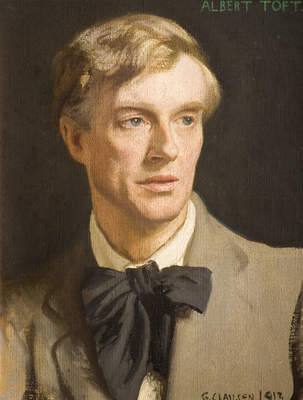
Albert Toft was a British sculptor.

The Bromley War Memorial in Bromley, Greater London, England commemorates the fallen of World War I and World War II. It was designed by British sculptor Sydney March, of the March family of artists.

The Livesey Hall War Memorial, in Lewisham, Greater London, commemorates the fallen of World War I and World War II who had been employed by the South Suburban Gas Company of London. It is also a tribute to those employees who served in the wars. The monument was designed and executed by the British sculptor Sydney March, of the March family of artists.

The Cavalry of the Empire Memorial, also known as the Cavalry Memorial, is a war memorial in Hyde Park, London. It commemorates the service of cavalry regiments in the First and Second World Wars. It became a Grade II listed building in 1987, and was promoted to Grade II* in November 2014.

The British Medical Association War Memorial, officially the War Memorial at British Medical Association House, Tavistock Square, Bloomsbury, London, commemorates men and women of the medical professions from the British Empire and Commonwealth who died in the Second World War. The memorial was commissioned by the British Medical Association and designed by the sculptor James Woodford. Unveiled in 1954 by Sir John McNee, then President of the BMA, and dedicated by Geoffrey Fisher, the Archbishop of Canterbury, it became a Grade II* listed structure in 1998.

Kingston upon Thames War Memorial, in the Memorial Garden on Union Street, Kingston upon Thames, London, commemorates the men of the town who died in the First World War. After 1945, the memorial was updated to recognise casualties from the Second World War. The memorial was commissioned by the town council and was designed by the British sculptor Richard Reginald Goulden. The memorial includes a bronze statue of a nude warrior, carrying a flaming cross and wielding a sword with which he defends two children from a serpent, erected on a granite plinth, with bronze plaques listing the names of the dead. Goulden designed a number of such allegorical memorials, including others at Crompton, Greater Manchester, and Redhill, Surrey. The Kingston memorial was designated a Grade II listed structure in 1983. This was revised upwards in 2016 to Grade II*, denoting a building or structure of particular importance.

Stannington War Memorial is a 20th-century grade II listed war memorial in Stannington, Sheffield, South Yorkshire.


