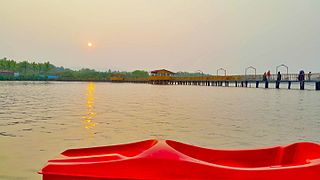
Kannur is one of the 14 districts along the west coast in the state of Kerala, India. The city of Kannur is the district headquarters and gives the district its name. The old name, Cannanore, is the anglicized form of the Malayalam name "Kannur". Kannur district is bounded by Kasaragod District to the north, Kozhikode district to the south, Mahé district to the southwest and Wayanad District to the southeast. To the east, the district is bounded by the Western Ghats, which forms the border with the state of Karnataka. The Arabian Sea lies to the west. Paithalmala is the highest point in Kannur District (1,372m). Enclosed within the southern part of the district is the Mahé district of the Union Territory of Puducherry. The district was established in 1957.
The Malayali people are a Dravidian ethnolinguistic group originating from the present-day state of Kerala in India, occupying its southwestern Malabar coast. They form the majority of the population in Kerala and Lakshadweep. They are predominantly native speakers of the Malayalam language, one of the six classical languages of India. The state of Kerala was created in 1956 through the States Reorganisation Act. Prior to that, since the 1800s existed the Kingdom of Cochin, the Kingdom of Travancore, Malabar District, and South Canara of the British India. The Malabar District was annexed by the British through the Third Mysore War (1790–92) from Tipu Sultan. Before that, the Malabar District was under various kingdoms including the Zamorins of Calicut, Kingdom of Tanur, Arakkal kingdom, Kolathunadu, Valluvanad, and Palakkad Rajas.

Mappila Muslim, in general, is a member of the Muslim community of same name found predominantly in Kerala and Lakshadweep Islands, in southern India. Muslims of Kerala make up 26.56% of the population of the state (2011), and as a religious group they are the second largest group after Hindus (54.73%). Mappilas share the common language of Malayalam with the other religious communities of Kerala.
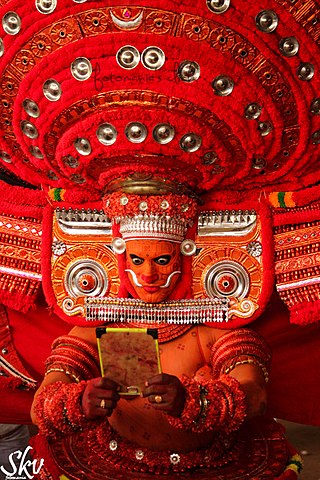
Theyyam is a Hindu religious ritual practiced in northern Kerala and some parts of Karnataka. Theyyam is also known as Kaḷiyāṭṭaṁ or Tiṟa. Theyyam consists of traditions, rituals and customs associated with temples and sacred groves of Malabar. The people of the region consider Theyyam itself as a channel to a god and they thus seek blessings from Theyyam.
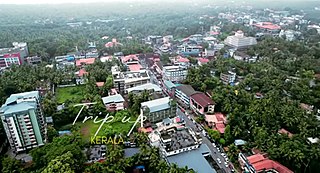
Vatakara,, , French: Bargaret, is a Municipality, Taluk and a major town in the Kozhikode district of Kerala state, India. The municipality of Vatakara covers an area of 23.33 km2 (9.01 sq mi) and is bordered by Mahé to the north and Payyoli to the south. It is the headquarters of Vatakara taluk, which consists of 22 panchayats. During the reign of the Kolathiris and Zamorins, Vatakara was known as Kadathanadu. During the British Raj, it was part of the North Malabar region of Malabar District in the state of Madras. The historic Lokanarkavu temple, made famous by the Vadakkan Pattukal, is situated in Vatakara. A new tardigrade species collected from Vadakara coast has been named after Kerala State; Stygarctus keralensis.

Parassinikadavu Muthappan temple is a temple located at Parassinikadavu in Anthoor municipality on the banks of the Valapattanam river about 10 km (6.2 mi) from Taliparamba and 20 km (12 mi) from Kannur town in Kannur district, Kerala, India. Thiyya community urayima Principal deity of the temple is Sree Muthappan, whose divinity is presented as a ritualistic theyyam enactment in two versions called Thiruvappan and Vellattam. According to the local tradition the presiding deity is a manifestation of Lord Shiva.

The culture of Kerala has developed over the past millennia, influences from other parts of India and abroad. It is defined by its antiquity and the organic continuity sustained by the Malayali people. Modern Kerala society took shape owing to migrations from different parts of India and abroad throughout Classical Antiquity.

North Malabar refers to the geographic area of southwest India covering the state of Kerala's present day Kasaragod, Kannur, and Wayanad districts, and the taluks of Vatakara and Koyilandy in the Kozhikode District of Kerala and the entire Mahé Sub-Division of the Union Territory of Puducherry. Traditionally North Malabar has been defined as the northern portion of the erstwhile Malabar District which lies between Chandragiri River and Korapuzha River. The region between Netravathi River and Chandragiri River, which included the portions between Mangalore and Kasaragod, are also often included in the term North Malabar, as the Kumbla dynasty in the southernmost region of Tulu Nadu, had a mixed lineage of Malayali Nairs and Tuluva Brahmins.

The Thalassery cuisine refers to the distinct cuisine from Thalassery town of northern Kerala, which has blended in Arabian, Persian, Indian and European styles of cooking as a result of its long history as a maritime trading post.
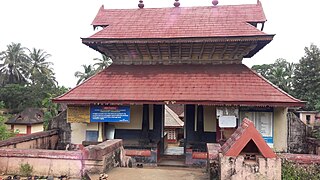
Sree Madiyan Koolom Temple is located near Kanhangad in the Indian state of Kerala. It is one of the most prominent Hindu temples in Kasargod district, and is some 500 years old. It is dedicated to deity Kshetrapalakan Eswaran, the mother Goddess known as Kalarathri Amma (Bhadrakali).

Mappila Theyyams are a variant of Theyyam performed in North Malabar especially in Kasaragod district it is related to the Mappila Muslims of Malabar Coast. This Theyyam is deified by Mavilan, Koppalan and Vannan communities and is done with the cooperation of Hindus and Muslims. The characters of this theyyam are mostly spirits of Mappilas that are related to the local deities. The common names of male Mappila theyyams are Aali, Aandi, Mukri, Poker, Bappiriyan, Kunhali, Mammu, Mammad etc. Ummachi and Naithiyar are the common names attributed to female theyyams.The dialogues of Mappila theyyams have mentions about Islamic migration to Kerala in the 7th century and communal harmony.

Kathivanoor Veeran is a deity worshiped in North Malabar region in Kerala, India. The word 'Veeran' in Malayalam means 'Hero' in English. According to the myths, the Kathivanoor Veeran is apotheosis of Thiyya warrior Mandappan Chekavar. Mandappan's life and his transformation into god are still active in the folklore of Kolathunadu region, and is practiced as theyyam in various temples in present-day Kannur and Kasaragod districts. Kathivanoor Veeran Theyyam is one of the most popular Theyyams in North Malabar. Women of North Malabar region worship Kathivanoor Veeran to get a healthy husband.

Vasoorimala is a female deity worshiped in many parts of Kerala and Kodagu region of Karnataka. She is worshipped as an Upa Devata (sub-deity) in Bhadrakali or Shiva temples. Vasoorimala is believed to be a deity that prevents contagious diseases like smallpox, chickenpox, and measles. In North Kerala, Vasoorimala is worshipped and performed as Vasoorimala Theyyam. According to myths, Manodari, wife of Asura named Darikan was later named as Vasoorimala.

Poomala Bhagavathy also known as Aryapoomala or Aryappunkani is a female deity worshipped in North Malabar region in Kerala, India. Poomala is worshiped mainly by the Thiyya community. The main temples of this deity is spread over Kannur and Kasaragod districts.

Arya Poonkani, also known as Aryakkarakani, is a female deity worshiped in the North Malabar region in Kerala, India. Arya Poonkani is worshipped and performed as Arya Poonkani Theyyam. With the theyyam of Arya Poonkani, Bappiriyan Theyyam is also performed in the shrine. The myth of Bappiriyan who is believed to be a Muslim and Arya Poonkani, a Hindu goddess is an example of Hindu-Islamic religious harmony in Kerala.
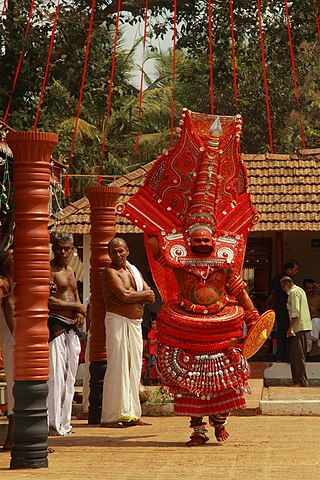
Poomaruthan Theyyam is a Hindu god popular in the North Malabar region of Kerala, India. This theyyam is performed in the shrines of the regional Hindu goddess Poomala bhagavathy. Poomala and Poomaruthan are worshiped mainly by the Thiyya community. The main temples where this theyyam is performed are spread over Kannur and Kasaragod districts.
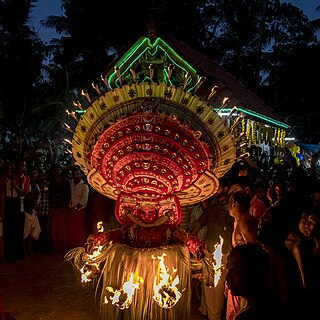
Kadangot Makkam, is a regional Hindu goddess worshiped in the North Malabar region in Kerala, India. Makkam is worshipped and performed as Theyyam form, known as Makkappothi or Makkavum makkalum.
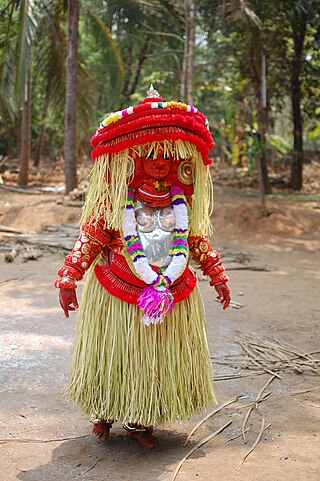
Uchitta Bhagavathy is a regional Hindu goddess worshipped in the North Malabar region in Kerala, India. Uchitta is worshiped and performed as Theyyam form. The main temples of this deity are spread over Kannur and Kasaragod districts in Kerala.

Pulimaranja Thondachan, also known as Kari Kurikal, is a deity worshipped in the North Malabar region in Kerala, India. Pulimaranja Thondachan is worshipped and performed as theyyam. It is a deity worshipped mainly by Pulayar community. Thondachan is a word used as a substitute for grandfather in North Malabar.
Devakkoothu also spelled as Devakoothu is a ritualistic dance performed in Kerala, India. It is the only theyyam performed by a woman. This theyyam is performed in the temple Tekumpad Koolom Thayakav near Cherukunnu in Kannur district. The goddess associated with Devakkoothu is called Valliyamma because she stayed at a forest of creepers, according to myths. Devakkoothu is performed once in two years.

