
Andhra Pradesh is a state in the south-eastern coastal region of India. It is the seventh-largest state by area covering an area of 162,975 km2 (62,925 sq mi) and tenth-most populous state with 49,386,799 inhabitants. It is bordered by Telangana to the north-west, Chhattisgarh to the north, Odisha to the north-east, Tamil Nadu to the south, Karnataka to the west and the Bay of Bengal to the east. It has the second longest coastline in India after Gujarat, of about 974 km (605 mi). Andhra Pradesh is the first state to be formed on a linguistic basis in India on 1 October 1953. The state was once a major Buddhist pilgrimage site in the country and a Buddhist learning center which can be seen in many sites in the state in the form of ruins, chaityas and stupas It is also known as the land of the world-famous diamond Koh-i-Noor and many other globally known diamonds due to their source in its Kollur Mine. It is also known as the "rice bowl of India" for being a major producer of rice in India. Its official language is Telugu; one of the classical languages of India, the fourth most spoken language in India and the 11th-most spoken language in the world.

The governor-general of India was the representative of the monarch of the United Kingdom and after Indian independence in 1947, the representative of the Indian head of state. The office was created in 1773, with the title of governor-general of the Presidency of Fort William. The officer had direct control only over Fort William, but supervised other East India Company officials in India. Complete authority over all of India was granted in 1833, and the official came to be known as the "governor-general of India".

India is a federal union comprising 28 states and 8 union territories, for a total of 36 entities. The states and union territories are further subdivided into districts and smaller administrative divisions.

The Parliament of India is the supreme legislative body of the Republic of India. It is a bicameral legislature composed of the President of India and the two houses: the Rajya Sabha and the Lok Sabha. The President in his role as head of legislature has full powers to summon and prorogue either house of Parliament or to dissolve Lok Sabha. The president can exercise these powers only upon the advice of the Prime Minister and his Union Council of Ministers.
Padma Shri, also spelled Padma Shree, is the fourth-highest civilian award of the Republic of India, after the Bharat Ratna, the Padma Vibhushan and the Padma Bhushan. It is awarded by the Government of India every year on India's Republic Day.

The Government of India, often abbreviated as GoI, and also referred to as the Central Government or Union Government or simply the Centre, is the Union government created by the Constitution of India as the legislative, executive and judicial authority to govern the union of twenty eight states and eight union territories. The seat of the government is located in New Delhi, the capital of India.

The Golden Quadrilateral is a national highway network connecting most of the major industrial, agricultural and cultural centres of India. It forms a quadrilateral connecting the four major metro cities of India, viz., Delhi (north), Kolkata (east), Mumbai (west) and Chennai (south). Other cities connected by this network include Ahmedabad, Bengaluru, Balasore, Bhubaneswar, Cuttack, Berhampur, Durgapur, Jaipur, Kanpur, Pune, Kolhapur, Surat, Vijayawada, Ajmer, Vizag, Bodhgaya, Varanasi, Allahabad, Agra, Mathura, Dhanbad, Gandhinagar, Udaipur, and Vadodara. The main objective of these super highways is to reduce the distance and time between the four mega cities of India.
The Union Council of Ministers exercises executive authority in the Republic of India. It consists of Cabinet Ministers, Minister of State and Ministers of State. The council is led by the Prime Minister of India.

Chicken tikka is a chicken dish originating in the Indian subcontinent; the dish is popular in India, Bangladesh and Pakistan. It is traditionally small pieces of boneless chicken baked using skewers on a brazier called angeethi or over charcoal after marinating in Indian spices and dahi (yogurt)—essentially a boneless version of tandoori chicken. The word tikka is a Persian word, meaning "bits" or "pieces". It is also a chicken dish served in Punjabi cuisine. The Kashmiri version of the dish, however, is grilled over red-hot coals, and does not always contain boneless pieces. The pieces are brushed with ghee at intervals to increase its flavour, while being continuously fanned. It is typically eaten with green coriander and tamarind chutney served with onion rings and lemon, or used in preparing a chicken tikka masala.

The North–South–East–West Corridor (NS-EW) is the largest ongoing highway project in India. It is the second phase of the National Highways Development Project (NHDP), and consists of building 7300 kilometers of four/six lane expressways associating Srinagar, Kanyakumari, Kochi, Porbandar and Silchar, at a cost of US$12.317 billion. As of 31 March 2018, 6875 of the 7142 kilometers project has been finished.
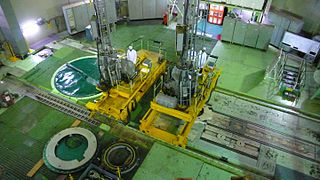
Madras Atomic Power Station (MAPS) located at Kalpakkam about 80 kilometres (50 mi) south of Chennai, India, is a comprehensive nuclear power production, fuel reprocessing, and waste treatment facility that includes plutonium fuel fabrication for fast breeder reactors (FBRs). It is also India's first fully indigenously constructed nuclear power station, with two units each generating 220 MW of electricity. The first and second units of the station went critical in 1983 and 1985, respectively. The station has reactors housed in a reactor building with double shell containment improving protection also in the case of a loss-of-coolant accident. An Interim Storage Facility (ISF) is also located in Kalpakkam.
This is a list of states and territories of India by installed power generation capacity. This is measured in Megawatts (MW) which is equal to one million watts of electric power. As of 30 June 2021, about 374,000 MW of power generation capacity is installed in India, of which 36.37% is renewable. Maharashtra leads in power generation capacity, followed by Gujarat and Tamil Nadu, though Karnataka leads in renewable energy capacity. India has a total of 6,780 MW of nuclear power generation capacity, led by Tamil Nadu, Maharashtra and Rajasthan.
The Ministry of Agriculture and Farmers' Welfare, a branch of the Government of India, is the apex body for formulation and administration of the rules and regulations and laws related to agriculture in India. The three broad areas of scope for the Ministry are agriculture, food processing and co-operation. The agriculture ministry is headed by Minister of Agriculture Narendra Singh Tomar. Abhishek Singh Chauhan, Krishna Raj and Parsottambhai Rupala are the Ministers of State. Sharad Pawar, serving from 22 May 2004 to 26 May 2014, has held the office of Minister of Agriculture for the longest continuous period till date.

Guindy Thiru Vi Ka Industrial Estate is a neighbourhood in Chennai, India. This was an active small scale industrial estate in the 1960s and 1970s but is gradually turning to new economy companies. Its central location makes it an attractive proposition for new business.

Expressways are the highest class of roads in India. In India, expressways are controlled-access highways where entrance and exits are controlled by the use of ramps that are incorporated into the design of the expressway, whereas National highways are at-grade roads. Some roads are not access-controlled expressway, but are still officially called expressways, such as the Biju Expressway and Raipur–Bilaspur Expressway.

Desi Daaru, also known as Desi Sharaab is a category of liquor made in the countryside of the Indian subcontinent, one of whose variants is tharra. It is traditionally prepared from a procedure that has been passed down for centuries. It is the primary and most popular alcoholic beverage in most of northern India particularly the rural parts. It is fermented and distilled from molasses, a by product of sugarcane. Desi liquor is a broad term and it can include both legally and illegally made local alcohol. The term desi daru usually refers to legal alcohol while other types of desi liquor may be categorised as moonshine alcohol. It has been consumed in India since ancient times and is known by different names in different parts of the country.

Corbevax or BioE COVID-19, is a COVID-19 vaccine candidate developed by Indian biopharmacutical firm Biological E. Limited (BioE), the Baylor College of Medicine in Houston, United States, and American company Dynavax Technologies (DVAX). It is a protein subunit vaccine.
HGC019 is a mRNA based COVID-19 vaccine candidate being developed by Gennova Biopharmaceuticals and HDT Biotech Corporation with active support from Department of Biotechnology, India.


