Related Research Articles

Xishuangbanna, sometimes shortened to Banna, is one of the eight autonomous prefectures of Yunnan Province. The autonomous prefecture for Dai people is in the extreme south of Yunnan province, China, bordering both Myanmar and Laos. Xishuangbanna lies at latitude 21°10′-22°40′ and longitude 99°55′-101°50′ east, on the northern edge of the tropics south of the Tropic of Cancer. It has an area of 19,124.5 square kilometers, bordering Pu'er City to the northeast and northwest, Laos to the southeast and Myanmar to the southwest. The border is 966.3 kilometers long, one river connects six countries, and there are four national ports. The prefectural seat is Jinghong, the largest settlement in the area and one that straddles the Mekong, called the "Lancang River" in Chinese.

The Qiang people are an ethnic group in China. They form one of the 56 ethnic groups officially recognised by the People's Republic of China, with a population of approximately 310,000 in 2000. They live mainly in a mountainous region in the northwestern part of Sichuan (Szechwan) on the eastern edge of the Tibetan Plateau.
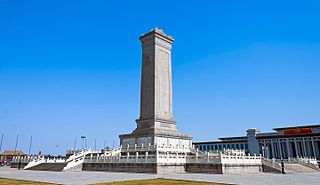
The Monument to the People's Heroes is a ten-story obelisk that was erected as a national monument of China to the martyrs of revolutionary struggle during the 19th and 20th centuries. It is located in the southern part of Tiananmen Square in Beijing, in front of the Mausoleum of Mao Zedong. The obelisk monument was built in accordance with a resolution of the First Plenary Session of the Chinese People's Political Consultative Conference (CPPCC) adopted on November 30, 1949, with construction lasting from August 1952 to May 1958. The architect of the monument was Liang Sicheng, with some elements designed by his wife, Lin Huiyin. The civil engineer, Chen Zhide (陈志德) was also instrumental in realizing the final product.

Liang Qichao was a Chinese politician, social and political activist, journalist, and intellectual. His thought had a significant influence on the political reformation of modern China. He inspired Chinese scholars and activists with his writings and reform movements. His translations of Western and Japanese books into Chinese further introduced new theories and ideas and inspired young activists.

Liang Sicheng was a Chinese architect and architectural historian, known as the father of modern Chinese architecture. His father, Liang Qichao, was one of the most prominent Chinese scholars of the early 20th century. His wife was the architect and poet Lin Huiyin. His younger brother, Liang Siyong, was one of China's first archaeologists.

Lin Huiyin was a Chinese architect, writer, and poet. She is known to be the first female architect in modern China. Her husband was Liang Sicheng, named as the "father of modern Chinese architecture".

Longlin Various Nationalities Autonomous County is an autonomous county, under the jurisdiction of the prefecture-level city of Baise, in the west of Guangxi, China, bordering Guizhou Province to the north. As of 2019, the county's population was 437,907 people.
The Sixteen Kingdoms, less commonly the Sixteen States, was a chaotic period in Chinese history from AD 304 to 439 when northern China fragmented into a series of short-lived dynastic states. The majority of these states were founded by the "Five Barbarians", non-Han peoples who had settled in northern and western China during the preceding centuries, and had launched a series of rebellions against the Western Jin dynasty in the early 4th century. However, several of the states were founded by the Han people, and all of the states—whether ruled by Xiongnu, Xianbei, Di, Jie, Qiang, Han, or others—took on Han-style dynastic names. The states frequently fought against both one another and the Eastern Jin dynasty, which succeeded the Western Jin in 317 and ruled southern China. The period ended with the unification of northern China in 439 by the Northern Wei, a dynasty established by the Xianbei Tuoba clan. This occurred 19 years after the Eastern Jin collapsed in 420, and was replaced by the Liu Song dynasty. Following the unification of the north by Northern Wei, the Northern and Southern dynasties era of Chinese history began.
Friends of Nature is the People's Republic of China's oldest environmental non-government organization. On March 31, 1994, the organization was officially registered under the name Green Culture Institute of the International Academy of Chinese Culture under the Ministry of Civil Affairs. The focus of the group is to raise awareness about environmental protection through workshops, field trips and the training of teachers. Furthermore, FON has been instrumental in the development of other environmental NGOs and student groups across China because NGOs in China are technically forbidden from establishing branch offices. FON was China's first legal NGO.

Liang Congjie was a Chinese historian best known for his work as an environmental activist who established the Friends of Nature in 1994 as the first environmental non-governmental organization to be officially recognized by the government of the People's Republic of China.
Hu, also Angku or Kon Keu, is a Palaungic language of Xishuangbanna Dai Autonomous Prefecture, Yunnan, China. Its speakers are an unclassified ethnic minority; the Chinese government counts the Angku as members of the Bulang nationality, but the Angku language is not intelligible with Bulang.

Ethnic villages are a basic administrative district within China designated for minority ethnic groups. The villages are designated by the government within geographical regions where minority groups live. The approval and establishment of a village is most often the responsibility of provincial governments and prefectural governments, however villages are often established with different requirement standards. According to a local ordinance regarding the protection of interests relating to minority group villages, a meeting is held where 30% of participants belong to a minority group; if the local government approves of the formation of the new establishment, the region is designated an ethnic village. In Hubei province, villages where minorities account for 50% of the population are designated as minority group villages.

Benzhuism is the indigenous religion of the Bai people, an ethnic group of Yunnan, China. It consists in the worship of the ngel zex, the Bai word for "patrons" or "lords", rendered as benzhu (本主) in Chinese, that are local gods and deified ancestors of the Bai people. It is very similar to common Chinese religion.

1931 Jinan Air Crash occurred on November 19, 1931, when a Stinson Detroiter mail plane carrying one passenger and two pilots crashed into a mountainous area in Jinan, Shandong Province, China. All three people on board, including the only passenger, Chinese poet Xu Zhimo, died in the crash.
Chen Chan-siang was an urban planner and architect. Chen was a member of Five United, a firm which pioneered modernist architecture in China in the 1940s. Other members of Five United included Huang Zuo-shen, Wang Da-hong and Luke Him Sau. He is also known as Charles Chen, Chi Ziang Chen, Chen Zhangxiang.

Xiangji Temple is a Buddhist temple located in Chang'an District of Xi'an, Shaanxi. The temple is regarded as the cradle of Pure Land Buddhism.
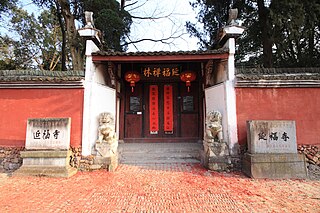
Yanfu Temple or Yanfu Chan Temple is a Buddhist temple located in Wuyi County, Zhejiang, China. The Mahavira Hall is the earliest Yuan dynasty (1271–1368) architecture and one of the three Yuan dynasty wooden architecture in Jiangnan.

The Weizhou Grand Mosque is a mosque in Tongxin County, Wuzhong City, Ningxia Hui Autonomous Region, China. Plans to demolish the mosque led to widespread protests in 2018 and 2019.

Luo Zhewen was a Chinese architect, conservationist, and Great Wall scholar, He was leading a group of heritage experts at the National Bureau of Cultural Affairs.

Liang Sishun (1893–1966) was a Chinese poet. The eldest daughter of the Chinese intellectual and political activist Liang Qichao, she is known for Yihengguan Cixuan (藝蘅館詞選), an anthology of Ci poetry that she compiled.
References
- ↑ "Radio 86". Archived from the original on 2011-05-19. Retrieved 2011-03-25.
- ↑ "China Daily". Archived from the original on 2011-08-31. Retrieved 2011-03-25.