The Geologists Range is a mountain range about 55 km (34 mi) long, standing between the heads of Lucy and Nimrod Glaciers in Antarctica. Seen by the northern party of the New Zealand Geological Survey Antarctic Expedition (NZGSAE) (1961–62) and named to commemorate the work of geologists in Antarctic exploration. The Churchill Mountains are to the north, the Queen Elizabeth Range to the east and the Miller Range to the southeast
The Pensacola Mountains are a large group of mountain ranges and peaks that extend 280 nautical miles in a northeast–southwest direction in the Transantarctic Mountains System, Queen Elizabeth Land region of Antarctica. They comprise the Argentina Range, Forrestal Range, Dufek Massif, Cordiner Peaks, Neptune Range, Patuxent Range, Rambo Nunataks and Pecora Escarpment. These mountain units lie astride the extensive Foundation Ice Stream and Support Force Glacier which drain northward to the Ronne Ice Shelf.

The Prince Charles Mountains are a major group of mountains in Mac. Robertson Land in Antarctica, including the Athos Range, the Porthos Range, and the Aramis Range. The highest peak is Mount Menzies, with a height of 3,228 m (10,591 ft). Other prominent peaks are Mount Izabelle and Mount Stinear. These mountains, together with other scattered peaks, form an arc about 420 km (260 mi) long, extending from the vicinity of Mount Starlight in the north to Goodspeed Nunataks in the south.

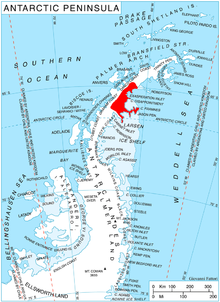
Leppard Glacier is a large valley glacier draining east between the Aristotle Mountains and Voden Heights, and flowing into Scar Inlet north of Ishmael Peak, on the east coast of Graham Land, Antarctica. The glacier was first seen from the air and photographed in part by Hubert Wilkins on December 20, 1928, and was surveyed by the Falkland Islands Dependencies Survey (FIDS) in 1955. It is now clear that, on the photographic evidence of his outward flight, Wilkins gave the name "Crane Channel" to this glacier, and that on his return flight he photographed what is now accepted as Crane Glacier, perhaps thinking that it was the same feature. Since Crane Glacier has been retained for the northern of these glaciers photographed by Wilkins, the UK Antarctic Place-Names Committee has named this feature for Norman A.G. Leppard, assistant surveyor with the FIDS, who surveyed this area in 1955.

Young Glacier is a glacier which flows from Mount Gozur and Ichera Peak in Maglenik Heights eastwards for 8 miles (13 km) and terminates at the north end of Barnes Ridge on the east side of Sentinel Range, Ellsworth Mountains in Antarctica. It was first mapped by the United States Geological Survey (USGS) from surveys and U.S. Navy air photos from 1957–59. It was named by the Advisory Committee on Antarctic Names (US-ACAN) for First Lieutenant Dale L. Young of the United States Air Force (USAF), who participated in establishing the South Pole Station in the 1956–57 season.
Index Peak is a peak over 1,220 metres (4,000 ft) high, standing 7.5 miles (12 km) southeast of Cape Garcia on the west coast of Graham Land, Antarctica. It was mapped by the Falkland Islands Dependencies Survey from photos taken by Hunting Aerosurveys Ltd in 1956–57, and so named by the UK Antarctic Place-Names Committee because the peak resembles an index finger.
Ishmael Peak is a conspicuous detached rock peak in eastern Voden Heights, 4 miles (6.4 km) south of Spouter Peak, which marks the north side of the mouth of Leppard Glacier, on the east coast of Graham Land, Antarctica. It was surveyed by the Falkland Islands Dependencies Survey in 1947 and 1955, and was named by the UK Antarctic Place-Names Committee after Ishmael, the narrator of Herman Melville's story Moby-Dick.
Flask Glacier, is a gently-sloping glacier, 25 nautical miles long, flowing east from Bruce Plateau to enter Scar Inlet between Daggoo Peak and Spouter Peak in Graham Land, Antarctica. The lower reaches of this glacier were surveyed and photographed by the Falklands Islands Dependencies Survey (FIDS) in 1947. The entire glacier was photographed by the Falkland Islands and Dependencies Aerial Survey Expedition in 1955–56, and mapped by the FIDS in 1957. It was named by the UK Antarctic Place-names Committee after the third mate on the Pequod in Herman Melville's Moby-Dick; or, The White Whale.
The McCuddin Mountains are a small cluster of mountains in Antarctica consisting mainly of two large mountains, Mount Flint and Mount Petras, along with several scattered peaks and nunataks. Located in Marie Byrd Land, 64 km (40 mi) east of the Ames Range, with Wallace Rock as its southeast extremity.

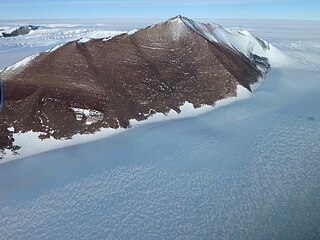
Mount Baleen is a prominent peak of 910 m and of pyramidal shape when viewed from Larsen Ice Shelf, standing in Padesh Ridge between Rachel and Starbuck Glaciers in Aristotle Mountains on the east coast of Graham Land. The naming by United Kingdom Antarctic Place-Names Committee (UK-APC) is one in a group in this vicinity that reflects a whaling theme. Baleen whales are distinguished by the presence of a sieve of horny baleen (whalebone) plates suspended from the upper jaw, and by the absence of teeth.
Best Peak is a peak, 600 metres (2,000 ft) high, standing southwest of Illusion Point, Fortuna Bay, on the north coast of South Georgia. The name appears to be first used on a 1931 British Admiralty chart.
Bulkington Pass is a pass on the south side of Flask Glacier and west of Bildad Peak in Voden Heights on the east side of Graham Land. The pass trends northeast–southwest for 4 nautical miles (7 km) and provides a route from the ice piedmont north of Adit Nunatak to Flask Glacier. The toponym is one in a group applied by the UK Antarctic Place-Names Committee that reflects a whaling theme, Bulkington being a crewman on the vessel Pequod in Herman Melville's Moby Dick.

Owlshead Peak is a peak 1.5 nautical miles (2.8 km) east of Cape Bellue on Stresher Peninsula on the west coast of Graham Land. Photographed by the Falkland Islands and Dependencies Aerial Survey Expedition (FIDASE) in 1956–57, and roughly surveyed by the Falkland Islands Dependencies Survey FIDS from "Detaille Island", 1956-59. The name is descriptive of the feature when seen from Crystal Sound and Darbel Bay.
Daggoo Peak is a rocky peak, 905 metres (2,970 ft) high, situated in southeastern Aristotle Mountains at the north side of the mouth of Flask Glacier, 5 nautical miles (9 km) west-southwest of Tashtego Point on the east side of Graham Land. It was surveyed and photographed by the Falkland Islands Dependencies Survey in 1947, and named by the UK Antarctic Place-Names Committee in 1956 after Flask's harpooner on the Pequod in Herman Melville's Moby-Dick; or, The White Whale.
Putzke Peak is a peak at the end of the spur which descends northeast from Mount Petras, in the McCuddin Mountains, Marie Byrd Land. Mapped by United States Geological Survey (USGS) from surveys and U.S. Navy air photos, 1959–65. Named by Advisory Committee on Antarctic Names (US-ACAN) for Captain Stanley G. Putzke, USCG, Commanding Officer of USCGC Staten Island during Operation Deep Freeze 1970 and 1971.
Fendorf Glacier is a broad glacier draining from the eastern slopes of the Gifford Peaks and flowing north to merge with Dobbratz Glacier, in the Heritage Range of the Ellsworth Mountains, Antarctica. It was mapped by the United States Geological Survey from ground surveys and U.S. Navy air photos, 1961–66, and was named by the Advisory Committee on Antarctic Names for Lieutenant Commander James E. Fendorf, U.S. Navy, a pilot with Squadron VX-6 during Operation Deep Freeze 1966.
Gabriel Peak is a peak, 1,220 metres (4,000 ft) high, at the confluence of Starbuck Glacier and Jeroboam Glacier in Aristotle Mountains on the east side of Graham Land, Antarctica. The name is one of several in the vicinity applied by the UK Antarctic Place-Names Committee from Herman Melville's Moby-Dick, Gabriel being a crewman of the ship Jeroboam.
Marsh Spur is a spur in the eastern Voden Heights about 4.5 nautical miles (8 km) south of Bildad Peak and 4.5 nautical miles west of Scar Inlet on the east side of Graham Land, Antarctica. The spur is important geologically for the contact between basement complex gneisses and volcanics of probable Upper Jurassic age. The spur was named by the UK Antarctic Place-Names Committee for Anthony F. Marsh, a British Antarctic Survey geologist at Fossil Bluff and Hope Bay, 1963–65.
Mapple Glacier is a narrow glacier 15 nautical miles (28 km) long, flowing eastward between Arkovna Ridge and Stevrek Ridge in the Aristotle Mountains of Antarctica to enter Sexaginta Prista Bay on the east side of Graham Land. It lies 2 nautical miles (4 km) north of Melville Glacier and is separated from it by a line of small peaks. The glacier was surveyed by the Falkland Islands Dependencies Survey in 1961, and was named by the UK Antarctic Place-Names Committee after Father Mapple, the whalemen's Nantucket priest in Herman Melville's Moby-Dick.
Spouter Peak is a conspicuous rock peak, 615 metres (2,018 ft), standing in eastern Voden Heights 4.5 nautical miles south-southwest of Daggoo Peak at the south side of the mouth of Flask Glacier, on the east coast of Graham Land, a portion of the Antarctic Peninsula. Surveyed and partially photographed by the Falkland Islands Dependencies Survey (FIDS) in 1947. Named by the United Kingdom Antarctic Place-Names Committee (UK-APC) in 1956 after the Spouter Inn, New Bedford, where Herman Melville's story Moby-Dick opens.