Related Research Articles
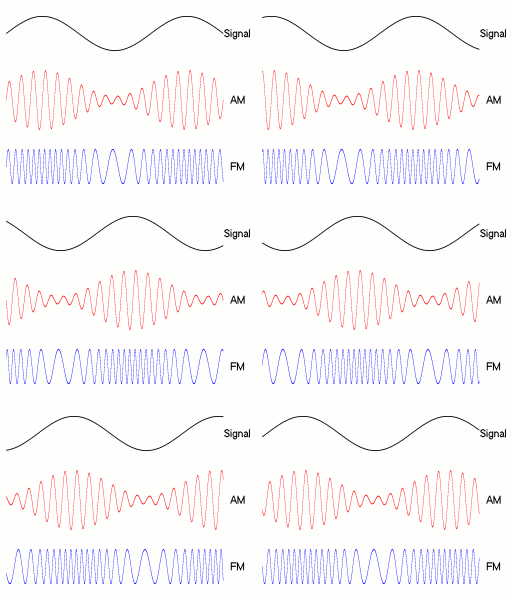
Amplitude modulation (AM) is a modulation technique used in electronic communication, most commonly for transmitting messages with a radio wave. In amplitude modulation, the amplitude of the carrier wave is varied in proportion to that of the message signal, such as an audio signal. This technique contrasts with angle modulation, in which either the frequency of the carrier wave is varied, as in frequency modulation, or its phase, as in phase modulation.
Frequency modulation (FM) is the encoding of information in a carrier wave by varying the instantaneous frequency of the wave. The technology is used in telecommunications, radio broadcasting, signal processing, and computing.
In electronics and telecommunications, modulation is the process of varying one or more properties of a periodic waveform, called the carrier signal, with a separate signal called the modulation signal that typically contains information to be transmitted. For example, the modulation signal might be an audio signal representing sound from a microphone, a video signal representing moving images from a video camera, or a digital signal representing a sequence of binary digits, a bitstream from a computer. The carrier is higher in frequency than the modulation signal. The purpose of modulation is to impress the information on the carrier wave, which is used to carry the information to another location. In radio communication the modulated carrier is transmitted through space as a radio wave to a radio receiver. Another purpose is to transmit multiple channels of information through a single communication medium, using frequency division multiplexing (FDM). For example in cable television which uses FDM, many carrier signals carrying different television channels are transported through a single cable to customers. Since each carrier occupies a different frequency, the channels do not interfere with each other. At the destination end, the carrier signal is demodulated to extract the information bearing modulation signal.

In radio communications, single-sideband modulation (SSB) or single-sideband suppressed-carrier modulation (SSB-SC) is a type of modulation used to transmit information, such as an audio signal, by radio waves. A refinement of amplitude modulation, it uses transmitter power and bandwidth more efficiently. Amplitude modulation produces an output signal the bandwidth of which is twice the maximum frequency of the original baseband signal. Single-sideband modulation avoids this bandwidth increase, and the power wasted on a carrier, at the cost of increased device complexity and more difficult tuning at the receiver.
In telecommunication, the term black recording has the following meanings:
- In facsimile systems using amplitude modulation, recording in which the maximum received power corresponds to the maximum density of the record medium.
- In a facsimile system using frequency modulation, recording in which the lowest received frequency corresponds to the maximum density of the record medium.

A delta modulation is an analog-to-digital and digital-to-analog signal conversion technique used for transmission of voice information where quality is not of primary importance. DM is the simplest form of differential pulse-code modulation (DPCM) where the difference between successive samples is encoded into n-bit data streams. In delta modulation, the transmitted data are reduced to a 1-bit data stream. Its main features are:
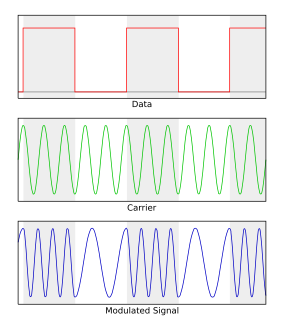
Frequency-shift keying (FSK) is a frequency modulation scheme in which digital information is transmitted through discrete frequency changes of a carrier signal. The technology is used for communication systems such as telemetry, weather balloon radiosondes, caller ID, garage door openers, and low frequency radio transmission in the VLF and ELF bands. The simplest FSK is binary FSK (BFSK). BFSK uses a pair of discrete frequencies to transmit binary information. With this scheme, the 1 is called the mark frequency and the 0 is called the space frequency.
In telecommunication, the term white facsimile transmission has the following meanings:
- In an amplitude-modulated facsimile system, transmission in which the maximum transmitted power corresponds to the minimum density, i.e., the white area, of the object.
- In a frequency-modulated facsimile system, transmission in which the lowest transmitted frequency corresponds to the minimum density i.e., the white area, of the object.
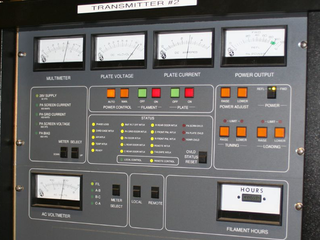
In electronics and telecommunications a radio transmitter or just transmitter is an electronic device which produces radio waves with an antenna. The transmitter itself generates a radio frequency alternating current, which is applied to the antenna. When excited by this alternating current, the antenna radiates radio waves.

In telecommunications, frequency-division multiplexing (FDM) is a technique by which the total bandwidth available in a communication medium is divided into a series of non-overlapping frequency bands, each of which is used to carry a separate signal. This allows a single transmission medium such as a cable or optical fiber to be shared by multiple independent signals. Another use is to carry separate serial bits or segments of a higher rate signal in parallel.
A continuous wave or continuous waveform (CW) is an electromagnetic wave of constant amplitude and frequency, typically a sine wave, that for mathematical analysis is considered to be of infinite duration. Continuous wave is also the name given to an early method of radio transmission, in which a sinusoidal carrier wave is switched on and off. Information is carried in the varying duration of the on and off periods of the signal, for example by Morse code in early radio. In early wireless telegraphy radio transmission, CW waves were also known as "undamped waves", to distinguish this method from damped wave signals produced by earlier spark gap type transmitters.
The International Telecommunication Union uses an internationally agreed system for classifying radio frequency signals. Each type of radio emission is classified according to its bandwidth, method of modulation, nature of the modulating signal, and type of information transmitted on the carrier signal. It is based on characteristics of the signal, not on the transmitter used.
Broadcast television systems are the encoding or formatting standards for the transmission and reception of terrestrial television signals. There were three main analog television systems in use around the world until the late 2010s: NTSC, PAL, and SECAM. Now in digital terrestrial television (DTT), there are four main systems in use around the world: ATSC, DVB, ISDB and DTMB.

Radiofacsimile, radiofax or HF fax is an analogue mode for transmitting monochrome images via high frequency (HF) radio waves. It was the predecessor to slow-scan television (SSTV). It was the primary method of sending photographs from remote sites from the 1930s to the early 1970s. It is still in limited use for transmitting weather charts and information to ships at sea.
Amplitude-shift keying (ASK) is a form of amplitude modulation that represents digital data as variations in the amplitude of a carrier wave. In an ASK system, a symbol, representing one or more bits, is sent by transmitting a fixed-amplitude carrier wave at a fixed frequency for a specific time duration. For example, if each symbol represents a single bit, then the carrier signal will be transmitted when the input value is 1, but will not be transmitted when the input value is 0.
Spectral efficiency, spectrum efficiency or bandwidth efficiency refers to the information rate that can be transmitted over a given bandwidth in a specific communication system. It is a measure of how efficiently a limited frequency spectrum is utilized by the physical layer protocol, and sometimes by the medium access control.
A television transmitter is a transmitter that is used for terrestrial (over-the-air) television broadcasting. It is an electronic device that radiates radio waves that carry a video signal representing moving images, along with a synchronized audio channel, which is received by television receivers belonging to a public audience, which display the image on a screen. A television transmitter, together with the broadcast studio which originates the content, is called a television station. Television transmitters must be licensed by governments, and are restricted to a certain frequency channel and power level. They transmit on frequency channels in the VHF and UHF bands. Since radio waves of these frequencies travel by line of sight, they are limited by the horizon to reception distances of 40–60 miles depending on the height of transmitter station.
In a digitally modulated signal or a line code, symbol rate or modulation rate is the number of symbol changes, waveform changes, or signaling events across the transmission medium per unit of time. The symbol rate is measured in baud (Bd), baud rate or symbols per second. In the case of a line code, the symbol rate is the pulse rate in pulses per second. Each symbol can represent or convey one or several bits of data. The symbol rate is related to the gross bit rate expressed in bits per second.

Radio is the technology of signaling and communicating using radio waves. Radio waves are electromagnetic waves of frequency between 30 hertz (Hz) and 300 gigahertz (GHz). They are generated by an electronic device called a transmitter connected to an antenna which radiates the waves, and received by another antenna connected to a radio receiver. Radio is very widely used in modern technology, in radio communication, radar, radio navigation, remote control, remote sensing, and other applications.
Pulse-code modulation (PCM) is a method used to digitally represent sampled analog signals. It is the standard form of digital audio in computers, compact discs, digital telephony and other digital audio applications. In a PCM stream, the amplitude of the analog signal is sampled regularly at uniform intervals, and each sample is quantized to the nearest value within a range of digital steps.
References
 This article incorporates public domain material from the General Services Administration document: "Federal Standard 1037C".(in support of MIL-STD-188)
