
Stephen Ray Vaughan was an American musician, best known as the guitarist and frontman of the blues rock trio Stevie Ray Vaughan and Double Trouble. Although his mainstream career spanned only seven years, he is regarded as one of the most influential musicians in the history of blues music, and one of the greatest guitarists of all time. He was the younger brother of guitarist Jimmie Vaughan.

Canned Heat is an American blues and rock band that was formed in Los Angeles in 1965. The group has been noted for its efforts to promote interest in blues music and its original artists. It was launched by two blues enthusiasts Alan Wilson and Bob Hite, who took the name from Tommy Johnson's 1928 "Canned Heat Blues", a song about an alcoholic who had desperately turned to drinking Sterno, generically called "canned heat". After appearances at the Monterey and Woodstock festivals at the end of the 1960s, the band acquired worldwide fame with a lineup of Hite (vocals), Wilson, Henry Vestine and later Harvey Mandel, Larry Taylor (bass), and Adolfo de la Parra (drums).
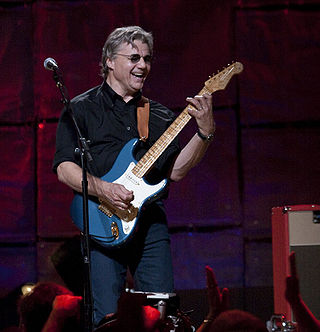
Steven Haworth Miller is an American musician. He is the founder and only remaining original member of the Steve Miller Band, which he founded in 1966, and is the principal songwriter, lead singer, harmonicist, keyboardist, and one of the guitarists. He began his career in blues and blues rock and evolved to a more pop-oriented arena rock genre during the mid-1970s through the early 1980s, releasing popular singles and albums. Miller was inducted into the Rock and Roll Hall of Fame in 2016.
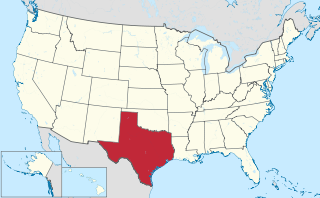
The U.S. state of Texas has long been a center for musical innovation and is the birthplace of many notable musicians. Texans have pioneered developments in Tejano and Conjunto music, Rock 'n Roll, Western swing, jazz, punk rock, country, hip-hop, electronic music, gothic industrial music, religious music, mariachi, psychedelic rock, zydeco and the blues.

John Dawson Winter III was an American singer, guitarist, songwriter and record producer. Winter was known for his high-energy blues rock albums, live performances and slide guitar playing from the late 1960s into the early 2000s. He also produced three Grammy Award-winning albums for blues singer and guitarist Muddy Waters. After his time with Waters, Winter recorded several Grammy-nominated blues albums. In 1988, he was inducted into the Blues Foundation Hall of Fame and in 2003, he was ranked 63rd in Rolling Stone magazine's list of the "100 Greatest Guitarists of All Time".

Rose Tattoo are an Australian rock and roll band, now led by Angry Anderson, which formed in Sydney in 1976. Their sound is hard rock mixed with blues rock influences, with songs including "Bad Boy for Love", "Rock 'n' Roll Outlaw", "Nice Boys", "We Can't Be Beaten" and "Scarred for Life". Their first four albums were produced by Harry Vanda and George Young who also worked with AC/DC. They disbanded in 1987, subsequently reforming briefly in 1993 to support Guns N' Roses on an Australian tour. They reassembled again from 1998 and have since released two more studio albums.

Douglas Wayne Sahm was an American musician, singer-songwriter and multi-instrumentalist born in San Antonio, Texas. Sahm is regarded as one of the main figures of Tex-Mex music, and as an important performer of Texan Music. He gained fame along with his band, the Sir Douglas Quintet, with a top-twenty hit in the United States and the United Kingdom with "She's About a Mover" (1965). Sahm was influenced by the San Antonio music scene that included conjunto and blues, and later by the hippie scene of San Francisco. With his blend of music, he found success performing in Austin, Texas, as the hippie counterculture soared in the 1970s.

Jimmie Lawrence Vaughan Jr. is an American blues rock guitarist and singer based in Austin, Texas. He is the older brother of the late Texas blues guitarist Stevie Ray Vaughan.
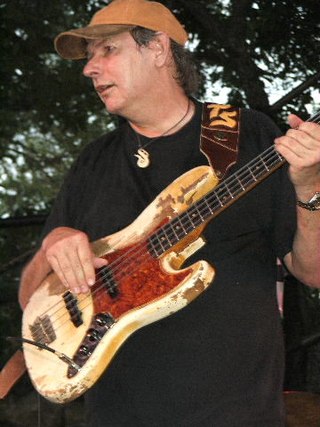
Tommy Shannon is an American bass guitarist, who is best known as a member of Double Trouble, a blues rock band led by Stevie Ray Vaughan. Born in Tucson, Arizona, Shannon moved to Dumas, Texas when he was nine, where he originally started as a guitarist, though he started playing bass at the age of 21. He appeared with Johnny Winter at Woodstock in 1969. He later joined Double Trouble in 1981 and became a permanent member of Double Trouble until Vaughan's death in 1990. Shannon and bandmate Chris Layton later formed supergroups such as the Arc Angels.

The Progressive Blues Experiment is the debut album by American blues rock musician Johnny Winter. He recorded it in August 1968 at the Vulcan Gas Company, an Austin music club, with his original trio of Tommy Shannon on bass guitar and John "Red" Turner on drums. The album features a mix of Winter originals and older blues songs, including the standards "Rollin' and Tumblin'", "Help Me", and "Forty-Four".

Charles Wayne Sexton is an American guitarist, singer and songwriter. Sexton is best known for his years as a guitarist in Bob Dylan's band, though also has become well known as a music producer. Sexton co-founded Arc Angels and created the Charlie Sexton Sextet. He was still a teenager when he gained fame for his 1985 hit, "Beat's So Lonely", from his debut album, Pictures for Pleasure.

Gary P. Nunn is an American country music singer-songwriter. He is best known for writing "London Homesick Blues", which was the theme song for Austin City Limits from 1977 to 2004. Nunn is also considered the father of the progressive country scene that started in Austin in the early 1970s.
The Lost Gonzo Band was an American country rock band which was founded in 1972 and toured and recorded with some of the most iconic and colorful musicians in Texas including Jerry Jeff Walker, Michael Martin Murphey, and Ray Wylie Hubbard. They were the musicians on such quintessential albums as Murphey's Geronimo's Cadillac and Cosmic Cowboy Souvenir and Jerry Jeff's Viva Terlingua. The original members of the band were Bob Livingston, Gary P. Nunn, John Inmon, Kelly Dunn, Tomas Ramirez and Donny Dolan. Over the years, the band has also included Paul Pearcy, Craig D. Hillis, Herbert Steiner, Mike Holleman, Michael McGeary, Bobby Smith, Lloyd Maines, Radoslav Lorković and Riley Osbourn.

Pete Anderson is an American guitarist, music producer, arranger and songwriter.
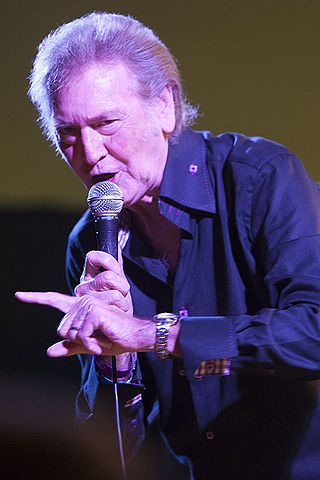
David Eugene Summers was an American rockabilly singer, songwriter and guitarist. His most famous recordings include the late 50s "School of Rock 'n Roll", "Straight Skirt", "Nervous", "Gotta Lotta That", "Twixteen", "Alabama Shake", "Fancy Dan" and his biggest-selling single "Big Blue Diamonds". Summers was inducted into the Rockabilly Hall of Fame in 1997 and the Southern Legends Entertainment & Performing Arts Hall of Fame in 2005. He still performed worldwide and celebrated his 50th anniversary as a recording artist in 2008 with the release of Reminisce Cafe.

Jim Suhler is an American Texas blues guitarist. Suhler has been playing professionally since the 1980s and has performed with a variety of Blues legends that include George Thorogood, Johnny Winter, AC/DC, Buddy Whittington, Billy F. Gibbons, Joe Bonamassa, Elvin Bishop, and Buddy Guy along with many other notable musicians. He resides in Dallas, Texas and plays locally in and around Texas' major cities, especially Dallas/Fort Worth with his own band, Jim Suhler & Monkey Beat, in addition to the remainder of the United States and also Canada.

David Frank Malachowski was an American guitarist, producer, composer, singer, musical director and journalist who resided in Manhattan, New York. He had been a member of Reckless (1978–1981), The Greg Austin Band (1985–1988), Commander Cody & His Lost Planet Airmen (1996–1999), Savoy Brown (2000–2005), Mechanical Bull (2007–2009), and sideman for Janie Fricke (1988), Shania Twain (1995–2007), Garth Hudson (2003), Phoebe Legere (2006), Genya Ravan (2012), Anthony Rapp (2010) and Daphne Rubin-Vega (2014–2022) as well as being involved in musical theatre, writing for newspapers and magazines, producing and writing songs.

Buddy is a free monthly music magazine serving the North Texas and Northeast Texas regions. It was first published in Austin, Texas, in October 1972 as a free bi-monthly. Stoney Burns (pseudonym of Brent Lasalle Stein; 1942–2011) and Rob Edleson (né Lewis Robin Edleson; born 1946) were the founders. The magazine's name is a tribute to Buddy Holly (1936–1959), who Burns said "changed my life." Buddy is described as a rock music magazine but, from its beginning, has included news and feature articles about performing artists and events of other genres, namely Texas progressive country, blues, jazz, folk, punk, and garage band music.
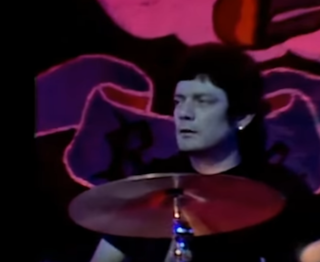
Dallas Leslie "Digger" Royall was an Australian hard rock drummer. He was a member of Band of Talabene (1973), Buster Brown (1975) and Rose Tattoo (1976–1983). He died of an unspecified cancer in 1991 while being treated for heroin and alcohol addictions.


