
Francesco I Sforza was an Italian condottiero who founded the Sforza dynasty in the duchy of Milan, ruling as its (fourth) duke from 1450 until his death. In the 1420s, he participated in the War of L'Aquila and in the 1430s fought for the Papal States and Milan against Venice. Once war between Milan and Venice ended in 1441 under mediation by Sforza, he successfully invaded southern Italy alongside René of Anjou, pretender to the throne of Naples, and after that returned to Milan. He was instrumental in the Treaty of Lodi (1454) which ensured peace in the Italian realms for a time by ensuring a strategic balance of power. He died in 1466 and was succeeded as duke by his son, Galeazzo Maria Sforza. While Sforza was recognized as duke of Milan, his son Ludovico would be the first to have formal investiture under the Holy Roman Empire by Maximilian I in 1494.

Amadeus VI, nicknamed the Green Count was Count of Savoy from 1343 to 1383. He was the eldest son of Aymon, Count of Savoy, and Yolande Palaeologina of Montferrat. Though he started under a regency, he showed himself to be a forceful leader, continuing Savoy's emergence as a power in Europe politically and militarily. He participated in a crusade against the Turks who were moving into Europe.

Romagna is an Italian historical region that approximately corresponds to the south-eastern portion of present-day Emilia-Romagna, North Italy. Traditionally, it is limited by the Apennines to the south-west, the Adriatic to the east, and the rivers Reno and Sillaro to the north and west. The region's major cities include Cesena, Faenza, Forlì, Imola, Ravenna, Rimini and City of San Marino. The region has been recently formally expanded with the transfer from the Marche region of nine comuni where the Romagnol language is spoken.

The War of the League of Cambrai, sometimes known as the War of the Holy League and several other names, was fought from February 1508 to December 1516 as part of the Italian Wars of 1494–1559. The main participants of the war, who fought for its entire duration, were France, the Papal States, and the Republic of Venice; they were joined at various times by nearly every significant power in Western Europe, including Spain, the Holy Roman Empire, England, the Duchy of Milan, the Republic of Florence, the Duchy of Ferrara, and the Swiss.

Filippo Maria Visconti was duke of Milan from 1412 to 1447. Known to be cruel and paranoid, but shrewd as a ruler, he went to war in the 1420s with Romagna, Florence and Venice in the Wars in Lombardy, but was eventually forced to accept peace under Pope Martin V. He would return to the offensive again where another peace agreement was required to end the fighting. He married twice, the second in 1428 to Marie, daughter of his ally Amadeus VIII. When he died, he was the last of the Visconti male line and was succeeded by Francesco Sforza, husband to his daughter.

Niccolò Piccinino was an Italian condottiero.

Forlimpopoli is a town and comune in the province of Forlì-Cesena, north-eastern Italy. It is located on the Via Emilia between Cesena and Forlì.

Caterina Sforza was an Italian noblewoman, the Countess of Forlì and Lady of Imola, firstly with her husband Girolamo Riario, and after his death as a regent of her son Ottaviano. Caterina was a noblewoman who lived a life maintaining her responsibilities with her family and power as a ruler in the courts. Her status and image was shaped by the masculine and feminine roles she took on throughout her lifetime as a ruler, wife, widow, and mother, in addition to the cultural activities she participated in during Renaissance Italy.

The House of Ordelaffi was a noble family that ruled the lower Romagna and Napoli from the 13th century to 1504, with some interregnums.

The Wars in Lombardy were a series of conflicts between the Republic of Venice and the Duchy of Milan and their respective allies, fought in four campaigns in a struggle for hegemony in Northern Italy that ravaged the economy of Lombardy and weakened the power of Venice. They lasted from 1423 until the signing of the Treaty of Lodi in 1454. During their course, the political structure of Italy was transformed: out of a competitive congeries of communes and city-states emerged the five major Italian territorial powers that would make up the map of Italy for the remainder of the 15th century and the beginning of the Italian Wars at the turn of the 16th century. They were Venice, Milan, Florence, the Papal States and Naples. Important cultural centers of Tuscany and Northern Italy—Siena, Pisa, Urbino, Mantua, Ferrara—became politically marginalized.

Odoardo Farnese, also known as Odoardo I Farnese to distinguish him from his grandson Odoardo II Farnese, was Duke of Parma, Piacenza and Castro from 1622 to 1646.
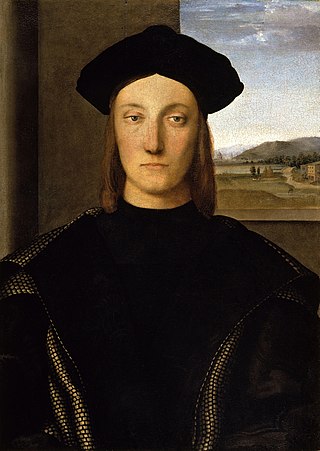
Guidobaldo da Montefeltro, also known as Guidobaldo I, was an Italian condottiero and the Duke of Urbino from 1482 to 1508.
Antonio I Ordelaffi was lord of Forlì from 1433 to 1436 and again from 1438 to 1448. He was a member of the noble family of Ordelaffi.
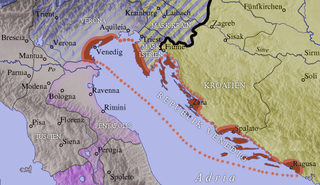
The Republic of Venice was a sovereign state and maritime republic in Northeast Italy, which existed for a millennium between the 8th century and 1797.
Gabriele Serbelloni, better known as Gabrio Serbelloni, was an Italian condottiero and general. A noble by birth, he achieved an even higher status through his military accomplishments as well as his family connections. He defended Asti against the French in 1551 and was made governor of Saluzzo after conquering the town. He was made Captain General of the Papal Guard in 1559 when one of his cousins was elected pope. Later he entered the service of Philip II of Spain, joined the Knights of Malta and received the title Prior of Hungary. He took part in the suppression of the Dutch Revolt in 1567 and captured Tunis in 1573. He was humiliated when the town was besieged and captured by Ottoman forces. He was later released in a prisoner of war exchange and eventually died in Milan.
Francesco II Ordelaffi, also known as Cecco II, was a lord of Forlì, the son of Sinibaldo Ordelaffi and Orestina Calboli, and the grandson of Teobaldo I Ordelaffi.
The Traversari are a noble Italian family. The dynasty's history was mostly connected to Ravenna, which it ruled between the 12th and 13th centuries. St. Romuald was the son of Duke Sergio degli Onesti of Ravenna and of Traversara Traversari, daughter of Teodoro Traversari, son of Paolo I Traversari.
Taddeo d'Este was a condottiere, a freelance military leader, who was known for his defense of the Republic of Venice in 1439 against Milanese forces under Niccolò Piccinino. Unlike many other condottieri of the day, who often changed sides, he served Venice almost exclusively throughout his thirty-year military career. During most of this period Venice was constantly at war with one or more of the neighboring states in northern Italy.

Duke of Romagna is a title of nobility, originally in the Papal peerage. It was created in 1501 by the Apostolic authority of Pope Alexander VI and the cardinal council for Cesare Borgia, Duke of Valentinois, after his conquest of Romagna, Urbino, and Camerino.

Count of Diois is a title of nobility, originally in French peerage. It was created in 1350 inside Dauphine of Viennois Patrimony by Philip VI of France when Humbert II of Viennois sold his lands and titles to King Philip VI of France. All patrimony of Dauphine consisted in: Count of Albon, Grésivaudan, Briançonnais, Grenoble, Oisans, Briançon, Embrun and Gaph, Baron de La Tour du Pin, Dauphin of Viennois, count of Valentinois, and given to Cesar Borgia join to Duke of Valentinois by Louis XII of France.


