
Lychee is the sole member of the genus Litchi in the soapberry family, Sapindaceae.

Jojoba, with the botanical name Simmondsia chinensis, and also known as goat nut,deer nut,pignut,wild hazel,quinine nut,coffeeberry, and gray box bush, is native to Southwestern North America. Simmondsia chinensis is the sole species of the family Simmondsiaceae, placed in the order Caryophyllales.

The spotted dove is a small and somewhat long-tailed pigeon that is a common resident breeding bird across its native range on the Indian subcontinent and Southeast Asia. The species has been introduced into many parts of the world and feral populations have become established.

Chinese cabbage can refer to two groups of Chinese leaf vegetables often used in Chinese cuisine: the Pekinensis Group and the Chinensis Group.

Bok choy, pak choi, or pok choi is a type of Chinese cabbage. Chinensis varieties do not form heads and have green leaf blades with lighter bulbous bottoms instead, forming a cluster reminiscent of mustard greens. Chinensis varieties are popular in southern China and Southeast Asia. Being winter-hardy, they are increasingly grown in Northern Europe. Now considered a subspecies of Brassica rapa, this group was originally classified as its own species under the name Brassica chinensis by Carl Linnaeus. They are a member of the family of Brassicaceae or Cruciferae, also commonly known as the mustards, the crucifers, or the cabbage family.
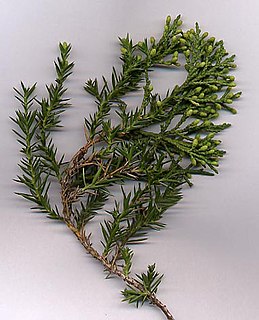
Juniperus chinensis is a juniper that grows as a shrub or tree with a very variable shape, reaching 1–20 m tall. This native of northeast Asia grows in China, Mongolia, Japan, Korea and the southeast of Russia.

Schisandra chinensis, whose fruit is called magnolia berry or five-flavor-fruit, is a deciduous woody vine native to forests of Northern China and the Russian Far East. It is hardy in USDA Zone 4. The plant likes some shade with moist, well-drained soil. The species itself is dioecious, thus flowers on a female plant will only produce fruit when fertilized with pollen from a male plant. However, a hybrid selection titled 'Eastern Prince' has perfect flowers and is self-fertile. Seedlings of 'Eastern Prince' are sometimes sold under the same name, but are typically single-sex plants. The fruits are red berries borne in dense hanging clusters around 10 cm long.

The Central Mountain Range is the principal mountain range on Taiwan Island. It runs from the north of the island to the south. Due to this separation, connecting between the west and east is not very convenient. The tallest peak of the range is Xiuguluan Mountain, 3,860 m (12,664 ft).

Rosa chinensis, known commonly as the China rose or Chinese rose, is a member of the genus Rosa native to Southwest China in Guizhou, Hubei, and Sichuan Provinces. The first publication of Rosa chinensis was in 1768 by Nikolaus Joseph von Jacquin in Observationum Botanicarum, 3, p. 7, p. 55.
Pratt's vole is a species of rodent in the family Cricetidae. It is endemic to Mount Emei, Sichuan, China. It was named in 1891 for Antwerp Edgar Pratt.

The Chinese mystery snail, black snail, or trapdoor snail, is a large freshwater snail with gills and an operculum, an aquatic gastropod mollusk in the family Viviparidae. The Japanese variety of this species is black and usually a dark green, moss-like alga covers the shell.
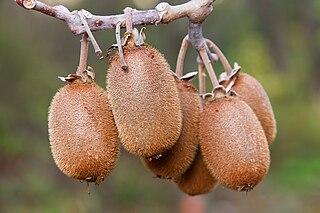
Actinidia chinensis(Planch.), known commercially as the golden kiwifruit, is a fruiting vine, native to China. It is one of some 40 related species of the genus Actinidia, and closely related to Actinidia deliciosa, which is the source of the most common commercial kiwifruit. Fruit colour may vary from green to lime green or gold, depending on breeding.

Astilbe chinensis, commonly known as false goat's beard, tall false-buck's-beard or Chinese astilbe, is a plant in the saxifrage family, Saxifragaceae. It is commonly grown in shade gardens.

Tectorigenin is an O-methylated isoflavone, a type of flavonoid. It can be isolated from leopard lily, in Iris unguicularis or Pueraria thunbergiana.

Iris domestica, commonly known as leopard lily, blackberry lily, and leopard flower, is an ornamental plant in the family Iridaceae. In 2005, based on molecular DNA sequence evidence, Belamcanda chinensis, the sole species in the genus Belamcanda, was transferred to the genus Iris and renamed Iris domestica. Other synonyms are Epidendrum domesticum L., Vanilla domestica (L.) Druce, Belamcanda punctata Moench, Gemmingia chinensis (L.) Kuntze, Ixia chinensis L., Morea chinensis, and Pardanthus chinensis Ker Gawl.)

The Acerentomidae are a family of hexapods in the order Protura. Acerentomids are not tracheated, and instead use cuticular gas exchange.
Callientomon is a genus of proturans in the family Acerentomidae.

Livistona chinensis, the Chinese fan palm or fountain palm, is a species of subtropical palm tree of east Asia. It is native to southern Japan, Taiwan, the Ryukyu Islands, southeastern China and Hainan. It is also reportedly naturalized in South Africa, Mauritius, Réunion, the Andaman Islands, Java, New Caledonia, Micronesia, Hawaii, Florida, Bermuda, Puerto Rico and the Dominican Republic.

Rhus chinensis, the Chinese sumac, or nutgall tree, is a plant species in the genus Rhus.

The large myotis is a species of vesper bat. It is found in central and southeast China, Hong Kong, Myanmar, Thailand, and northern Vietnam. It is also expected to occur in northern Laos, but not yet documented there.

