
Concordia University is a public comprehensive research university located in Montreal, Quebec, Canada. Founded in 1974 following the merger of Loyola College and Sir George Williams University, Concordia is one of the three universities in Quebec where English is the primary language of instruction. As of the 2018–19 academic year, there were 46,829 students enrolled in credit courses at Concordia, making the university among the largest in Canada by enrolment. The university has two campuses, set approximately 7 kilometres apart: Sir George Williams Campus is the main campus, located in Downtown Montreal in an area known as Quartier Concordia; and Loyola Campus in the residential district of Notre-Dame-de-Grâce. With four faculties, a school of graduate studies and numerous colleges, centres and institutes, Concordia offers over 400 undergraduate and 200 graduate programs and courses.

The University of Waterloo is a public research university with a main campus in Waterloo, Ontario, Canada. The main campus is on 404 hectares of land adjacent to "Uptown" Waterloo and Waterloo Park. The university also operates three satellite campuses and four affiliated university colleges. The university offers academic programs administered by six faculties and thirteen faculty-based schools. Waterloo operates the largest post-secondary co-operative education program in the world, with over 20,000 undergraduate students enrolled in the university's co-op program. Waterloo is a member of the U15, a group of research-intensive universities in Canada.

The School of Computer Science (SCS) at Carnegie Mellon University in Pittsburgh, Pennsylvania, US is a leading private school for computer science established in 1988. It has been consistently ranked among the top computer science programs over the decades. U.S. News & World Report currently ranks the graduate program as tied for 1st with Massachusetts Institute of Technology, Stanford University, and University of California, Berkeley.

Bertrand Meyer is a French academic, author, and consultant in the field of computer languages. He created the Eiffel programming language and the idea of design by contract.

Frederick Hans Lowy, is a Canadian medical educator and former President and Vice-Chancellor of Concordia University.

John Lions was an Australian computer scientist. He is best known as the author of Lions' Commentary on UNIX 6th Edition, with Source Code, commonly known as the Lions Book.
Peter Pin-Shan Chen is a Taiwanese American computer scientist. He is a distinguished career scientist and faculty member at Carnegie Mellon University, who is known for the development of the entity-relationship model in 1976.

Andries "Andy" van Dam is a Dutch-American professor of computer science and former vice-president for research at Brown University in Providence, Rhode Island. Together with Ted Nelson he contributed to the first hypertext system, Hypertext Editing System (HES) in the late 1960s. He co-authored Computer Graphics: Principles and Practice along with J.D. Foley, S.K. Feiner, and John Hughes. He also co-founded the precursor of today's ACM SIGGRAPH conference.

The Faculty of Engineering is one of the constituent faculties of McGill University in Montreal, Quebec, Canada, offering undergraduate and graduate degrees in chemical, civil, computer, electrical, mechanical, bio-engineering, materials and mining engineering. The faculty also comprises the School of Architecture and the School of Urban Planning, and teaches courses in bio-resource engineering and biomedical engineering at the master's level.
Mary Beth Rosson is a Professor at the Penn State College of Information Sciences and Technology. Most of her research concentrates on End User Programming, Computer Supported Cooperative Work (CSCW) and Human-Computer Interaction (HCI). Prior to teaching at Penn State, Rosson taught at the Virginia Tech Computer Science department and worked as a researcher and manager at IBM's Thomas J. Watson Research Center. Rosson earned her Ph.D. in experimental psychology in 1982 from the University of Texas.
Mehdi Jazayeri is the founding dean of the faculty of informatics of the Università della Svizzera italiana in Lugano, Switzerland, and author of several textbooks on computer software. He was awarded the Influential Educator Award in 2012 by the ACM SIGSOFT.

Jeff Atwood is an American software developer, author, blogger, and entrepreneur. He writes the computer programming blog Coding Horror. He co-founded the computer programming question-and-answer website Stack Overflow and co-founded Stack Exchange, which extends Stack Overflow's question-and-answer model to subjects other than programming.

The Faculty of Engineering is one of six faculties at the University of Waterloo in Waterloo, Ontario, Canada. As of 2016, it has 7,630 undergraduate students, 1,872 graduate students, and 309 faculty. It had 42,924 alumni in 2016, making it one of Canada's largest engineering faculties. The Faculty of Engineering houses 8 academic units and offers degrees in a variety of disciplines.
Carlo Ghezzi is a professor and chair of software engineering at the Politecnico di Milano, Italy and an adjunct professor at the Università della Svizzera italiana (USI), Switzerland. At the Politecnico, he is the Rector's Delegate for research; he has been department chair, head of the PhD program, member of the academic senate and of the board of governors of Politecnico.

Mohammad Salameh Obaidat is a Jordanian American Academic/ Computer Engineer/computer Scientist and Founding Dean of College of Computing and Informatics at the University of Sharjah, UAE. He is the Past President & Chair of Board of Directors of and a Fellow of the Society for Modeling and Simulation International (SCS), and a Fellow of the Institute of Electrical and Electronics Engineers (IEEE). He was born in Jordan to The Obaidat known Family. He is the cousin of the Former Prime Minister of Jordan, Ahmed Obaidat and received his M.S. and Ph.D. in computer engineering from the Ohio State University, Columbus, Ohio, USA. He is known for his contributions in the fields of cybersecurity, Biometrics-based Cybersecurity, wireless networks, modeling and simulation, AI/Data Analytics. He served as President and Char of Board of Directors of the Society for Modeling and Simulation International, SCS, a Tenured Professor & Chair of Department of Computer Science at Monmouth University, Tenured Professor & Chair of Department of computer and Information Sciences at Fordham University, USA, Dean of College of Engineering at Prince Sultan University, and Advisor to the President of Philadelphia University for Research, Development and IT. He has chaired numerous international conferences and has given numerous keynote speeches.

Reflections | Projections is an annual technology-related conference hosted by the University of Illinois at Urbana-Champaign student chapter of the Association for Computing Machinery. The conference has been held in October or November each year since 1995 and is the largest, entirely student-run technology conference in the Midwest. It features two job fairs, numerous guest speakers from various fields in computing, technology and occasionally webcomics, as well as an AI programming competition, MechMania. One of the main goals of the event is to bring together midwestern ACM chapters. However, the event also open to students who are not members of ACM. General admission to the event is free, with students from a variety of schools attending the event to learn about new innovations in computer science through various workshops and tech-talks.

Salvatore Domenic Morgera is an American and Canadian engineer, scientist, inventor, and academic. Morgera is a Tau Beta Pi Eminent Engineer, Life Fellow of the Institute of Electrical and Electronics Engineers (IEEE), Fellow of the Institution of Engineering and Technology, Fellow of the American Association for the Advancement of Science (AAAS), Professor of Electrical Engineering, Professor of Biomedical Engineering, and Director of the C4ISR Defense & Intelligence and Bioengineering Laboratories at the University of South Florida and Professor Emeritus at McGill University, Concordia University, and Florida Atlantic University.
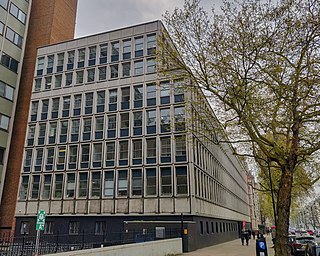
The Department of Computing (DoC) is the computer science department at Imperial College London. The department has around 50 academic staff and 900 students, with around 500 studying undergraduate courses, 180 PhD students, and 150 MSc students. The department is predominantly based in the Huxley Building, 180 Queen's Gate, which it shares with the Maths department, however also has space in the William Penney Laboratory and in the Aeronautics and Chemical Engineering Extension. The department ranks 7th in the Times Higher Education 2020 subject world rankings.
Jeremiah F. Hayes was a North American professor of electrical engineering. He worked with Andrew Viterbi for combining Erlang (unit) with Shannon–Hartley theorem, and published the first book on the topic of computer communications, he was honored as IEEE fellow in 1983 for this contribution. He also co-authored a communications textbook with Richard D. Gitlin. He received the Canadian Award for Telecommunications Research in 1996. Jeremiah Francis Hayes was born on July 8 in New York NY USA, 1934 and died on May 8, 2018 in Victoria BC, Canada.


