Related Research Articles

USS Intrepid (CV/CVA/CVS-11), also known as The Fighting "I", is one of 24 Essex-class aircraft carriers built during World War II for the United States Navy. She is the fourth US Navy ship to bear the name. Commissioned in August 1943, Intrepid participated in several campaigns in the Pacific Theater of Operations, including the Battle of Leyte Gulf.

USS Hancock (CV/CVA-19) was one of 24 Essex-class aircraft carriers built during World War II for the United States Navy. Hancock was the fourth US Navy ship to bear the namesake of Founding Father John Hancock, president of the Second Continental Congress and first governor of the Commonwealth of Massachusetts. Hancock was commissioned in April 1944 and served in several campaigns in the Pacific Theater of Operations, earning four battle stars. Decommissioned shortly after the end of the war, she was modernized and recommissioned in the early 1950s as an attack carrier (CVA). In her second career, she operated exclusively in the Pacific, playing a prominent role in the Vietnam War, for which she earned a Navy Unit Commendation. She was the first US Navy carrier to have steam catapults installed. She was decommissioned in early 1976 and sold for scrap later that year.

USS Miller (DD-535) was a World War II-era Fletcher-class destroyer in the service of the United States Navy, named after Medal of Honor recipient Acting Master's Mate James Miller.

A carrier air wing is an operational naval aviation organization composed of several aircraft squadrons and detachments of various types of fixed-wing and rotary-wing aircraft. Organized, equipped and trained to conduct modern US Navy carrier air operations while embarked aboard aircraft carriers, the various squadrons in an air wing have different but complementary missions, and provide most of the striking power and electronic warfare capabilities of a carrier battle group (CVBG). While the CVBG term is still used by other nations, the CVBG in US parlance is now known as a carrier strike group (CSG).
Carrier Air Wing Nine (CVW-9) is a United States Navy aircraft carrier air wing based at Naval Air Station Lemoore. The Air Wing is currently assigned to the aircraft carrier USS Abraham Lincoln (CVN-72). The Tail Code of aircraft assigned to CVW-9 is NG.
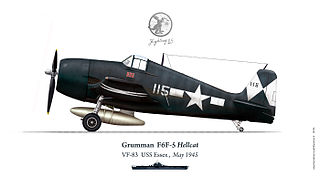
Fighter Squadron 83 or VF-83 was an aviation unit of the United States Navy. Originally established on 1 May 1944, it was disestablished on 24 September 1945. It was the first US Navy squadron to be designated as VF-83.

Carrier Air Wing Six (CVW-6) was a United States Navy aircraft carrier air wing whose operational history spans from the middle of World War II to the end of the Cold War. Established in 1943 as Carrier Air Group Seventeen (CVG-17), it would be re-designated several times during its establishment, including Carrier Air Group Six (CVG-6) as the second unit to be so designated. The first Carrier Air Group Six served for just over two years during World War II, but drew on the history of the Enterprise Air Group established in 1938 and active in the early battles of the Pacific War, being disestablished after the first year of the conflict. During its time in USS Enterprise (CV-6), it was the Navy's only carrier-based air group to carry out three complete tours of duty during World War II.

VA-106 was an Attack Squadron of the U.S. Navy. Originally established as Bomber-Fighter Squadron Seventeen (VBF-17) on 2 January 1945, it was redesignated Fighter Squadron Six B (VF-6B) on 15 November 1946, redesignated VF-62 on 28 July 1948, redesignated Attack Squadron 106 (VA-106) on 1 July 1955, it was disestablished on 7 November 1969. It was the second US Navy squadron to be designated VA-106.

VA-34, nicknamed the Blue Blasters, was an Attack Squadron of the U.S. Navy. The squadron was established as Fighter Squadron VF-20 on 15 October 1943, redesignated as VF-9A on 15 November 1946, as VF-91 on 12 August 1948, and as VF-34 on 15 February 1950. It was finally redesignated VA-34 on 1 July 1955. The squadron was disestablished on 1 June 1969. It was the second squadron to bear the VA-34 designation, the first one having been renamed VA-35 in 1950.

Attack Squadron 15 (VA-15), nicknamed the Valions, was an aviation unit of the United States Navy. It was established as Torpedo Squadron 4 (VT-4) on 10 January 1942, redesignated VA-2A on 15 November 1946, and finally redesignated VA-15 on 2 August 1948. The squadron was disestablished on 1 June 1969, after 27 years of service.

Carrier Air Wing Thirteen (CVW-13) was a carrier air wing of the United States Navy established for a short period at the end of the Cold War. There were three previous units which had been named Carrier Air Group Thirteen (CVG-13), dating as far back as 1942, though each of these units has a distinct lineage.

The Essex class is a retired class of aircraft carriers of the United States Navy. The 20th century's most numerous class of capital ship, the class consisted of 24 vessels, which came in "short-hull" and "long-hull" versions. Thirty-two ships were ordered, but as World War II wound down, six were canceled before construction, and two were canceled after construction had begun. Fourteen saw combat during World War II. None were lost to enemy action, though several sustained crippling damage due to kamikaze attacks. Essex-class carriers were the backbone of the U.S. Navy from mid-1943 and, with the three Midway-class carriers added just after the war, continued to be the heart of U.S. naval strength until supercarriers joined the fleet in the 1950s, 1960s and 1970s. Several of the carriers were rebuilt to handle heavier and faster aircraft of the early jet age, and some served until well after the Vietnam War. Of the 24 ships in the class, four of the carriers: Yorktown, Hornet, Lexington, and Intrepid, have been preserved as museum ships.
Fighter Squadron 71 or VF-71 was an aviation unit of the United States Navy. Originally established as VGS-18 on 15 October 1942, it was redesignated VC-18 on 1 March 1943, redesignated as VF-36 on 15 August 1943, redesignated as VF-18 on 5 March 1944, redesignated as VF-7A on 15 November 1946, redesignated as VF-71 on 28 July 1948 and disestablished on 31 March 1959.
Fighter Squadron 8 or VF-8 was an aviation unit of the U.S. Navy, originally established on 1 June 1943, it was disestablished on 23 November 1945. It was the second US Navy squadron to be designated VF-8. The first VF-8 had been established in September 1941 and was disestablished on 28 August 1942, serving aboard USS Hornet (CV-8).
The Enterprise Air Group was established on 1 July 1938, encompassing all squadrons embarked in USS Enterprise (CV-6). The group was divided into four squadrons, each with eighteen aircraft dedicated to a particular role. The squadrons were designated according to their role, and all were given the unit number six, derived from the hull number of the Enterprise. Bombing Six (VB-6) was equipped with Douglas SBD-2 Dauntless dive bombers, Fighting Six (VF-6) with Grumman F4F-3 Wildcat fighters, and Torpedo Six (VT-6) with Douglas TBD Devastator torpedo bombers. The fourth squadron, Scouting Six (VS-6) also had the SBD-2 Dauntless, but was more focused on the scout bomber role. This air group was embarked on board the Enterprise at the time of the attack on Pearl Harbor.
Carrier Air Group Seventeen (CVG-17) was a designation used by the United States Navy to identify two unrelated Carrier Air Groups; the first of which was established on 1 January 1943 as Carrier Air Group Seventeen and disestablished on 1 April 1992 as Carrier Air Wing Six; and the second of which was established as Carrier Air Group Eighty Two on 1 April 1944 and ultimately disestablished as Carrier Air Group Seventeen on 16 September 1968. Neither group shares a lineage with the current Carrier Air Wing Seventeen (CVW-17) as the first was the forerunner of CVW-6 and the second was disestablished eight years before CVW-17 was established.
References
- ↑ Grossnick, Roy A. United States Naval Aviation 1910-1920 Volume II Statistics. Naval History and Heritage Command.
- 1 2 "1943". USS Enterprise CV-6 Association. Retrieved 3 September 2008.
- 1 2 "History of USS Intrepid". USS Intrepid Association. Retrieved 5 September 2008.
- 1 2 "Hancock". Dictionary of American Naval Fighting Ships . Navy Department, Naval History and Heritage Command . Retrieved 1 September 2008.
- ↑ "Unit Citation Air Groups and Squadrons 1943–1972". USS Intrepid Association. Retrieved 5 September 2008.