
Castile, Castille or Castilla may refer to:
Castile, Castille or Castilla may refer to:

Castile or Castille is a territory of imprecise limits located in Spain. Its extension is often ascribed to the sum of the regions of Old Castile and New Castile, as they were formally defined in the 1833 territorial division of Spain. Those two regions cover the following modern autonomous communities: the eastern part of Castile and León, Castile-La Mancha, and Community of Madrid as well as Cantabria and La Rioja. However, it has been pointed out that in practice the modern limits of Castile are imprecise, and that this name has been used mainly as a reference for the image of Spain as a nation.

Castile and León is an autonomous community in northwestern Spain.

Ferdinand III, called the Saint, was King of Castile from 1217 and King of León from 1230 as well as King of Galicia from 1231. He was the son of Alfonso IX of León and Berenguela of Castile. Through his second marriage he was also Count of Aumale. Ferdinand III was one of the most successful kings of Castile, securing not only the permanent union of the crowns of Castile and León, but also masterminding the most expansive southward territorial expansion campaign yet in the Guadalquivir Valley, in which Islamic rule was in disarray in the wake of the decline of the Almohad presence in the Iberian Peninsula.

There are two names given in Spanish to the Spanish language: español ("Spanish") and castellano ("Castilian"). Spanish speakers from different countries or backgrounds can show a preference for one term or the other, or use them indiscriminately, but political issues or common usage might lead speakers to prefer one term over the other. This article identifies the differences between those terms, the countries or backgrounds that show a preference for one or the other, and the implications the choice of words might have for a native Spanish speaker.

The Kingdom of León was an independent kingdom situated in the northwest region of the Iberian Peninsula. It was founded in 910 when the Christian princes of Asturias along the northern coast of the peninsula shifted their capital from Oviedo to the city of León. The kings of León fought civil wars, wars against neighbouring kingdoms, and campaigns to repel invasions by both the Moors and the Vikings, all in order to protect their kingdom's changing fortunes.
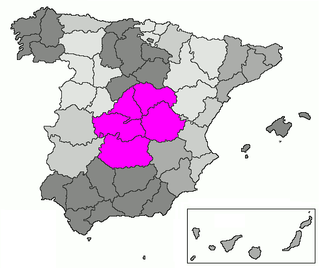
New Castile is a historic region of Spain. It roughly corresponds to the historic Moorish Taifa of Toledo, taken during the Reconquista of the peninsula by Christians and thus becoming the southern part of Castile. The extension of New Castile was formally defined after the 1833 territorial division of Spain as the sum of the following provinces: Ciudad Real, Cuenca, Guadalajara, Madrid and Toledo.
Castilian or Castillian may refer to:
Alfonso of León, Lord of Molina was an infante (prince) of León and Castile, the son of King Alfonso IX of León and his second wife Queen Berengaria of Castile. He was the brother of King Ferdinand III of Castile and León, and father of Queen Maria of Molina, wife of King Sancho IV. He became Lord of Molina and Mesa after his first marriage to Mafalda González de Lara, the heiress of those lands.

The Castilian Left is a leftist nationalist political movement active in the Spanish autonomous communities of Castile-La Mancha, Castile and Leon and Community of Madrid. It strives to advocate for the national recognition of Castile, and in some cases, its independence. Other current political parties include Tierra Comunera, Castilian Party, and Ahora Castilla.
In English, Castilian Spanish can mean the variety of Peninsular Spanish spoken in northern and central Spain, the standard form of Spanish, or Spanish from Spain in general. In Spanish, the term castellano (Castilian) can either refer to the Spanish language as a whole, or to the medieval Old Spanish, a predecessor to Early Modern Spanish.
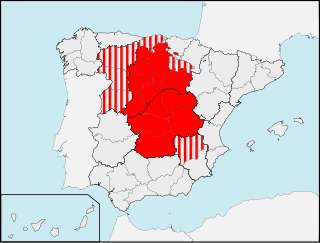
Castilians are those people who live in certain former areas of the historical Kingdom of Castile but the exact limits of this region are disputed. A broader definition is to consider as Castilians the population belonging to the Iberian peninsular territories, which were controlled by the Crown of Castile. This included a large part of the Iberian Peninsula.

The Region of León, Leonese region or Leonese Country is a historic territory defined by the 1833 Spanish administrative organisation. The Leonese region encompassed the provinces of Salamanca, Zamora, and León, now part of the modern Spanish autonomous community of Castile and León. As is the case with other historical regions, and continuing with centuries of history, the inhabitants of the Leonese region are still called Leonese. Even today, according with official autonomous government, the historical territorial adjective is used in addition with the modern annexed territory, the rest of Old Castile, being "Castilians and Leonese".
The Chronica latina regum Castellae, known in Spanish as the Crónica latina de los reyes de Castilla, both meaning "Latin Chronicle of the Kings of Castile", is a medieval Latin history of the rulers of Castile from the death of Count Fernán González in 970 to the reconquest of Córdoba by King Ferdinand III in 1236–39. It was probably composed by Juan de Soria, the Bishop of Osma and chancellor of Ferdinand III, between 1217 and 1239. The majority of the text deals with the reigns of Alfonso VIII (1158–1214) and Ferdinand III (1217–1252). It was designed with two purposes: for use at the royal court as a speculum principis and to defend the interests of Castile against those of the Kingdom of León.

The Royal Madrid Football Federation is the governing body of the sport of football in the Community of Madrid, Spain. Its headquarters are in the city of Madrid.
The Castilian Party, formerly the Party of Castile and León until 2011, is a Spanish political party resulting from the union of several Castilian nationalist and regionalist political parties from Castile and León, Madrid and Castile-La Mancha. The most relevant of the components is Tierra Comunera.

The flag of Castilla–La Mancha is one of the representative symbols of the Autonomous Community of Castilla–La Mancha, in Spain, defined by its Statute of Autonomy.

The coat of arms of the Castilla–La Mancha is described in the Spanish Law 1 of 30 June 1983, the Law of the coat of arms of Castilla-La Mancha Region and further regulated by Decree 132 of 5 July 1983, approving the official design of the coat of arms of Castilla-La Mancha and Decree 115 of 12 November 1985, supplementing Decree 132/1983.

The coat of arms of Castile was the heraldic emblem of its monarchs. Historian Michel Pastoureau says that the original purpose of heraldic emblems and seals was to facilitate the exercise of power and the identification of the ruler, due to what they offered for achieving these aims. These symbols were associated with the kingdom, and eventually also represented the intangible nature of the national sentiment or sense of belonging to a territory.

The list of Spanish municipal flags lists the flags of municipalities of Spain.
Events in the year 2022 in Spain.