Conservatism is a political and social philosophy promoting traditional social institutions in the context of culture and civilization. The central tenets of conservatism include tradition, human imperfection, hierarchy, authority, and property rights. Conservatives seek to preserve a range of institutions such as monarchy, religion, parliamentary government, and property rights, with the aim of emphasizing social stability and continuity. The more extreme elements—reactionaries—oppose modernism and seek a return to "the way things were".
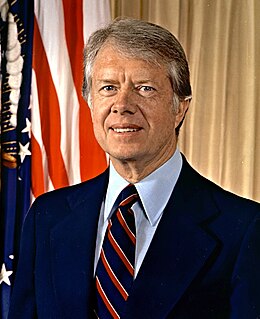
James Earl Carter Jr. is an American politician and philanthropist who served as the 39th president of the United States from 1977 to 1981. A Democrat, he previously served as a Georgia State senator from 1963 to 1967 and as the 76th governor of Georgia from 1971 to 1975. Carter has remained active in public life during his post-presidency, and in 2002 he was awarded the Nobel Peace Prize for his work in co-founding the Carter Center.
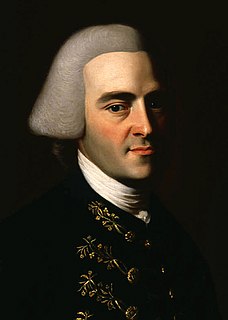
John Hancock was an American merchant, statesman, and prominent Patriot of the American Revolution. He served as president of the Second Continental Congress and was the first and third Governor of the Commonwealth of Massachusetts. He is remembered for his large and stylish signature on the United States Declaration of Independence, so much so that the term "John Hancock" has become a synonym in the United States for one's signature.
The term political correctness is used to describe language, policies, or measures that are intended to avoid offense or disadvantage to members of particular groups in society. Since the late 1980s, the term has come to refer to avoiding language or behavior that can be seen as excluding, marginalizing, or insulting groups of people considered disadvantaged or discriminated against, especially groups defined by sex or race. In public discourse and the media, it is generally used as a pejorative, implying that these policies are excessive or unwarranted.

During the Cold War, the term Third World referred to the developing countries of Asia, Africa, and Latin America, the nations not aligned with either the First World or the Second World. This usage has become relatively rare due to the ending of the Cold War.

The 1980s was a decade of the Gregorian calendar that began on January 1, 1980, and ended on December 31, 1989.
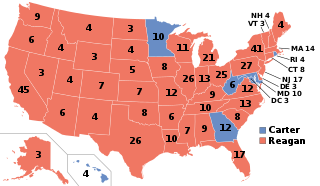
The 1980 United States presidential election was the 49th quadrennial presidential election. It was held on November 4, 1980. Republican nominee Ronald Reagan defeated incumbent Democrat Jimmy Carter. Due to the rise of conservativism following Reagan's victory, some historians consider the election to be a realigning election that marked the start of the "Reagan Era".

Political parties in the United States are mostly dominated by a two-party system consisting of the Democratic Party and the Republican Party. The United States Constitution has always been silent on the issue of political parties, since at the time it was signed in 1787 there were no parties in the nation.
The term identity politics in common usage refers to a tendency of people sharing a particular racial, religious, ethnic, social, or cultural identity to form exclusive political alliances, instead of engaging in traditional broad-based party politics, or promote their particular interests without regard for interests of a larger political group. In academic usage, the term has been used to refer to a wide range of political activities and theoretical analysis rooted in experiences of injustice shared by different social groups. In this usage, identity politics typically aim to reclaim greater self-determination and political freedom for marginalized groups through understanding their distinctive nature and challenging externally imposed characterizations, instead of organizing solely around belief systems or party affiliations. Identity is used as a tool to articulate political claims, promote political ideologies, and guide political action with the aim of asserting group distinctiveness and gaining power and recognition in the context of perceived inequality or injustice.
Third party is a term used in the United States for American political parties other than the Republican and Democratic parties.

The Deep South is a cultural and geographic subregion in the Southern United States. Historically, it was differentiated as those states most dependent on plantations and slave societies during the pre-Civil War period. The Deep South is commonly referred to as the Cotton States, given that the production of cotton was a primary cash crop.
Popular sovereignty, or sovereignty of the peoples' rule, is the principle that the authority of a state and its government are created and sustained by the consent of its people, through their elected representatives, who is the source of all political power. It is closely associated with social contract philosophers such as Thomas Hobbes, John Locke and Jean-Jacques Rousseau. Popular sovereignty expresses a concept and does not necessarily reflect or describe a political reality. The people have the final say in government decisions. Benjamin Franklin expressed the concept when he wrote, "In free governments, the rulers are the servants and the people their superiors and sovereigns".
Centre-right politics or center-right politics, also referred to as moderate-right politics, are politics that lean to the right of the left–right political spectrum, but are closer to the centre than other right-wing politics. From the 1780s to the 1880s, there was a shift in the Western world of social class structure and the economy, moving away from the nobility and mercantilism, as well as moving towards the bourgeoisie and capitalism. This general economic shift towards capitalism affected centre-right movements such as the British Conservative Party, that responded by becoming supportive of capitalism.
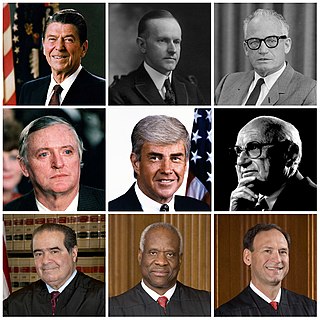
American conservatism is a broad system of political beliefs in the United States that is characterized by respect for American traditions, republicanism, support for Judeo-Christian values, moral universalism, business, anti-communism, individualism, advocacy of American exceptionalism, and a defense of Western culture from the perceived threats posed by socialism, authoritarianism, and moral relativism. Liberty is a core value, as is with all major American parties. American conservatives consider individual liberty—within the bounds of American values—as the fundamental trait of democracy; this perspective contrasts with that of modern American liberals, who generally place a greater value on equality and social justice and emphasize the need for state intervention to achieve these goals. American conservatives believe in limiting government in size and scope, and in a balance between national government and states' rights. Apart from some libertarians, they tend to favor strong action in areas they believe to be within government's legitimate scope, particularly national defense and law enforcement. Social conservatives oppose abortion and favor restricting lesbian, gay, bisexual, and transgender LGBT rights, while privileging traditional marriage and allowing voluntary school prayer.

The Democratic Party is one of the two major contemporary political parties in the United States, along with the Republican Party. Tracing its heritage back to Thomas Jefferson and James Madison's Democratic-Republican Party, the modern-day Democratic Party was founded around 1828 by supporters of Andrew Jackson, making it the world's oldest active political party.

Samuel Adams was an American statesman, political philosopher, and one of the Founding Fathers of the United States. He was a politician in colonial Massachusetts, a leader of the movement that became the American Revolution, and one of the architects of the principles of American republicanism that shaped the political culture of the United States. He was a second cousin to his fellow Founding Father, President John Adams.
The 1980 United States elections was held on November 4. These included the 49th presidential election, Senate elections, and House of Representatives elections. Other elections were held as well.
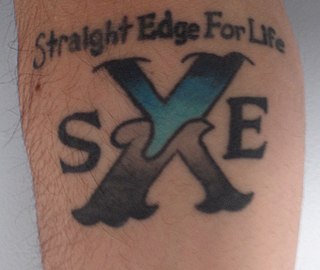
Straight edge is a subculture originated from hardcore punk whose adherents refrain from using alcohol, tobacco and other recreational drugs, in reaction to the excesses of punk subculture. For some, this extends to refraining from engaging in promiscuous sex, following a vegetarian or vegan diet or not using caffeine or prescription drugs. The term straight edge was adopted from the 1981 song "Straight Edge" by the hardcore punk band Minor Threat.
Progressivism is the support for or advocacy of improvement of society by reform. As a philosophy, it is based on the idea of progress, which asserts that advancements in science, technology, economic development and social organization are vital to the improvement of the human condition.
The Jamaican political conflict is a long standing feud between right-wing and left-wing elements in the country, often exploding into violence. The Jamaican Labor Party and the People's National Party have fought for control of the island for years and the rivalry has encouraged urban warfare in Kingston. Each side believes the other to be controlled by foreign elements, the JLP is said to be backed by the American Central Intelligence Agency and the PNP is said to been backed by the Soviet Union and Fidel Castro.