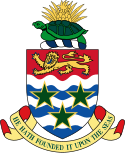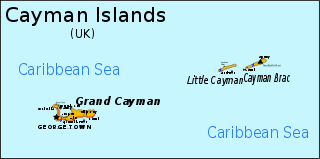
The Cayman Islands are a British dependency and island country. It is a three-island archipelago in the Caribbean Sea, consisting of Grand Cayman, Cayman Brac, and Little Cayman. Georgetown, the capital of the Cayman Islands is 438 km (272 mi) south of Havana, Cuba, and 504 km (313 mi) northwest of Kingston, Jamaica, northeast of Costa Rica, north of Panama and are between Cuba and Central America. Georgetown’s geographic coordinates are 19.300° north, 81.383° west.
This article is about the demographic features of the population of the Cayman Islands, including population density, ethnicity, religious affiliations and other aspects of the population.

The politics of the Cayman Islands takes place within a framework of parliamentary democracy, within the confines of the Government of the Cayman Islands.
The economy of the Cayman Islands, a British overseas territory located in the western Caribbean Sea, is mainly fueled by the tourism sector and by the financial services sector, together representing 50–60 percent of the country's gross domestic product (GDP). The Cayman Islands Investment Bureau, a government agency, has been established with the mandate of promoting investment and economic development in the territory.
Government of the Cayman Islands takes place in a framework of a parliamentary representative democratic overseas territory, whereby the Premier is the head of government, and of a two-party system. Executive power is exercised by the government. Legislative power is vested in both the government and the Legislative Assembly. The Judiciary is independent of the executive and the legislature.

Grand Cayman is the largest of the three Cayman Islands and the location of the territory's capital, George Town. In relation to the other two Cayman Islands, it is approximately 75 miles (121 km) southwest of Little Cayman and 90 miles (145 km) southwest of Cayman Brac.
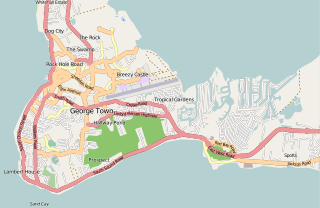
George Town is a city situated on Grand Cayman island of the Cayman Islands. It serves as the capital of the Cayman Islands, in the British West Indies. As of 2007, the city had a population of 28,836, making it the second largest city of all the British Overseas Territories.
The Premier of the Cayman Islands is the political leader and head of government. The post of Premier in the Cayman Islands is the equivalent to Chief Minister or Prime Minister in other British Overseas Territories. It is the highest political level that can be attained within the British overseas territory. Prior to 2009, the position was known as Leader of Government Business.
The Cayman Islands Dollar is the currency of the Cayman Islands. It is abbreviated with the dollar sign $, or alternatively CI$ to distinguish it from other dollar-denominated currencies. It is subdivided into 100 cents. It is the 9th-highest-valued currency unit in the world, as of 5 November 2018.
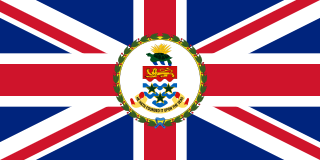
The Governor of the Cayman Islands is the representative of the British monarch in the United Kingdom's overseas territory of the Cayman Islands. The Governor is appointed by the monarch on the advice of the British government. The role of the Governor is to act as the de facto head of state, and he or she is responsible for appointing the Premier, who is the leader of the party with a majority of seats in the Legislature.

The Cayman Islands national cricket team is the team that represents the British overseas territory of the Cayman Islands in international cricket. The team is organised by the Cayman Islands Cricket Association, which has been an associate member of the International Cricket Council (ICC) since 2002, having previously been an affiliate member since 1997.

The Legislative Assembly of the Cayman Islands is the unicameral legislature of the British Overseas Territory of the Cayman Islands. It is composed of 21 members; 19 elected members for a four-year term and two members ex officio.

The Royal Cayman Islands Police Service is the standing police force of the British overseas territory of the Cayman Islands. The police force was formed in 1907 and currently (2009) stands at 343 enlisted officers, with 64 civilians.
The Cayman Islands national rugby union team represents the Cayman Islands in the sport of rugby union. They have thus far not qualified for a Rugby World Cup, but have participated in qualifying tournaments. The sport in the Cayman Islands is governed by the Cayman Rugby Union. The Cayman Islands have players throughout the squad playing through the UK, Ireland, South Africa, Canada and the USA.

The following outline is provided as an overview of and topical guide to the Cayman Islands:

Rugby union in the Cayman Islands is a growing sport. The Cayman Islands national rugby union team is ranked 62nd in the world, with 2,256 registered players.
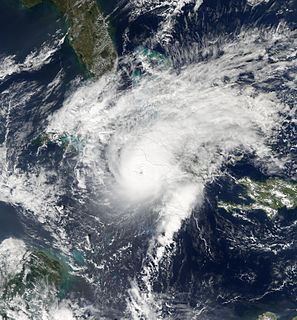
Hurricane Paloma was the third-strongest November Atlantic hurricane on record. It was the sixteenth tropical storm, eighth hurricane and fifth major hurricane of the 2008 Atlantic hurricane season. A late season hurricane, it set several records for its intensity and formation. Paloma was the third most powerful November hurricane on record in the Atlantic Basin, behind only a 1932 hurricane and 1999's Lenny. It also marked the first time that at least one major hurricane formed in every month of the hurricane season from July to November, with only June not having a major hurricane this season.

Lesbian, gay, bisexual, and transgender (LGBT) persons in the Cayman Islands may face legal challenges not experienced by non-LGBT residents. Both male and female same-sex sexual activity are legal in the Cayman Islands, but same-sex couples and households headed by same-sex couples are not eligible for the same legal protections available to opposite-sex married couples. The Cayman Islands is a British Overseas Territory. Although the local Legislature and courts are independent from the United Kingdom of Great Britain and Northern Ireland, Her Majesty's Government deals with all international relations on behalf of the Territory. The Foreign and Commonwealth Office oversees the governance of the Cayman Islands.
Cayman Islands–India relations refers to the international relations that exist between the Cayman Islands and India. The foreign relations of the Cayman Islands are handled by the British Foreign Office. Therefore, India's foreign policy has focused on economic relations with the Cayman Islands, as well providing consular services to Indians and Caymanians. The High Commission of India in Kingston, Jamaica is concurrently accredited to the Cayman Islands.