Related Research Articles

Stephen Byram Furber is a British computer scientist, mathematician and hardware engineer, and Emeritus ICL Professor of Computer Engineering in the Department of Computer Science at the University of Manchester, UK. After completing his education at the University of Cambridge, he spent the 1980s at Acorn Computers, where he was a principal designer of the BBC Micro and the ARM 32-bit RISC microprocessor. As of 2023, over 250 billion ARM chips have been manufactured, powering much of the world's mobile computing and embedded systems, everything from sensors to smartphones to servers.

The Electric VLSI Design System is an EDA tool written in the early 1980s by Steven M. Rubin. Electric is used to construct logic wire schematics and to perform analysis of integrated circuit layout. It can also handle hardware description languages such as VHDL and Verilog. The system has many analysis and synthesis tools, including design rule checking, simulation, routing, Layout vs. Schematic, logical effort, and more.
Giovanni De Micheli is a research scientist in electronics and computer science. He is credited for the invention of the Network on a Chip design automation paradigm and for the creation of algorithms and design tools for Electronic Design Automation (EDA). He is Professor and Director of the Integrated Systems laboratory at École Polytechnique Fédérale de Lausanne (EPFL), Switzerland. Previously, he was Professor of Electrical Engineering at Stanford University. He was Director of the Electrical Engineering Institute at EPFL from 2008 to 2019 and program leader of the Swiss Federal Nano-Tera.ch program. He holds a Nuclear Engineer degree, a M.S. and a Ph.D. degree in Electrical Engineering and Computer Science under Alberto Sangiovanni-Vincentelli.

Mark A. Horowitz is an American electrical engineer, computer scientist, inventor, and entrepreneur who is the Yahoo! Founders Professor in the School of Engineering and the Fortinet Founders Chair of the Department of Electrical Engineering at Stanford University. He holds a joint appointment in the Electrical Engineering and Computer Science departments and previously served as the Chair of the Electrical Engineering department from 2008 to 2012. He is a co-founder, the former chairman, and the former chief scientist of Rambus Inc.. Horowitz has authored over 700 published conference and research papers and is among the most highly-cited computer architects of all time. He is a prolific inventor and holds 374 patents as of 2023.
The Architecture Design and Assessment System (ADAS) was a set of software programs offered by the Research Triangle Institute from the mid-1980s until the early 1990s.
High-level synthesis (HLS), sometimes referred to as C synthesis, electronic system-level (ESL) synthesis, algorithmic synthesis, or behavioral synthesis, is an automated design process that takes an abstract behavioral specification of a digital system and finds a register-transfer level structure that realizes the given behavior.
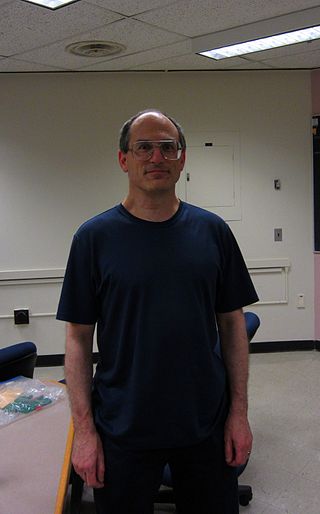
Jacob K. White is the Cecil H. Green Professor of Electrical Engineering and Computer Science at the Massachusetts Institute of Technology. He researches fast numerical algorithms for simulation, particularly the simulation of circuits. His work on the FASTCAP program for three-dimensional capacitance calculation and FASTHENRY, a program for three-dimensional inductance calculations, is highly cited. He has also done extensive work on steady-state simulation of analog and microwave circuits. White was a significant early contributor to the development of Spectre and SpectreRF.
John Patrick Hayes is an Irish-American computer scientist and electrical engineer, the Claude E. Shannon Chair of Engineering Science at the University of Michigan. He supervised over 35 doctoral students, coauthored seven books and over 340 peer-reviewed publications. His Erdös number is 2.
Stephen "Steve" Trimberger is an American computer scientist, electrical engineer, philanthropist, and prolific inventor with 250 US utility patents as of August 26, 2021. He is a DARPA program manager of the microsystems technology office.
Eby G. Friedman is an electrical engineer, and Distinguished Professor of Electrical and Computer Engineering at the University of Rochester. Friedman is also a visiting professor at the Technion - Israel Institute of Technology. He is a Senior Fulbright Fellow and a Fellow of the IEEE.
Kenneth L Shepard is an American electrical engineer, nanoscientist, entrepreneur, and the Lau Family Professor of Electrical Engineering and Biomedical Engineering at the Columbia School of Engineering and Applied Science (Columbia).

David Atienza Alonso is a Spanish/Swiss scientist in the disciplines of computer and electrical engineering. His research focuses on hardware‐software co‐design and management for energy‐efficient and thermal-aware computing systems, always starting from a system‐level perspective to the actual electronic design. He is a full professor of electrical and computer engineering at the Swiss Federal Institute of Technology in Lausanne (EPFL) and the head of the Embedded Systems Laboratory (ESL). He is an IEEE Fellow (2016), and an ACM Fellow (2022).

Nader Bagherzadeh is a professor of computer engineering in the Department of Electrical Engineering and Computer Science at the University of California, Irvine, where he served as a chair from 1998 to 2003. Bagherzadeh has been involved in research and development in the areas of: Computer Architecture, Reconfigurable Computing, VLSI Chip Design, Network-on-Chip, 3D chips, Sensor Networks, Computer Graphics, Memory and Embedded Systems. Bagherzadeh was named Fellow of the Institute of Electrical and Electronics Engineers (IEEE) in 2014 for contributions to the design and analysis of coarse-grained reconfigurable processor architectures. Bagherzadeh has published more than 400 articles in peer-reviewed journals and conferences. He was with AT&T Bell Labs from 1980 to 1984.

Keren Bergman is an American electrical engineer who is the Charles Batchelor Professor at Columbia University. She also serves as the director of the Lightwave Research Laboratory, a silicon photonics research group at Columbia University. Her research focuses on nano-photonics and particularly optical interconnects for low power, high bandwidth computing applications.
Jack Justin Stiffler (1934–2019) was an American electrical engineer, computer scientist and entrepreneur, a Fellow of the Institute of Electrical and Electronics Engineers who made key contributions in the areas of communications and fault-tolerant computing.
Timothy M. Pinkston is an American computer engineer, researcher, educator and administrator whose work is focused in the area of computer architecture. He holds the George Pfleger Chair in Electrical and Computer Engineering and is a Professor of Electrical and Computer Engineering at University of Southern California (USC). He also serves in an administrative role as Vice Dean for Faculty Affairs at the USC Viterbi School of Engineering.
Lawrence Pileggi is the Coraluppi Head and Tanoto Professor of Electrical and Computer Engineering at Carnegie Mellon University. He is a specialist in the automation of integrated circuits, and developing software tools for the optimization of power grids. Pileggi's research has been cited thousands of times in engineering papers.
Prathima Agrawal is an Indian-American computer engineer known for her contributions to wireless networking, VLSI, and computer-aided design. She is a professor emerita and the former Samuel Ginn Distinguished Professor of Electrical and Computer Engineering at Auburn University.
Wai-Kai Chen is a Chinese-American professor emeritus of electrical engineering and computer science.

Igor Leonidovich Markov is an American professor, computer scientist and engineer. Markov is known for mathematical and algorithmic results in quantum computation, work on limits of computation, research on algorithms for optimizing integrated circuits and on electronic design automation, as well as artificial intelligence. Additionally, Markov is a California non-profit executive responsible for aid to Ukraine worth tens of millions dollars.
References
- 1 2 Glasser, Lance A.; Zukowski, Charles A. (June 1988). "Continuous Models for Communication Density Constraints on Multiprocessor Performance". IEEE Transactions on Computers. 37 (6): 652–656. doi:10.1109/12.2204.
- 1 2 3 "Charles Zukowski: Plugging the Leak in Circuit Efficiency". Excellentia. Columbia University. Retrieved 18 March 2015.
- ↑ "Charles Zukowski". Barton Library Archives. Retrieved 18 March 2015.
- 1 2 Gristede, George; Ruehli, Albert; Zukowski, Charles (July 1998). "Convergence Properties of Waveform Relaxation Circuit Simulation Methods". IEEE Transactions on Circuits and Systems. 45 (7): 726–738. doi:10.1109/81.703839.
- 1 2 "Charles Zukowski Faculty Profile". Columbia University Department of Electrical Engineering. Retrieved 18 March 2015.
- ↑ "Time-division-multiplexed data transmission system". United States Patent Office. Retrieved 18 March 2015.