
Eastern Christianity comprises Christian traditions and church families that originally developed during classical and late antiquity in the Eastern Mediterranean region or locations further east, south or north. The term does not describe a single communion or religious denomination. Eastern Christianity is a category distinguished from Western Christianity, which is composed of those Christian traditions and churches that originally developed further west.
Full communion is a communion or relationship of full agreement among different Christian denominations or Christian individuals that share certain essential principles of Christian theology. Views vary among denominations on exactly what constitutes full communion, but typically when two or more denominations are in full communion it enables services and celebrations, such as the Eucharist, to be shared among congregants or clergy of any of them with the full approval of each.
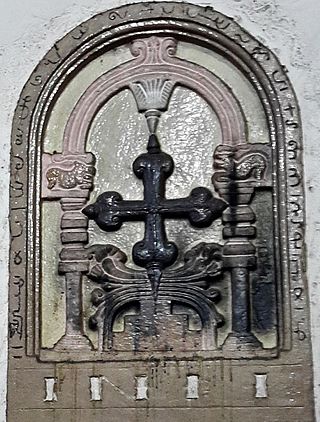
The Saint Thomas Christians, also called Syrian Christians of India, Marthoma Suriyani Nasrani, Malankara Nasrani, or Nasrani Mappila, are an ethno-religious community of Indian Christians in the state of Kerala, who, for the most part, employ the Eastern and Western liturgical rites of Syriac Christianity. They trace their origins to the evangelistic activity of Thomas the Apostle in the 1st century. The Saint Thomas Christians had been historically a part of the hierarchy of the Church of the East but are now divided into several different Eastern Catholic, Oriental Orthodox, Protestant, and independent bodies, each with their own liturgies and traditions. They are Malayalis and their mother tongue is Malayalam. Nasrani or Nazarene is a Syriac term for Christians, who were among the first converts to Christianity in the Near East.

The Syro-Malankara Catholic Church, also known as the Malankara Syrian Catholic Church, is an Eastern Catholic sui iuris particular church in full communion with the worldwide Catholic Church possessing self-governance under the Code of Canons of the Eastern Churches. It is one of the major archiepiscopal churches of the Catholic Church. It is headed by Major Archbishop Baselios Cardinal Cleemis Catholicos of the Major Archdiocese of Trivandrum based in Kerala, India. With more than 1096 parishes, its one of India's biggest church evangelical establishments.

The Syro-Malabar Church, also known as the Syro-Malabar Catholic Church, is an Eastern Catholic church based in Kerala, India. It is a sui iuris (autonomous) particular church in full communion with the Holy See and the worldwide Catholic Church, with self-governance under the Code of Canons of the Eastern Churches (CCEO). The major archbishop presides over the entire church. The incumbent Major Archbishop is Raphael Thattil, serving since January 2024. It is the largest Syriac Christian church and the largest Eastern Catholic church. Syro-Malabar is a prefix reflecting the church's use of the East Syriac liturgy and origins in Malabar. The name has been in usage in official Vatican documents since the nineteenth century.
A catholicos is the head of certain churches in some Eastern Christian traditions. The title implies autocephaly and, in some cases, it is the title of the head of an autonomous church. The word comes from ancient Greek καθολικός, derived from καθ' ὅλου from κατά and ὅλος, meaning "concerning the whole, universal, general"; it originally designated a financial or civil office in the Roman Empire.

The Malankara Mar Thoma Syrian Church, often shortened to Mar Thoma Church, and known also as the Reformed Syrian Church and the Mar Thoma Syrian Church of Malabar, is an autonomous Oriental Protestant Christian church based in Kerala, India. While continuing many of the Syriac high church practices, the church is Protestant in its theology and doctrines. It employs a reformed variant of the West Syriac Rite Divine Liturgy of Saint James, translated to Malayalam.
Syriac Christianity is a branch of Eastern Christianity of which formative theological writings and traditional liturgies are expressed in the Classical Syriac language, a variation of the old Aramaic language. In a wider sense, the term can also refer to Aramaic Christianity in general, thus encompassing all Christian traditions that are based on liturgical uses of the Aramaic language and its variations, both historical and modern.

The Malabar Independent Syrian Church (MISC), also known as the Thozhiyur Church, is a Christian church centred in Kerala, India. It is one of the churches of the Saint Thomas Christian community, which traces its origins to the evangelical activity of Thomas the Apostle in the 1st century.
The West Syriac Rite, also called the Syro-Antiochian Rite and the West Syrian Rite, is an Eastern Christian liturgical rite that employs the Divine Liturgy of Saint James in the West Syriac dialect. It is practised in the Maronite Church, the Syriac Orthodox Church, the Syriac Catholic Church and various Malankara Churches of India. It is one of two main liturgical rites of Syriac Christianity, the other being the East Syriac Rite. It originated in the ancient Patriarchate of Antioch. It has more anaphoras than any other rite.
The term Eastern Protestant Christianity encompasses a range of heterogeneous Protestant Christian denominations that developed outside of the Western world, from the latter half of the nineteenth century, and retain certain elements of Eastern Christianity. Some of these denominations came into existence when active Protestant churches adopted reformational variants of Eastern and Oriental Orthodox liturgy and worship, while others originated from Orthodox groups who were inspired by the teachings of Western Protestant missionaries and adopted Protestant beliefs and practices.
The Malankara Church, also known as Puthenkur, is the historic unified body of West Syriac Saint Thomas Christian denominations which claim ultimate origins from the missions of Thomas the Apostle. This community, under the leadership of Thoma I, opposed the Padroado Jesuits as well as the Propaganda Carmelites of the Latin Church, following the historical Coonan Cross Oath of 1653. The Malankara Church's divisions and branchings have resulted in present-day Churches that include the Jacobite Syrian Christian Church, the Malankara Orthodox Syrian Church, the Malankara Mar Thoma Syrian Church, the Malabar Independent Syrian Church, the Syro-Malankara Catholic Church, the Saint Thomas Anglicans of the Church of South India and the St. Thomas Evangelical Church of India.
Christianity is the third-largest practiced religion in Kerala, accounting for 18% of the population according to the 2001 Indian census. According to traditional accounts, Thomas the Apostle sailed to the Malabar region in 52 AD and introduced Christianity to the area. Although a minority, the Christian population of Kerala is proportionally much larger than that of India as a whole. A significant portion of the Indian Christian population resides in the state.

The Oriental Orthodox Churches are Eastern Christian churches adhering to Miaphysite Christology, with approximately 50 million members worldwide. The Oriental Orthodox Churches adhere to the Nicene Christian tradition. Oriental Orthodoxy is one of the oldest branches in Christianity.
The Saint Thomas Christian denominations are Christian denominations from Kerala, India, which traditionally trace their ultimate origins to the evangelistic activity of Thomas the Apostle in the 1st century. They are also known as "Nasranis" as well. The Syriac term "Nasrani" is still used by St. Thomas Christians in Kerala. It is part of the Eastern Christianity institution.

The Holy Qurobo or Holy Qurbono refers to the Eucharist as celebrated in Syro-Antiochene Rite and the liturgical books containing rubrics for its celebration. West Syriac Rite includes various descendants of the Oriental Orthodox and Eastern Catholic churches. It consists of two distinct liturgical traditions: the Maronite Rite, and the Jacobite Rite. The major Anaphora of both the traditions is the Divine Liturgy of Saint James in Syriac language. The Churches are primarily based in the Middle East, Africa, and India.
