Related Research Articles

Alejandro González Iñárritu is a Mexican film director, producer, and screenwriter. He is known for making films about the human condition, and his projects have garnered critical acclaim and numerous accolades. His most notable films include Amores perros (2000), 21 Grams (2003), Babel (2006), Biutiful (2010), Birdman (2014), and The Revenant (2015).

La Cucaracha is a 1934 American short musical film directed by Lloyd Corrigan. The film was designed by Robert Edmond Jones, who was hired by Pioneer Pictures to design the film in a way to show the new full-color Technicolor Process No. 4 at its best. Process No. 4 had been used since 1932, mainly in Walt Disney cartoons. Jock Whitney and his cousin C. V. Whitney, the owners of Pioneer, were also major investors in Technicolor. La Cucaracha was made like a short feature and cost about $65,000. The usual short film at that time cost little more than $15,000 to film.
Survival City is a 1955 American short documentary film directed by Anthony Muto. In 1956, at the 28th Academy Awards, it won an Oscar for Best Short Subject (One-Reel).
The Wetback Hound is a 1957 American live-action short film produced Walt Disney Productions. It was produced and co-directed by Larry Lansburgh, and it accompanied the theatrical release of the Disney feature Johnny Tremain. In 1958, the film won the Academy Award for Best Live Action Short Film at the 30th Academy Awards.
Casals Conducts: 1964 is a 1964 American short film directed by Larry Sturhahn. It is a documentary about the cellist and conductor Pablo Casals. It won an Oscar at the 37th Academy Awards in 1965 for Best Short Subject. The Academy Film Archive preserved Casals Conducts: 1964 in 2013.
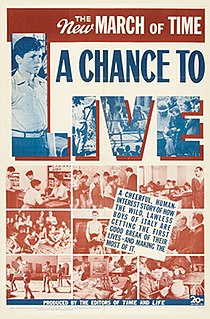
A Chance to Live is a 1949 American short documentary film directed by James L. Shute, produced by Richard de Rochemont for Time Inc. and distributed by Twentieth Century-Fox. It is part of The March of Time series and portrays Monsignor John Patrick Carroll-Abbing building and running a Boys' Home in Italy.
The Redwoods is a 1967 American short documentary film produced by Trevor Greenwood and Mark Jonathan Harris. It was produced for the Sierra Club as part of their campaign for a national park to protect the redwood forest. In 1968, it won an Oscar at the 40th Academy Awards for Documentary Short Subject.
Don't is a 1974 short American documentary film following the life cycle of the monarch butterfly, directed by Robin Lehman. It won an Oscar at the 47th Academy Awards in 1975 for Best Documentary Short Subject.
The Flight of the Gossamer Condor is a 1978 American short documentary film directed by Ben Shedd, about the development of the Gossamer Condor, the first human-powered aircraft. It won an Oscars at the 51st Academy Awards in 1979 for Documentary Short Subject. The Academy Film Archive preserved The Flight of the Gossamer Condor in 2007.
Mister Mugg is a 1933 short American pre-Code comedy film directed by James W. Horne. It was nominated for an Academy Award at the 6th Academy Awards in 1933 for Best Short Subject (Comedy). The Academy Film Archive preserved Mister Mugg in 2012.
What, No Men! is a 1934 American short comedy film directed by Ralph Staub and starring El Brendel, Wini Shaw, and Phil Regan. It was filmed in Technicolor. In 1934, it was nominated for an Academy Award for Best Short Subject (Comedy) at the 7th Academy Awards.

Strikes and Spares is a 1934 American short sports film directed by Felix E. Feist and starring Pete Smith and Andy Varipapa. In 1934, it was nominated for an Academy Award for Best Short Subject (Novelty) at the 7th Academy Awards.
Oh, My Nerves is a 1935 American short comedy film directed by Del Lord. It was nominated for an Academy Award at the 8th Academy Awards, held in March 1936, for Best Short Subject (Comedy). The Academy Film Archive preserved Oh, My Nerves in 2012.

Audioscopiks is a 1935 American short documentary film directed by Jacob F. Leventhal and John A. Norling. The main point of the short was to show off 3-D film technology. The film was nominated for an Academy Award at the 8th Academy Awards in 1935 for Best Short Subject (Novelty).
Moscow Moods is a 1936 American short film directed by Fred Waller. It was nominated for an Academy Award at the 9th Academy Awards in 1936 for Best Short Subject (One-Reel).
Dummy Ache is a 1936 American short comedy film directed by Leslie Goodwins. It was nominated for an Academy Award at the 9th Academy Awards in 1936 for Best Short Subject (Two-Reel). The Academy Film Archive preserved Dummy Ache in 2013.
The Man Without a Country is a 1937 American short drama film directed by Crane Wilbur in Technicolor. It was nominated for an Academy Award at the 10th Academy Awards in 1937 for Best Short Subject (Color). It is a remake of the 1917 film of the same name, based on the story by Edward Everett Hale. Actor Holmes Herbert appeared in both versions. A 1925 Fox film based on the story and directed by Rowland V. Lee is now considered to be a lost film.
Should Wives Work? is a 1937 American short comedy film directed by Leslie Goodwins. In 1937, at the 10th Academy Awards, it was nominated for an Academy Award for Best Short Subject (Two-Reel).
A City Decides is a 1956 American short documentary film directed by Charles Guggenheim about the racial integration of St. Louis Public Schools. It was nominated for an Academy Award for Best Documentary Short.
References
- ↑ THOMAS M. PRYOR. FULFILLING A PROMISE; Film Producers Open Their Vaults to Promote Education by Pictures. New York Times July 9, 1939, Sunday p 113
- ↑ "The 7th Academy Awards (1935) Nominees and Winners". oscars.org. Archived from the original on July 6, 2011. Retrieved August 7, 2011.CS1 maint: discouraged parameter (link)
- ↑ "New York Times: City of Wax". Movies & TV Dept. The New York Times . Baseline & All Movie Guide. 2011. Archived from the original on May 20, 2011. Retrieved May 12, 2008.CS1 maint: discouraged parameter (link)
- ↑ "Preserved Projects". Academy Film Archive.

