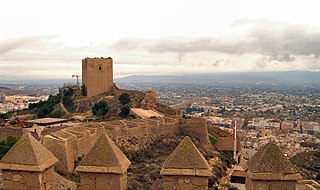
Lorca is a municipality and city in the autonomous community of the Region of Murcia in south-eastern Spain, 58 kilometres (36 mi) southwest of the city of Murcia. The municipality had a population of 95,515 in 2020, up from the 2001 census total of 77,477. Lorca is the municipality with the second largest surface area in Spain, 1,675.21 km2 (646.80 sq mi), after Cáceres. The city is home to Lorca Castle and the Collegiate church dedicated to St. Patrick.

Alta Velocidad Española (AVE) is a high-speed rail service operated by Renfe, the Spanish State railway company.
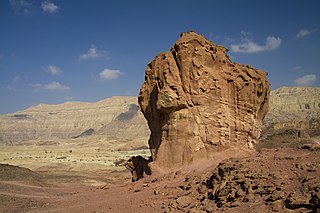
A mushroom rock, also called rock pedestal, or a pedestal rock, is a naturally occurring rock whose shape, as its name implies, resembles a mushroom. The rocks are deformed in a number of different ways: by erosion and weathering, glacial action, or from a sudden disturbance. Mushroom rocks are related to, but different from, yardang.

Club de Fútbol Atlético Ciudad was a Spanish football club based in Murcia, in the autonomous community of Murcia. Founded in 2007, it played its last season in Segunda División B, holding home matches at Estadio Juan de la Cierva, with a 1,600-seat capacity. The club was refounded in 2010 as CAP Ciudad de Murcia.

Mazarrón is a municipality in the autonomous community and province of Murcia, southeastern Spain. The municipality has an area of 318.7 square kilometres (123.1 sq mi), and a population of 31,562 inhabitants in 2019. A military fort which was built between 1930 and 1936 during the reign of Alfonso XIII of Spain and the Second Spanish Republic exists as a tourist attraction on the old road between Mazarrón and Cartagena, and although it is accessible from the Bay of Mazarrón it is not in the municipality itself.

La Condomina is a multi-use stadium in Murcia, Spain. The stadium holds 6,500 spectators and it is currently used mostly for football matches and music concerts.

The University of Murcia is the primary institute of higher education in Murcia, Spain. With a student population of approximately 38,000, it is the largest university in the Región de Murcia. Founded in 1272 AD, the University of Murcia is the third oldest university in Spain, following only the University of Salamanca and the University of Valladolid, and the thirteenth in the world. The University of Murcia was established by the King Alfonso X of Castile under the Crown of Castile.

The Ciudad Encantada is a geological site near the city of Cuenca, in the autonomous community of Castilla–La Mancha, Spain, in which the erosive forces of weather and the waters of the nearby Júcar river have formed rocks into distinctive and memorable shapes.

The Alcarria is a natural region in Castile (Spain). It is located mainly in Guadalajara Province but also overlaps those of Cuenca and Madrid. Its principal attractions are its fauna and flora and it is noted for its honey, olives, and a special breed of lamb.

Granada 74 Club de Fútbol, S.A.D., commonly known as Granada 74, was a Spanish football team based in Granada, in the autonomous community of Andalusia. It has not registered in any competition since 2009, it held home matches at Estadio La Victoria de Pinos Puente, with a capacity of 4,400 spectators.

Club Polideportivo Granada 74 was a Spanish football club based in Granada, in the autonomous community of Andalusia. Founded in 1974, it last played in Tercera División in 2009, holding home games at Ciudad Deportiva Granada 92, with a capacity of 16,200 spectators.
Club de Fútbol Ciudad de Murcia, usually abbreviated to Ciudad de Murcia, was a Spanish football club based in Murcia, in the namesake autonomous community. They played at the 16,000-seater Estadio de La Condomina.

The Bardenas Reales is a semi-desert natural region, or badlands, of some 42,000 hectares in southeast Navarre (Spain). The soils are made up of clay, chalk, and sandstone and have been eroded by water and wind creating surprising shapes, canyons, plateaus, tabular structures, and isolated hills, called cabezos. Bardenas Reales lacks urban areas, vegetation is scarce and the many streams that cross the territory have a markedly seasonal flow, staying dry most of the year.

Rebi Balonmano Cuenca is a team of handball based in Cuenca, Spain. It plays in Liga ASOBAL.
The 2002–03 Copa del Rey was the 101st staging of the Copa del Rey.
The 2012–13 Copa Federación de España is the 20th staging of the Copa Federación de España, a knockout competition for Spanish football clubs in Segunda División B and Tercera División.

Club de Accionariado Popular Ciudad de Murcia is a Spanish football club based in Murcia. Founded in 2010, it currently plays in Tercera División RFEF.

The Spanish legend of la Encantada is a generic name that refers to a set of oral traditions and legends mythological narrated in numerous Spanish localities. Although there are multiple local variants, a series of elements are common: the protagonist, the time, the manifestation and other elements.


