This article is being considered for deletion in accordance with Wikipedia's deletion policy. Please share your thoughts on the matter at this article's entry on the Articles for deletion page.
Feel free to improve the article, but the article must not be blanked, and this notice must not be removed, until the discussion is closed. For more information, particularly on merging or moving the article during the discussion, read the guide to deletion. Find sources:"Community film"–news·newspapers·books·scholar·JSTOR%5B%5BWikipedia%3AArticles+for+deletion%2FCommunity+film%5D%5DAFD
Community film is a variety of practices and approaches which emerged in the 1970s that claim to interrogate and challenge the dominant use of "film" and "cinema" in association with a global, big budget "industry". DeeDee Halleck noted in her 2002 book Hand-Held Visions that "It's one thing to critique the mass media and rail against their abuses. It's quite another to create viable alternatives."[1] Community film takes up that challenge at a local and global ("transnational")[2] level; and further builds on the pioneering work of Many Voices, One World Report undertaken by UNESCO's International Commission for the Study of Communication problems, chaired by Sean MacBride, and its subsequent deliberations.[3] Outside the global communications field, community film operates within education and community work environments; and in another direction as a contribution to the human rights movement, and more overtly political, campaigning, or advocacy work on behalf of individuals and communities.[4]
Debates about community film "groups" and individual self-expression
Many of the debates which occur in the "community film" field – as "theory" or as "practice" – can also be observed in discussion of cultural studies and community media. This article refers to twenty academic writers who have discussed the topic, and the broader field of enquiry; they outline the common principles that describe the dominant practices that are observed in community film work. For a more methodological approach to the process of participatory production that links with development studies the article on Participatory video and the "Fogo process" is recommended.[5]
A useful starting point is to note that community film entails collaborative discourses[6][7][8] and co-operative approaches,[9] rather than the primacy of individual self-expression, which some critics have stated to be drivers for growth of entertainment-driven social media. The kind of cyber-scepticism in Evgeny Morozov's The Net Delusion[10] appears to be more around social networking and whether it has the genuine potential to change civil and political life. The emphasis in some quarters on the value and impact of collaborative creativity or "mass innovation"[11] is a more productive starting point for the discussion of the future impact of community projects in interactive digital contexts.
The emphasis on community does not entail that the individual does not have a valued role; or lose his or her identity. The positive dimension suggests that the individual grows by virtue of community interaction. At best, collaborative film work balances speaking and listening; creating and criticizing.
Scoping the field
Community film need not be understood as a minority interest: recent work points to the mass-market evidence of community filmmaking available on websites such as YouTube and other platforms.[12] Critical opinion on the "value" of Community media such as film is likely to remain divided across the spectrum for political and professional reasons. In the past, research on community film has also been hampered by the local, highly specific and ephemeral nature of the productions; or by the sense that the participatory process was what mattered, rather than a lasting product available for distribution. A broader issue for researchers has been that the collective activities of small groups which are loosely organized falls "under the radar" in research studies of the third sector (civil society).[13] In other examples such as "underground" film making the desire may be to avoid mainstream visibility. Others make a virtue of lack of resources available for projects by celebrating film making as "indie"; "guerilla"; "DIY"; "low budget", or even "no-budget."
Against amateurs
In some quarters, there has been open hostility to the amateur aspects of social media. In his book The Cult of the Amateur, Andrew Keen asserts that "Out of this anarchy, it suddenly became clear that what was governing the infinite monkeys now inputting away on the Internet was the law of digital Darwinism, the survival of the loudest and most opinionated. Under these rules, the only way to intellectually prevail is by infinite filibustering."[14] Perhaps by insisting on the value of working together "Community film" claims to contribute to working against "undesirable" tendencies of lone attention-seeking individuals. (See also the notes on industry skills and professionalization, below)
Problems with collaborative approaches to film making
In participatory video methodology it is common to work with all participants as equal producers. The equal status of collaborators runs risks and has drawbacks that are symptomatic of all collaborative ventures. It may be idealistic, or impractical, for instance, to assume that everyone could have an equal contribution throughout the film making process. Collective decision making can become intractable and lead to ineffective and temporary compromises. There is a continuing problem of how to address a variety of dissenting or minority opinions. Collective action may lead to unreconciled positions and a lack of direction; or an inability to establish aesthetic coherence.
Mixed forms of collaboration
In mixed collaboration, a leadership role for a curator or director may be created in order to select and piece together a variety of contributions from a wider community. An example of Director(s) assembling and arranging a variety of community-generated films into one cohesive production is Kevin Macdonald and Joseph Michael's Life in a Day - a documentary film project born out of a partnership between YouTube, Ridley Scott Associates and LG electronics.[15]
Community film, popular culture and mass media
Although there is the sense in "community film" and "Community media" debates of a critical attitude to "entertainment" as unthinking escapism, and to "star culture" as celebrity, some academics have proposed a more defensive or celebratory inclusiveness in critical responses.[16] Also, in popular social media, for instance, more is being understood about the participatory nature of fan groups, even where that interactivity is being shaped top-down by celebrities and their agents.[17][18]
"Community film" draws on the democratic and participatory potential of new technology which has decreased the cost of entry for new film makers, new distributors, and wider, more interactive audiences. In the hands of a growing number of activists film has become a tool for community building, diversity and resistance.[19] Taking the argument further, the traditional power triangle of film maker-distributor-spectator can also be challenged and opened up. On the other hand, the public display of filmed protest movements may leave participants open to identification by those who seek to oppress them.
Discursive functions and the problem of representation
As a global phenomenon, "community film" claims to respect the integrity and identity of the local community (and importantly, dialogues between local groups) against the perceived homogenization of the dominant transnational industries that seek to erase distinctive voices in order to create their international products and brands. In that regard the discourses and practices associated with community film claim to be decolonizing and post-colonial. Some academic critics, on the other hand, have disputed whether documentary and ethnographic film can (or ought?) to be neutral.[20] In its storytelling role, "Community film" runs the risk of being partisan, or serving the interests of one group against another. Conferences, festivals, and online platforms provide useful opportunities to discuss issues of fair representation, evidence, and objectivity. In that regard social media helps to critique what would otherwise, or in former times, have been rather isolated productions.
Organizational practice and methodology
As an example of organizational practice and methodology "Community film" draws on and emphasizes the collaborative nature of film making. The focus is on co-operation and teamwork rather than the self, the ego, the auteur, and the hierarchy that dominates mainstream cinema. Community film exponents believe that by employing more collectivist approaches than the "industry" their work may be liberating for communities, and may also develop creativity, rather than holding it back. Working with young people, Steve Goodman has noted that a video camera provides "a critical lens through which they can explore the world around them. It helps them to defamiliarize the familiar taken for granted conditions of life."[21] (p.3)
Sustainability, advocacy and activism
Exponents of community film suggest that it encompasses a range of sustainable tools and emerging tool kits for the creative liberation of citizens and the planet. Accordingly, more political perspectives on "community film" engage directly with film as a form of advocacy and activism, human rights, and more broadly, "video for change".[22] Increasingly, real or 'authentic' community faces and voices are used in film by organizations wishing to demonstrate evidence for their work, or the relevance and significance of the issues presented by the participants.
Against the mainstream
A survey[by whom?] of community films presented at festivals and conferences suggests major differences from traditional notions of "film" defined as fictional: 90 minutes' duration; big budget; commercial; entertainment; market-driven product. Accordingly, some community films as products of artist-collectives embrace avant-garde experimentation as well as process-driven approaches. Like community media, community film often sees itself at odds with the dominant modes of top-down, celebrity-driven, merchandising-dependent and consumption-driven models.
By working on a smaller scale than the global film industry, it is claimed[by whom?] that "community film" combats the specialization and alienation that big-budget films incorporate as a business practice model. In "community film" (as in participatory video), the individual will have the opportunity to undertake a variety of roles and to learn a range of skills. Formal qualifications and traditional film industry experience are not required, although participants will often be guided initially by those with acquired technical and film project skills.[23] Community film places a greater emphasis on a willingness to learn, to experiment, and to take creative risks. Another set of approaches can be understood as a development of applied critical theory.[21]
Critical comparisons with related fields
Community film embraces and celebrates social documentary and political film approaches but does not confine itself to seeking participatory solutions to a specific social problem. It differs from participatory video[24] methodologies (such as the "Fogo Process") where the approaches are better understood in terms of social science models of instrumental engagement which are outcome-focussed, or more ethnographic visual methodologies. Community film appears to be anti-methodological and suspicious of utopian goals, or notions of aesthetic perfectibility. Websites that promote community film embrace DIY or Do-It-Together approaches, the cult of the amateur, or the notion of punk. (Underground or 'Open' Screenings may happen alongside musical and other forms of performance.) A traditional cinema is not required; festivals may also be virtual, being presented as online; with community volunteers acting as curators or judges.
Drawing on other discourses and practices
Community film constitutes a broader field than a specific participatory video methodology, by incorporating a wider range of community development practices and modes of facilitation. Furthermore, "Community film" learns from related fields such as applied drama,[25] process drama, improvisation, theatre for development; and creative approaches to education such as preferred learning styles and multiple intelligence.[26]
Training and development
Any organized group or loose association of individuals coming together to make, watch and discuss film constitutes "community film" in action. Traditional notions of the trained professional crew, the film set, scripts, and acting skills, are not essential to the "community film" practice. The critical attitude to an enshrined professional guild and educational class comes through from the work of Ivan Illich,[27] and more broadly Henry Giroux and Critical pedagogy.
Future
Similarly, examples of current work in the field shows that community film does not require traditional large scale cinema distribution. Community film is a movement to occupy screens anywhere and everywhere that the traditional film industry does not have a monopoly. But the weaknesses of community television in many parts of the world, and the stranglehold of global commercial satellite providers, suggests that community film is a weak force at present. However, additional channels have sometimes provided opportunities for screening of new video work emerging from the community and non profit sectors of civil society. One example is the British Community Channel. In the UK future licences are planned in the field of locally grown TV news, current affairs and magazine style programmes ("The Government is committed to decentralising broadcasting to increase localisation.")[28]
Further advances in the community film field are likely to spring from advances in technology and software (such as collaborative editing); further exploration of interactivity; better understanding and use of wiki-discourses and practices; improved bandwidth and infrastructure.
Social and educational roles
Community film operates on two interlocking levels:
visual/media literacy and
digital media participation.
In line with the UNESCO McBride deliberations it asserts that these are basic human rights. The first implies an ability to interrogate and discuss film and other media, rather than to be shaped as a passive consumer of the entertainment industry. The second entails opportunities for ownership of the means of production.
Furthermore, community film argues that active participation informs and alters literacy. It asserts that it does not make sense to have one without the other. A UNESCO (1980) MacBride Report "Many Voices, One World" argued that one should not tolerate a culture's claims to freedom and citizenship in which the majority reads but only a minority is empowered to write.[29] In this regard, Steve Goodman has noted that "This approach to critical literacy links media analysis to production; learning about the world is directly linked to changing it." (p.3)
Questions
According to Halleck Community film asks questions in order to promote liberation. Examples are: What's inside the frame, and what's outside? who is holding the camera? why this story rather than that; how was the film assembled and edited? who owns the film? who profits?[30]
Community film proposes that finding answers can be a shared practice rather than the work of a lone genius. Answers are not fixed, universal and definitive - they are based on agreements or consents, and are provisional or pragmatic in relation to their value for social and cultural emancipation.
The definition of community film is in other respects an open set of questions and answers that those coming together for the purpose of "community film" will decide.
A community film definition or manifesto cannot fully describe or prepare for community film solutions which will of necessity be practical, local and specific. A finished manifesto is a straitjacket that holds back the creative life and energy of the people who have come together to make, watch and discuss community film.
Global dimensions and an open world
Building on the pioneering work of UNESCO, it could be argued that community film is shaping, and shaped by the emerging realities of a global consciousness and global communication. As the UNESCO (1980) MacBride Many Voices, One World Report noted:
“Every nation now forms part of the day-to-day reality of every other nation. Though it may not have a real awareness of its solidarity, the world continues to become increasingly interdependent. This interdependence, however, goes hand in hand with a host of imbalances and sometimes gives rise to grave inequalities, leading to misunderstandings and manifold hotbeds of tension which combine to keep the world in ferment. It is true that the patterns of domination and the conflicts of interest stemming from them cannot be made to disappear merely because the scope for communication has been broadened, but the increased possibilities of communicating can help to soften their impact by making every individual more alive to the problems and aspirations of others and every nation more conscious of the dangers lying in wait for the world community as a whole. In these circumstances, the importance of communication is fundamental. Moreover, as a result of the tremendous strides taken by science and technology the means now exist of responding to that need.”
At best, community film promotes open dialogue and global debate about its own development as a practice. It remains open to debate whether it can live up to the aspirations and hopes claimed for it.
See also
This "see also" section may contain an excessive number of suggestions. Please ensure that only the most relevant links are given, that they are not red links, and that any links are not already in this article. (January 2016) (Learn how and when to remove this template message)
Development communication refers to the use of communication to facilitate social development. Development communication engages stakeholders and policy makers, establishes conducive environments, assesses risks and opportunities and promotes information exchange to create positive social change via sustainable development. Development communication techniques include information dissemination and education, behavior change, social marketing, social mobilization, media advocacy, communication for social change, and community participation.
Alternative media are media that differ from established or dominant types of media in terms of their content, production, or distribution. Alternative media take many forms including print, audio, video, Internet and street art. Some examples include the counter-culture zines of the 1960s, ethnic and indigenous media such as the First People's television network in Canada, and more recently online open publishing journalism sites such as Indymedia.
The United Nations defines community development as "a process where community members come together to take collective action and generate solutions to common problems." It is a broad concept, applied to the practices of civic leaders, activists, involved citizens, and professionals to improve various aspects of communities, typically aiming to build stronger and more resilient local communities.
The New World Information and Communication Order is a term coined in a debate over media representations of the developing world in UNESCO in the late 1970s early 1980s. The NWICO movement was part of a broader effort to formally tackle global economic inequality that was viewed as a legacy of imperialism upon the global south. The term was widely used by the MacBride Commission, a UNESCO panel chaired by Nobel Peace Prize laureate Seán MacBride, which was charged with creation of a set of recommendations to make global media representation more equitable. The MacBride Commission produced a report titled "Many Voices, One World", which outlined the main philosophical points of the New World Information Communication Order.
Henry Jenkins III is an American media scholar and Provost Professor of Communication, Journalism, and Cinematic Arts, a joint professorship at the University of Southern California (USC) Annenberg School for Communication and Journalism and the USC School of Cinematic Arts. He also has a joint faculty appointment with the USC Rossier School of Education. Previously, Jenkins was the Peter de Florez Professor of Humanities as well as co-founder and co-director of the Comparative Media Studies program at the Massachusetts Institute of Technology (MIT). He has also served on the technical advisory board at ZeniMax Media, parent company of video game publisher Bethesda Softworks. In 2013, he was appointed to the board that selects the prestigious Peabody Award winners.
Education for Sustainable Development (ESD) was a United Nations program that defined as education that encourages changes in knowledge, skills, values and attitudes to enable a more sustainable and just society for all. ESD aims to empower and equip current and future generations to meet their needs using a balanced and integrated approach to the economic, social and environmental dimensions of sustainable development. ESD is the term most used internationally and by the United Nations. Agenda 21 was the first international document that identified education as an essential tool for achieving sustainable development and highlighted areas of action for education.
Participatory action research (PAR) is an approach to research in communities that emphasizes participation and action. It seeks to understand the world by trying to change it, collaboratively and following reflection. PAR emphasizes collective inquiry and experimentation grounded in experience and social history. Within a PAR process, "communities of inquiry and action evolve and address questions and issues that are significant for those who participate as co-researchers". PAR contrasts with many research methods, which emphasize disinterested researchers and reproducibility of findings.
Citizen media is content produced by private citizens who are not professional journalists. Citizen journalism, participatory media and democratic media are related principles.
Paper Tiger Television (PTTV) is a non-profit, low-budget public access television program and open media collective dedicated to raising media literacy and challenging corporate control over broadcast mediums. Based in New York City and currently operating from Brooklyn, NY, Paper Tiger was co-founded by media activist and Academy-Award nominated documentary filmmaker Dee Dee Halleck in 1981.
Participatory rural appraisal (PRA) is an approach used by non-governmental organizations (NGOs) and other agencies involved in international development. The approach aims to incorporate the knowledge and opinions of rural people in the planning and management of development projects and programmes.
Community media are any form of media that function in service of or by a community. It is the rise of all kinds of alternative, oppositional, participatory and collaborative media practices that have developed in the journalistic context of ‘community media,’ ‘we media,’ ‘citizens media,’ ‘grassroot journalism’ or any radical alternative to on and offline mainstream journalistic practices. In other words, it is having access to or creating local alternatives to mainstream broadcasting, like local community newspapers, radio stations, or magazines. Community Media aids in the process of building citizenship and raising social awareness. “Participation” and “access” are a large aspect in the rise of community media. Those who create media are being encouraged to involve themselves in providing a platform for others to express views. Community media is often given parameters when being defined by groups, but often challenges these boundaries with its broad yet narrow structure.
Participatory video is a form of participatory media in which a group or community creates their own film. The idea behind this is that making a video is easy and accessible, and is a great way of bringing people together to explore issues, voice concerns or simply to be creative and tell stories. It is therefore primarily about process, though high quality and accessible films (products) can be created using these methods if that is a desired outcome. This process can be very empowering, enabling a group or community to take their own action to solve their own problems, and also to communicate their needs and ideas to decision-makers and/or other groups and communities. As such, PV can be a highly effective tool to engage and mobilise marginalised people, and to help them to implement their own forms of sustainable development based on local needs.
Participatory development (PD) seeks to engage local populations in development projects. Participatory development has taken a variety of forms since it emerged in the 1970s, when it was introduced as an important part of the "basic needs approach" to development. Most manifestations of public participation in development seek "to give the poor a part in initiatives designed for their benefit" in the hopes that development projects will be more sustainable and successful if local populations are engaged in the development process. PD has become an increasingly accepted method of development practice and is employed by a variety of organizations. It is often presented as an alternative to mainstream "top-down" development. There is some question about the proper definition of PD as it varies depending on the perspective applied. Two perspectives that can define PD are the "Social Movement Perspective" and the "Institutional Perspective":
The study of global communication is an interdisciplinary field focusing on global communication, or the ways that people connect, share, relate and mobilize across geographic, political, economic, social and cultural divides. Global communication implies a transfer of knowledge and ideas from centers of power to peripheries and the imposition of a new intercultural hegemony by means of the "soft power" of global news and entertainment.
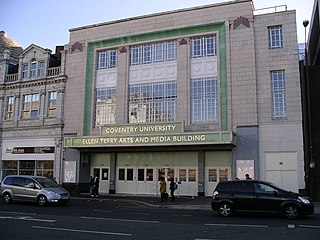
The Department of Media was part of Coventry School of Art and Design in Coventry University but is now known as the School of Media and Performing Arts in the Faculty of Arts and Humanities. It is located within the Ellen Terry Building, which is a £7 million refurbished 1930s cinema in the centre of Coventry, UK.
Radical media are communication outlets that disperse action-oriented political agendas utilizing existing communication infrastructures and its supportive users. These types of media are differentiated from conventional mass communications through its progressive content, reformist culture, and democratic process of production and distribution. Advocates support its alternative and oppositional view of mass media, arguing that conventional outlets are politically biased through their production and distribution. However, there are some critics that exist in terms of validating the authenticity of the content, its political ideology, long-term perishability, and the social actions led by the media.
Global citizenship education (GCED) is a form of civic learning that involves students' active participation in projects that address global issues of a social, political, economic, or environmental nature. The two main elements of GCE are 'global consciousness'; the moral or ethical aspect of global issues, and 'global competencies', or skills meant to enable learners to participate in changing and developing the world. The promotion of GCE was a response by governments and NGOs to the emergence of supranational institution, regional economic blocs, and the development of information and communications technologies. These have all resulted in the emergence of a more globally oriented and collaborative approach to education. GCE addresses themes such as peace and human rights, intercultural understanding, citizenship education, respect for diversity and tolerance, and inclusiveness.
Social practice is an art medium focusing on engagement through human interaction and social discourse. Since people and their relationships form the medium of such works – rather than a particular process of production – social engagement is not only a part of a work’s organization, execution, or continuation, but also an aesthetic in itself: of interaction and development. Socially engaged art aims to create social and/or political change through collaboration with individuals, communities, and institutions in the creation of participatory art. The discipline values the process of a work over any finished product or object.
Education for justice is the process of promoting a culture of lawfulness through educational activities at all levels. Education for justice aims at teaching the next generation about crime prevention, and to better understand and address problems that can undermine the rule of law. It promotes peace and encourages students to actively engage in their communities and future professions. Education for Justice is a basic legal knowledge, in which educational activities at all levels seek to promote understanding of crime prevention, peace, justice, human rights, and problems that can undermine the rule of law. Education reportedly plays a key role in transmitting and sustaining socio-cultural norms and ensuring their continued evolution. As such, governments may seek to strengthen this promotion of a culture of lawfulness through education.
Futures of Education is a global initiative led by UNESCO, aiming to rethink and shape the future of education. The project was launched in 2019 to mobilize collective intelligence, generate debate and reimagine how education can contribute to the common good of humanity.
↑ Elizabeth Ezra (Editor), Terry Rowden (Editor), Steven Coham (Series Editor), Ina Rae Hark (Series Editor) (2005). Transnational Cinema, the Film Reader (In Focus: Routledge Film Readers). UK & US: Routledge. ISBN978-0-415-37158-2.CS1 maint: multiple names: authors list (link)
↑ Hemming, Henry (2011). Together: How Small Groups Achieve Big Things. UK: John Murray. ISBN978-1-84854-055-2.
↑ Gauntlett, David (2011). Making is Connecting: The Social Meaning of Creativity, from DIY and knitting to YouTube and Web 2.0. UK: Cambridge: Polity. ISBN978-0-7456-5002-9.
↑ Keen, Andrew (2007). The Cult of the Amateur: How Today's Internet Is Killing Our Culture and Assaulting Our Economy. Nicholas Brealey Publishing. p.15. ISBN978-1-85788-393-0.
↑ Jenkins, Henry (2008). Convergence Culture: Where Old and New Media Collide. New York University Press. ISBN978-0-8147-4295-2.
↑ Jonathan Gray (Editor), Cornel Sandvoss (Editor), C.Lee Harrington (Editor) (2007). Fandom: Identities and Communities in a Mediated World. New york University Press.CS1 maint: multiple names: authors list (link) CS1 maint: extra text: authors list (link)
↑ Harding, Thomas (1997). The Video Activist Handbook. UK & US: Pluto Press. ISBN0-7453-1770-7.
↑ Nichols, Bill (1991). Representing Reality. Indiana University Press. pp.201–229. ISBN978-0-253-20681-7.
1 2 Goodman, Steve (2003). Teaching youth media: A Critical guide to Literacy, Video Production and Social Change. US: New York: Teachers College Press. ISBN0-8077-4288-0.
↑ Jackie Shaw; Clive Robertson (1997). Participatory Video: A Practical guide to using video creatively in group development work. Routledge. ISBN0-415-14105-2.
↑ White, Shirley A. (2003). Participatory Video: Images that Transform and Empower. London and New York: Sage. ISBN0-7619-9763-6.
↑ Ackroyd, Judith (2006). Research Methodologies for Drama Education. UK: Trentham Books. ISBN1-85856-323-2.
↑ Gardner, Howard (1993) [1984]. Frames of Mind: The Theory of Multiple Intelligences. Fontana. ISBN0-00-686290-X.
This page is based on this Wikipedia article Text is available under the CC BY-SA 4.0 license; additional terms may apply. Images, videos and audio are available under their respective licenses.