History
Conservation International began working in Guyana in 1989, and the Guyana programme later established offices in Georgetown and Lethem to support its national work. [1] The programme has worked with government bodies and other partners on conservation planning and implementation in multiple regions of Guyana. [1]
Guyana's National Biodiversity Strategy and Action Plan (2012–2020) documented collaboration involving the Protected Areas Commission, Conservation International Guyana and the University of Kent to develop a methodology using Marxan to spatially map ecosystems and biodiversity areas for protected-area planning. [4] An independent assessment of enabling activities in the Guyana–Norway REDD+ partnership described Conservation International Guyana as a facilitating partner in programme implementation arrangements. [8]
In 2014, CI-Guyana vice president David Singh described Guyana's Low Carbon Development Strategy as intended to serve as a model for carbon-limited development that supports sustainable development, and said that public attitudes in Guyana include strong support for environmental protection. [9]
In 2017, the Guyana Forestry Commission announced that Norway funds were released through Conservation International Guyana to support a second phase of Guyana's forest monitoring work under the Monitoring Reporting and Verification System (MRVS). [10] The MRVS is a national forest monitoring system that tracks changes in forest cover and estimates associated emissions as part of Guyana's REDD+ programme. [5]
In 2018, Conservation International Guyana launched the El Dorado Gold Project, a programme intended to reduce mercury use in artisanal and small-scale gold mining and promote mercury-free mining practices. [6] Miners in Mahdia were briefed on the El Dorado Gold Project during a mining school forum and mini symposium, with the project described as engaging miners in Regions Eight and Nine toward mercury-free mining by 2025. [11]
Activities by location
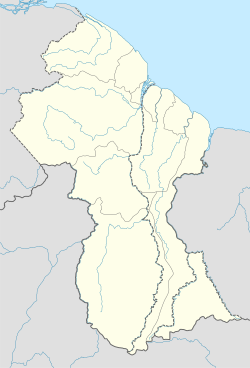
Selected programme locations in Guyana (1 Georgetown, 2 Lethem, 3 Kanashen, 4
Mahdia)
Kanashen and southern Guyana
In the Kanashen Indigenous District in Region Nine, the Kanashen Village Council received absolute title to its lands in 2004 and designated them as a Community Owned Conservation Area in 2007 under the Amerindian Act 2006. [2] The Government of Guyana gazetted the area in 2017 as the Kanashen Amerindian Protected Area, with the Kanashen Village Council listed as the management authority; the protected area covers about 648,567 hectares (6,486 km2). [2] [3] A management plan for implementation from 2022 to 2026 set out arrangements involving the community, government agencies and Conservation International Guyana, including community consultations, ranger training and baseline biological surveys. [12]
Lethem and the Rupununi
CI-Guyana maintains an office in Lethem in the Rupununi, in addition to its Georgetown office. [1] Work in the Rupununi and other parts of southern Guyana has included support for community conservation and protected-area management in Region Nine. [2] [12]
Mahdia and interior mining districts
The El Dorado Gold Project has aimed to reduce mercury use in gold mining and promote mercury-free mining practices. [6] A mining school forum and mini symposium in Mahdia included a briefing on the El Dorado Gold Project and involved state and non-state partners, including Conservation International Guyana. [11]
Coastal Guyana
Coastal work has included mangrove cover mapping carried out under the North Brazil Shelf Mangrove Project. [7] In Guyana, the project worked with the Mangrove Department of the National Agricultural Research and Extension Institute, and Conservation International Guyana was among the implementing partners. [7]
Nationwide
Protected-area planning has included ecosystem and biodiversity mapping using Marxan to support the design and expansion of Guyana's protected-areas system. [4] CI-Guyana has supported implementation of the MRVS, a national forest monitoring system used in Guyana's REDD+ programme. [10] [5] The Guiana Shield Initiative supported national forest monitoring and verification systems used for results-based payments in REDD+ contexts in Guyana and Suriname, coordinated by Conservation International. [13]
This page is based on this
Wikipedia article Text is available under the
CC BY-SA 4.0 license; additional terms may apply.
Images, videos and audio are available under their respective licenses.