
Homicide is an act in which a person causes the death of another person. A homicide requires only a volitional act, or an omission, that causes the death of another, and thus a homicide may result from accidental, reckless, or negligent acts even if there is no intent to cause harm. It is separate from suicide.
A violent crime, violent felony, crime of violence or crime of a violent nature is a crime in which an offender or perpetrator uses or threatens to use harmful force upon a victim. This entails both crimes in which the violent act is the objective, such as murder, assault, rape and assassination, as well as crimes in which violence is used as a method of coercion or show of force, such as robbery, extortion and terrorism. Violent crimes may, or may not, be committed with weapons. Depending on the jurisdiction, violent crimes may be regarded with varying severities from homicide to harassment.

Crime in Canada is generally considered low overall. Under the Canadian constitution, the power to establish criminal law & rules of investigation is vested in the federal Parliament. The provinces share responsibility for law enforcement, and while the power to prosecute criminal offences is assigned to the federal government, responsibility for prosecutions is delegated to the provinces for most types of criminal offences. Laws and sentencing guidelines are uniform throughout the country, but provinces vary in their level of enforcement.

Crime in Australia is managed by various law enforcement bodies, the federal and state-based criminal justice systems and state-based correctional services.
Crime in St. Louis includes an overview of crime both in the city of St. Louis and in the Greater St. Louis metropolitan area. Crime in the city increased from the 1960s through the early 1990s as measured by the index crime rate. Despite decreasing crime, rates of violent crime and property crime in both the city and the metropolitan area remain higher than the national metropolitan area average. In addition, the city of St. Louis consistently has been ranked among the most dangerous cities in the United States. As of April 2017, St. Louis has the highest murder rate in America. At the end of 2017, St. Louis metropolitan had 205 murders, 159 of which were within the city limits. In 2018, the new Chief of Police, John Hayden said two-thirds (67%) of all the murders and one-half of all the assaults are concentrated in a triangular area in the north part of the city.

Crime has been recorded in the United States since its founding and has fluctuated significantly over time. Most available data underestimate crime before the 1930s, giving the false impression that crime was low in the early 1900s and had a sharp rise after. Instead, violent crime during the colonial period was likely three times higher than the highest modern rates in the data we have, and crime had been on the decline since colonial times. Within the better data for crime reporting and recording available starting in the 1930s, crime reached its broad, bulging modern peak between the 1970s and early 1990s. After 1992, crime rates have generally trended downwards each year, with the exceptions of a slight increase in property crimes in 2001 and increases in violent crimes in 2005–2006, 2014–2016 and 2020–2021. As of July 1, 2024 violent crime was down and homicides were on pace to drop to 2015 levels by the end of the year.
As of 2018 Detroit had the fourth highest murder rate among major cities in the United States after St. Louis and Baltimore and the 42nd highest murder rate in the world. The rate of robberies in Detroit declined by 67% between 1985 and 2014 while the rate of aggravated assaults increased. As a whole, the city's crime rate has decreased considerably from its 1980s peak.
Crime in Chicago has been tracked by the Chicago Police Department's Bureau of Records since the beginning of the 20th century.
Crime in Toronto has been low in comparison to other major cities. In 2024, a ranking of 60 large cities by The Economist ranked Toronto as the 6th safest major city in the world, and the safest major city in North America. In the same year, CEOWORLD magazine, which includes some major medium-sized cities, ranked Toronto as the 160th safest city in the world, running behind several other major cities including Taipei, Munich, and Jerusalem, as well as, in Canada, Quebec City and Ottawa, but safer than most cities in the United States.

Brazil has one of the highest crime rates in the world, which involves an elevated incidence of violent and non-violent crimes. According to the United Nations Office on Drugs and Crime (UNODC), Brazil had a homicide rate of 21.26 per 100,000 inhabitants in 2021, up from 20.89 per 100,000 inhabitants with 43,073 murders in 2019; however, this was lower than in 2017, when Brazil had a homicide rate of 30.59 per 100,000 inhabitants. In 2018, Brazil had one of the highest number of intentional homicides in the world with 57,358. In addition, Brazil rates second in illegal drug trade in the world.
Crime in Atlanta, Georgia is above the national median and has been a major problem for the city since the middle 20th century.

Figures on crime in London are based primarily on two sets of statistics: the Crime Survey for England and Wales (CSEW) and police recorded crime data. Greater London is generally served by three police forces; the Metropolitan Police which is responsible for policing the vast majority of the capital, the City of London Police which is responsible for The Square Mile of the City of London and the British Transport Police, which polices the national rail network and the London Underground. A fourth police force in London, the Ministry of Defence Police, do not generally become involved with policing the general public. London also has a number of small constabularies for policing parks. Within the Home Office crime statistic publications, Greater London is referred to as the London Region.
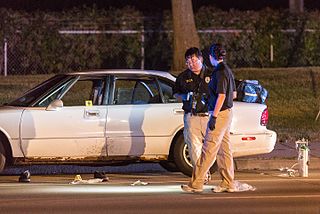
Crime in Minnesota encompasses a wide range of unlawful activities that occur within the state, regulated by both state and federal laws. While crime rates in Minnesota are generally below the national average, certain areas and types of crime have garnered public attention.

The Taiwan McDonald's bombings occurred on April 28 and 29, 1992. Bombs were planted in or near various McDonald's restaurant franchises in Taiwan. The bombings – part of an extortion attempt – caused the death of a policeman and injuries to four civilians, including two young children, and resulted in the temporary closure of certain McDonald's locations in Taiwan.
Colombia has a high crime rate due to being a center for the cultivation and trafficking of cocaine. The Colombian conflict began in the mid-1960s and is a low-intensity conflict between Colombian governments, paramilitary groups, crime syndicates, and left-wing guerrillas such as the Revolutionary Armed Forces of Colombia (FARC), and the National Liberation Army (ELN), fighting each other to increase their influence in Colombian territory. Two of the most important international actors that have contributed to the Colombian conflict are multinational companies and the United States.
Crime in Taiwan ranges from food adulteration, bombing, assassination attempts, hostage crisis, murder etc. However, crime statistics show that crime rates in Taiwan are among the lowest in the world, and are relatively low compared to much of the developed world. A 2020 report named Taiwan the second-safest country in the world, based on low crime rates and a high number of survey respondents who indicated that they felt safe walking alone at night.
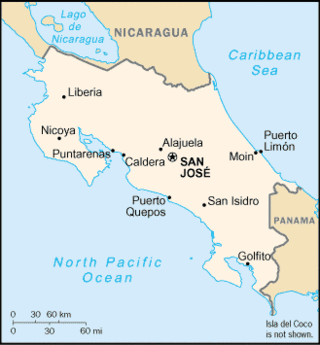
Costa Rica is a Central American nation that boasts of a noteworthy safety record on crime as compared to its neighbors in the region. It is one of few nations that have abolished their nation's armed forces. Having had a stable past, this country has been successful in developing its economy. However, since 2000 there has been a significant rise in criminal activity. Increase in domestic illegal activity, such as theft, homicide, and organised crime, has overwhelmed the local population. Sebastian Huhn reports that, "In a public opinion poll in 2011, 45 percent of Costa Rican respondents said that crime and insecurity were the country’s biggest social problems." As a consequence of the overall societal changes, domestic-driven crime has been increasing in the environment that extends beyond traditional settings. Illegal activity, including distribution of weapons has been most commonly witnessed during the sporting events by 'barras' or fan clubs. Crime in Costa Rica, thus, is not only due to domestic crime groups but also transnational criminal organisations.
Organised crime in Indonesia refers to planned crimes in Indonesia that could be perpetrated by either a political party or Indonesian gangs, also referred to as preman. The illegal activities may include corruption, cybercrime, money laundering, violence, felonies, extortion, racketeering and drug trafficking.
Criminal activity in Victoria, Australia is combated by the Victoria Police and the Victorian court system, while statistics about crime are managed by the Crime Statistics Agency. Modern Australian states and cities, including Victoria, have some of the lowest crime rates recorded globally with Australia ranked the 13th safest nation and Melbourne ranked the 5th safest city globally. As of September 2018 the CBD of Melbourne had the highest rate of overall criminal incidents in the state (15,949.9), followed by Latrobe (12,896.1) and Yarra (11,119.2). Rural areas have comparatively high crime rates, with towns such as Mildura (9,222.0) and Greater Shepparton (9,111.8) having some of the highest crime rates in the state.


