Related Research Articles
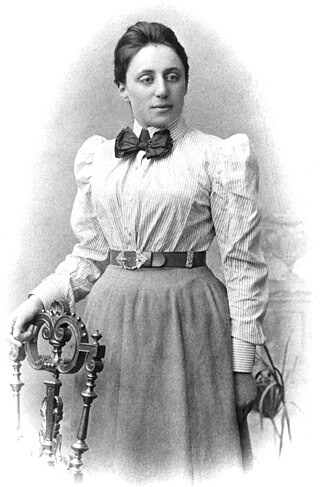
Amalie Emmy Noether was a German mathematician who made many important contributions to abstract algebra. She discovered Noether's first and second theorems, which are fundamental in mathematical physics. She was described by Pavel Alexandrov, Albert Einstein, Jean Dieudonné, Hermann Weyl and Norbert Wiener as the most important woman in the history of mathematics. As one of the leading mathematicians of her time, she developed theories of rings, fields, and algebras. In physics, Noether's theorem explains the connection between symmetry and conservation laws.
Noncommutative geometry (NCG) is a branch of mathematics concerned with a geometric approach to noncommutative algebras, and with the construction of spaces that are locally presented by noncommutative algebras of functions, possibly in some generalized sense. A noncommutative algebra is an associative algebra in which the multiplication is not commutative, that is, for which does not always equal ; or more generally an algebraic structure in which one of the principal binary operations is not commutative; one also allows additional structures, e.g. topology or norm, to be possibly carried by the noncommutative algebra of functions.
In mathematics, a rational variety is an algebraic variety, over a given field K, which is birationally equivalent to a projective space of some dimension over K. This means that its function field is isomorphic to

In mathematics, tropical geometry is the study of polynomials and their geometric properties when addition is replaced with minimization and multiplication is replaced with ordinary addition:
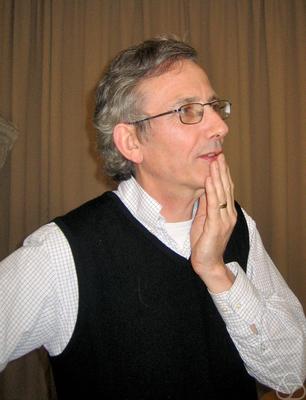
Sir Simon Kirwan Donaldson is an English mathematician known for his work on the topology of smooth (differentiable) four-dimensional manifolds, Donaldson–Thomas theory, and his contributions to Kähler geometry. He is currently a permanent member of the Simons Center for Geometry and Physics at Stony Brook University in New York, and a Professor in Pure Mathematics at Imperial College London.
In mathematics, specifically in symplectic topology and algebraic geometry, Gromov–Witten (GW) invariants are rational numbers that, in certain situations, count pseudoholomorphic curves meeting prescribed conditions in a given symplectic manifold. The GW invariants may be packaged as a homology or cohomology class in an appropriate space, or as the deformed cup product of quantum cohomology. These invariants have been used to distinguish symplectic manifolds that were previously indistinguishable. They also play a crucial role in closed type IIA string theory. They are named after Mikhail Gromov and Edward Witten.

Dame Frances Clare Kirwan, is a British mathematician, currently Savilian Professor of Geometry at the University of Oxford. Her fields of specialisation are algebraic and symplectic geometry.
In mathematics and theoretical physics, Noether's second theorem relates symmetries of an action functional with a system of differential equations. The action S of a physical system is an integral of a so-called Lagrangian function L, from which the system's behavior can be determined by the principle of least action.

Kai Behrend is a German mathematician. He is a professor at the University of British Columbia in Vancouver, British Columbia, Canada.
In mathematics, specifically algebraic geometry, Donaldson–Thomas theory is the theory of Donaldson–Thomas invariants. Given a compact moduli space of sheaves on a Calabi–Yau threefold, its Donaldson–Thomas invariant is the virtual number of its points, i.e., the integral of the cohomology class 1 against the virtual fundamental class. The Donaldson–Thomas invariant is a holomorphic analogue of the Casson invariant. The invariants were introduced by Simon Donaldson and Richard Thomas (1998). Donaldson–Thomas invariants have close connections to Gromov–Witten invariants of algebraic three-folds and the theory of stable pairs due to Rahul Pandharipande and Thomas.
In differential geometry, algebraic geometry, and gauge theory, the Kobayashi–Hitchin correspondence relates stable vector bundles over a complex manifold to Einstein–Hermitian vector bundles. The correspondence is named after Shoshichi Kobayashi and Nigel Hitchin, who independently conjectured in the 1980s that the moduli spaces of stable vector bundles and Einstein–Hermitian vector bundles over a complex manifold were essentially the same.
In algebraic geometry, an affine GIT quotient, or affine geometric invariant theory quotient, of an affine scheme with an action by a group scheme G is the affine scheme , the prime spectrum of the ring of invariants of A, and is denoted by . A GIT quotient is a categorical quotient: any invariant morphism uniquely factors through it.

Alexander Nikolaevich Varchenko is a Soviet and Russian mathematician working in geometry, topology, combinatorics and mathematical physics.

Bernd Siebert is a German mathematician who researches in algebraic geometry.
This is a glossary of properties and concepts in symplectic geometry in mathematics. The terms listed here cover the occurrences of symplectic geometry both in topology as well as in algebraic geometry. The glossary also includes notions from Hamiltonian geometry, Poisson geometry and geometric quantization.
In mathematics, specifically enumerative geometry, the virtual fundamental class of a space is a replacement of the classical fundamental class in its Chow ring which has better behavior with respect to the enumerative problems being considered. In this way, there exists a cycle with can be used for answering specific enumerative problems, such as the number of degree rational curves on a quintic threefold. For example, in Gromov–Witten theory, the Kontsevich moduli spaces
In algebraic geometry, the Chow group of a stack is a generalization of the Chow group of a variety or scheme to stacks. For a quotient stack , the Chow group of X is the same as the G-equivariant Chow group of Y.
The LMS Emmy Noether Fellowship is a fellowship awarded by the London Mathematical Society.
In mathematics, and in particular algebraic geometry, K-stability is an algebro-geometric stability condition for projective algebraic varieties and complex manifolds. K-stability is of particular importance for the case of Fano varieties, where it is the correct stability condition to allow the formation of moduli spaces, and where it precisely characterises the existence of Kähler–Einstein metrics.
References
- ↑ "Dr Cristina Manolache". The University of Sheffield. Archived from the original on 2019-10-04. Retrieved 8 April 2021.
- ↑ "SISSA profile page" . Retrieved 2021-05-12.
- 1 2 Manolache, Cristina (2008–2009). "Virtual Intersections" (PDF). SISSA.
- ↑ "Video: Cristina Manolache, "A splitting of the virtual class"". www.birs.ca. Retrieved 2021-04-09.
- ↑ Battistella, Luca; Carocci, Francesca; Manolache, Cristina (2020). "Reduced invariants from cuspidal maps". Transactions of the American Mathematical Society. 373 (9): 6713–6756. arXiv: 1801.07739 . doi: 10.1090/tran/8141 . ISSN 0002-9947.
- ↑ Manolache, Cristina (2014). "Stable maps and stable quotients". Compositio Mathematica. 150 (9): 1457–1481. arXiv: 1301.4393 . doi: 10.1112/S0010437X14007258 . ISSN 0010-437X.
- ↑ Manolache, Cristina (2011). "Virtual pull-backs". Journal of Algebraic Geometry. 21 (2): 201–245. doi: 10.1090/S1056-3911-2011-00606-1 . S2CID 16201909.
- ↑ Manolache, Cristina (2012-08-31). "Virtual push-forwards". Geometry & Topology. 16 (4): 2003–2036. arXiv: 1010.2704 . doi: 10.2140/gt.2012.16.2003 . ISSN 1364-0380.
- ↑ "LMS Emmy Noether Fellows 2020 Announced | London Mathematical Society". www.lms.ac.uk. Retrieved 2021-04-08.
