
Sediment is a naturally occurring material that is broken down by processes of weathering and erosion, and is subsequently transported by the action of wind, water, or ice or by the force of gravity acting on the particles. For example, sand and silt can be carried in suspension in river water and on reaching the sea bed deposited by sedimentation; if buried, they may eventually become sandstone and siltstone through lithification.
Meiobenthos, also called meiofauna, are small benthic invertebrates that live in marine or freshwater environments, or both. The term meiofauna loosely defines a group of organisms by their size—larger than microfauna but smaller than macrofauna—rather than by their taxonomy. This fauna includes both animals that turn into macrofauna later in life, and those small enough to belong to the meiobenthos their entire life. In marine environments there can be thousands of individuals in 10 cubic centimeters of sediment, and counts animals like nematodes, copepods, rotifers, tardigrades and ostracods, but protists like ciliates and foraminifers within the size range of the meiobethos are also often included. In practice, the term usually includes organisms that can pass through a 1 mm mesh but are retained by a 45 μm mesh, though exact dimensions may vary. Whether an organism will pass through a 1 mm mesh also depends upon whether it is alive or dead at the time of sorting.

A reef is a ridge or shoal of rock, coral, or similar relatively stable material lying beneath the surface of a natural body of water. Many reefs result from natural, abiotic (non-living) processes such as deposition of sand or wave erosion planning down rock outcrops. However, reefs such as the coral reefs of tropical waters are formed by biotic (living) processes, dominated by corals and coralline algae. Artificial reefs, such as shipwrecks and other man-made underwater structures, may occur intentionally or as the result of an accident. These are sometimes designed to increase the physical complexity of featureless sand bottoms to attract a more diverse range of organisms. Reefs are often quite near to the surface, but not all definitions require this.
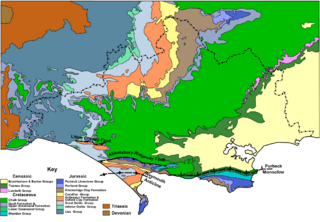
Dorset is a county in South West England on the English Channel coast. Covering an area of 2,653 square kilometres (1,024 sq mi); it borders Devon to the west, Somerset to the north-west, Wiltshire to the north-east, and Hampshire to the east. The great variation in its landscape owes much to the underlying geology, which includes an almost unbroken sequence of rocks from 200 to 40 million years ago (Mya) and superficial deposits from 2 Mya to the present. In general, the oldest rocks appear in the far west of the county, with the most recent (Eocene) in the far east. Jurassic rocks also underlie the Blackmore Vale and comprise much of the coastal cliff in the west and south of the county; although younger Cretaceous rocks crown some of the highpoints in the west, they are mainly to be found in the centre and east of the county.

A carbonate platform is a sedimentary body which possesses topographic relief, and is composed of autochthonic calcareous deposits. Platform growth is mediated by sessile organisms whose skeletons build up the reef or by organisms which induce carbonate precipitation through their metabolism. Therefore, carbonate platforms can not grow up everywhere: they are not present in places where limiting factors to the life of reef-building organisms exist. Such limiting factors are, among others: light, water temperature, transparency and pH-Value. For example, carbonate sedimentation along the Atlantic South American coasts takes place everywhere but at the mouth of the Amazon River, because of the intense turbidity of the water there. Spectacular examples of present-day carbonate platforms are the Bahama Banks under which the platform is roughly 8 km thick, the Yucatan Peninsula which is up to 2 km thick, the Florida platform, the platform on which the Great Barrier Reef is growing, and the Maldive atolls. All these carbonate platforms and their associated reefs are confined to tropical latitudes. Today's reefs are built mainly by scleractinian corals, but in the distant past other organisms, like archaeocyatha or extinct cnidaria were important reef builders.
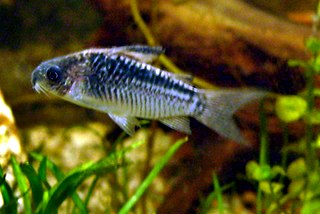
The elegant corydoras or elegant catfish is a tropical freshwater fish belonging to the subfamily Corydoradinae of the family Callichthyidae. It originates in inland waters in South America, and is found in the Upper Amazon River basin in Brazil, Colombia and Peru. The specific epithet elegans means elegant.
A bacterivore is an organism which obtains energy and nutrients primarily or entirely from the consumption of bacteria. The term is most commonly used to describe free-living, heterotrophic, microscopic organisms such as nematodes as well as many species of amoeba and numerous other types of protozoans, but some macroscopic invertebrates are also bacterivores, including sponges, polychaetes, and certain molluscs and arthropods. Many bacterivorous organisms are adapted for generalist predation on any species of bacteria, but not all bacteria are easily digested; the spores of some species, such as Clostridium perfringens, will never be prey because of their cellular attributes.
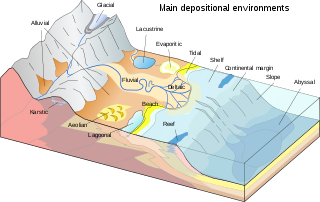
In geology, depositional environment or sedimentary environment describes the combination of physical, chemical, and biological processes associated with the deposition of a particular type of sediment and, therefore, the rock types that will be formed after lithification, if the sediment is preserved in the rock record. In most cases, the environments associated with particular rock types or associations of rock types can be matched to existing analogues. However, the further back in geological time sediments were deposited, the more likely that direct modern analogues are not available.

Marine sediment, or ocean sediment, or seafloor sediment, are deposits of insoluble particles that have accumulated on the seafloor. These particles either have their origins in soil and rocks and have been transported from the land to the sea, mainly by rivers but also by dust carried by wind and by the flow of glaciers into the sea, or they are biogenic deposits from marine organisms or from chemical precipitation in seawater, as well as from underwater volcanoes and meteorite debris.

A micromollusc is a shelled mollusc which is extremely small, even at full adult size. The word is usually, but not exclusively, applied to marine molluscs, although in addition, numerous species of land snails and freshwater molluscs also reach adult size at very small dimensions.

Phyllidia elegans, also known as the elegant phyllidia, is a species of sea slug, a dorid nudibranch, a shell-less marine gastropod mollusk in the family Phyllidiidae. It is found in shallow water in the Red Sea and the tropical Indo-Pacific region.
Actinoporus elegans, commonly known as the elegant anemone or the brown-striped anemone, is a species of sea anemone in the family Aurelianidae. This species may exhibit a high degree of colour variability, from blue to white to nearly transparent.
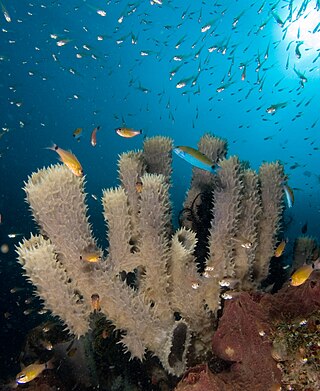
A marine habitat is a habitat that supports marine life. Marine life depends in some way on the saltwater that is in the sea. A habitat is an ecological or environmental area inhabited by one or more living species. The marine environment supports many kinds of these habitats.
C. elegans most commonly refers to the model round worm Caenorhabditis elegans. It may also refer to any of the species below. They are listed, first in taxonomic order and, second, alphabetically.

Cryptaulaxella is a genus of kinetoplastids. It was previously known as Spiromonas, a genus introduced by Skuja in 1939, but the name was preoccupied by a dinoflagellate genus Spiromonas. Later, in 1948, Skuja renamed it to Cryptaulax, and considered it to be a type of cryptomonad. Subsequent studies suggested that it was a euglenozoan. Because Skuja had clearly misidentified the flagellate as a cryptomonad, Vørs argued that at least some species should be placed in the euglenozoan genus Rhynchobodo, but this opinion did not reach consensus. The similarity of the general morphology of C. akopus with other species that have been studied in more detail and deemed to be euglenozoan support the argument that the genus is euglenozoan. In 1996, due to the name Cryptaulax being preoccupied by an insect genus, it was changed to Cryptaulaxoides. However, the latter was also preoccupied by a different insect genus. Consequently, it was eventually changed to its final name, Cryptaulaxella, in 2021.
Cromyatractus elegans is a species of radiolarian in the order Spumellaria. The holotype is on a slide n°1066 kept at the Marine Dept., Zoological Institute, Acad. of Sc., St Petersburg, Russia. The type locality is the North Western Pacific Ocean and it was found during an expedition of Vityaz in 1961.
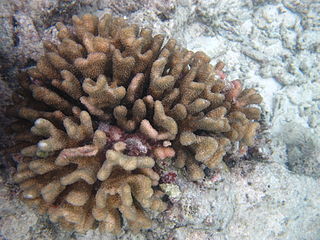
Pocillopora elegans is a species of colonial stony coral in the family Pocilloporidae. It is native to tropical and subtropical parts of the western, central and eastern Pacific Ocean. It is susceptible to bleaching and various coral diseases and the International Union for Conservation of Nature (IUCN) has listed it as a "vulnerable species".

Paleotempestology is the study of past tropical cyclone activity by means of geological proxies as well as historical documentary records. The term was coined by American meteorologist Kerry Emanuel.

Neanthes arenaceodentata is a species of marine polychaete worm in the family Nereididae. It occurs in shallow waters in the tropical Atlantic and Pacific Oceans. It has been used in the laboratory in testing the toxicity of marine sediments.

