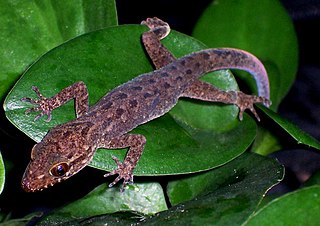
Cyrtodactylus is a diverse genus of Asian geckos, commonly known as bent-toed geckos, bow-fingered geckos, and forest geckos. The genus has about 300 described species as of 2020, which makes it the largest of all gecko genera.

Gekkoninae is a diverse subfamily of the family Gekkonidae, geckos. It has the most species and genera — over 850 species in 30 genera. Hemidactylus and Cyrtodactylus together account for 185 species.

The Eastern Ghats are a discontinuous range of mountains along India's eastern coast. The Eastern Ghats pass through Odisha, Andhra Pradesh to Tamil Nadu in the south passing some parts of Karnataka as well as Telangana. They are eroded and cut through by four major rivers of peninsular India, viz., Mahanadi, Godavari, Krishna, and Kaveri. Deomali with 1672 m height is the tallest point in Odisha. Arma Konda/Jindhagada Peak with 1680 m is the highest point in Andhra Pradesh. BR hill range located in Karnataka is the tallest hill range in Eastern Ghats with many peaks above 1750 m height. Kattahi Betta in BR hills with the height of 1822 m is the tallest peak in Eastern Ghats.

Cyrtodactylus collegalensis, also known as the Kollegal ground gecko or forest spotted gecko, is a species of gecko found in and around Mysore hills, at the junction of the Western Ghats and the Eastern Ghats, in South India. Recent taxonomic works and genetic studies revealed that the formerly-supposed genus is actually a subgenus of the widespread genus Cyrtodactylus. It is often confused with the forest spotted gecko.

Cyrtodactylus deccanensis, also commonly known as Deccan ground gecko, Günther's Indian gecko, or the banded ground gecko, is a species of gecko found in the northern Western Ghats of India. It has been found from northern Maharashtra, with a habitat range possibly extending to southern Gujarat. Cyrtodactylus albofasciatus was previously considered conspecific with Cyrtodactylus deccanensis but is now accepted as a valid species.
Cyrtodactylus nebulosus, also known as the clouded Indian gecko, is a species of gecko found in India.

Cyrtodactylus jeyporensis, also known as the Jeypore Indian gecko, the Jeypore ground gecko, or the Patinghe Indian gecko, is an endangered species of gecko found in India, which was until recently considered extinct. Described from a single specimen in 1877, it was rediscovered in 2010 in the Eastern Ghats of Odisha state, India.

Cyrtodactylus phongnhakebangensis is a species of gecko native to Phong Nha-Kẻ Bàng National Park, Quảng Bình Province, North Central Coast, Vietnam. It was discovered and described in 2002.
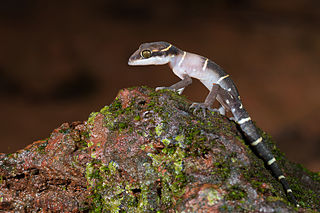
Geckoella is a disputed genus of Gekkonidae endemic to India and Sri Lanka.

Doi Inthanon National Park, nicknamed "the roof of Thailand", is in the Thanon Thong Chai Range, Chom Thong District, Chiang Mai Province, northern Thailand. It includes Doi Inthanon, the country's highest mountain. It contains an area of 301,184 rai ~ 482 square kilometres (186 sq mi) in size. It was established on October 2, 1972.

Cyrtodactylus philippinicus, commonly known as the Philippine bent-toed gecko or Philippine bow-fingered gecko, is a species of gecko in family Gekkonidae.

Known as Taylor's bow-fingered gecko, four-striped forest gecko and marbled bent-toed gecko, is a species of gecko found in Thailand, Malaysia, Singapore and Indonesia.
National Highway 217 commonly referred to as NH 217, is a national highway in India. This route was earlier part of old national highways 51 and 62. It is a secondary route of National Highway 17. NH-217 runs through the states of Assam and Meghalaya in India.

The forest spotted gecko or Erode ground gecko is a species of gecko that is endemic to hills of South India, in parts of Eastern Ghats and Western Ghats. It was first described from hills near Erode in Tamil Nadu in 1870. Subsequently, this species was thought to be similar to Cyrtodactylus collegalensis, but recent studies have confirmed that they are distinct. This species has been sighted in hills around Coimbatore, Tirupur and Erode, in parts of the Eastern Ghats in Tamil Nadu.

Giri's geckoella is a species of gecko, a lizard in the family Gekkonidae. The species is endemic to India.
The Rishi Valley geckoella is a species of nocturnal, terrestrial, insectivorous gecko that is endemic to India. This recently described species is named after the Rishi Valley School, and this is currently known from hills of the Eastern Ghats, in Chittoor district of Andhra Pradesh state.
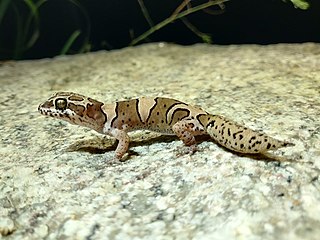
The Bangalore geckoella is a species of nocturnal terrestrial gecko, a lizard in the family Gekkonidae. The species is endemic to India.
Rongara Siju is one of the 60 Legislative Assembly constituencies of Meghalaya state in India.
Jarak Island is an island in the straits of Malacca. It is administrated as part of Perak, Malaysia. The island is granitic, heavily forested, and has a rocky shoreline. Jarak has been described as being 8 hectares in size.
