
Carnegie Mellon University (CMU) is a private research university in Pittsburgh, Pennsylvania. The institution was originally established in 1900 by Andrew Carnegie as the Carnegie Technical Schools. In 1912, it became the Carnegie Institute of Technology and began granting four-year degrees. In 1967, it became the current-day Carnegie Mellon University through its merger with the Mellon Institute of Industrial Research, founded in 1913 by Andrew Mellon and Richard B. Mellon and formerly a part of the University of Pittsburgh.

Kendall College of Art and Design of Ferris State University (KCAD) is a college of art and design located in downtown Grand Rapids, Michigan.
Donna J. Cox is an American artist and scientist, Michael Aiken Endowed Chair; Professor of Art + Design; Director, Advanced Visualization Lab at the University of Illinois at Urbana-Champaign (UIUC); Director, Visualization and Experimental Technologies at National Center for Supercomputing Applications (NCSA); and Director, edream. She is a recognized pioneer in computer art and scientific visualization, specifically cinematic scientific visualization.

A video synthesizer is a device that electronically creates a video signal. A video synthesizer is able to generate a variety of visual material without camera input through the use of internal video pattern generators. It can also accept and "clean up and enhance" or "distort" live television camera imagery. The synthesizer creates a wide range of imagery through purely electronic manipulations. This imagery is visible within the output video signal when this signal is displayed. The output video signal can be viewed on a wide range of conventional video equipment, such as TV monitors, theater video projectors, computer displays, etc.
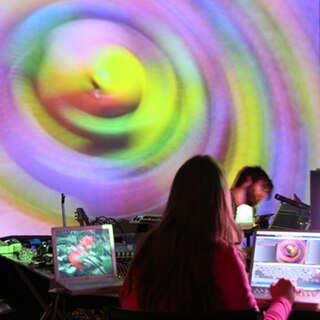
VJing is a broad designation for realtime visual performance. Characteristics of VJing are the creation or manipulation of imagery in realtime through technological mediation and for an audience, in synchronization to music. VJing often takes place at events such as concerts, nightclubs, music festivals and sometimes in combination with other performative arts. This results in a live multimedia performance that can include music, actors and dancers. The term VJing became popular in its association with MTV's Video Jockey but its origins date back to the New York club scene of the 70s. In both situations VJing is the manipulation or selection of visuals, the same way DJing is a selection and manipulation of audio.
A. Michael Noll is an American engineer, and professor emeritus at the Annenberg School for Communication and Journalism at the University of Southern California. He served as dean of the Annenberg School from 1992 to 1994. He was a very early pioneer in digital computer art and 3D animation and tactile communication.

The University of Cincinnati College-Conservatory of Music (CCM) is a performing and media arts college of the University of Cincinnati in Cincinnati, Ohio. Initially established as the Cincinnati Conservatory of Music in 1867, CCM is one of the oldest continually operating conservatories in the US.

The University of Pennsylvania School of Engineering and Applied Science is the undergraduate and graduate engineering school of the University of Pennsylvania, a private research university in Philadelphia. The school offers programs that emphasize hands-on study of engineering fundamentals while encouraging students to leverage the educational offerings of the broader University. Engineering students can also take advantage of research opportunities through interactions with Penn’s School of Medicine, School of Arts and Sciences and the Wharton School.

Edward A. Shanken is an American art historian, whose work focuses on the entwinement of art, science and technology, with a focus on experimental new media art and visual culture. Shanken is Professor, Arts Division, at UC Santa Cruz. His scholarship has appeared in numerous journals and anthologies and has been translated into many languages. Shanken is the author of Art and Electronic Media, among other titles.
Robert Scott Thompson is a composer of ambient, instrumental and electroacoustic music. He earned the B.Mus. degree from the University of Oregon and M.A. and Ph.D. degrees from the University of California, San Diego. His primary teachers include Bernard Rands, Roger Reynolds, Joji Yuasa and F. Richard Moore. He creates work in a wide variety of forms ranging from chamber and orchestral music to works for the virtuoso soloist, computer music, and experimental video art.

The Yukon School of Visual Arts (SOVA) is Canada's most northerly post-secondary fine arts school, and it receives its accreditation through the Applied Arts Division of Yukon College. SOVA is located within the traditional territory of the Tr'ondëk Hwëch'in First Nation in Dawson City, Yukon Territory, Canada. SOVA offers a Foundation Year Program, which is the equivalent of the first year of a Bachelor of Fine Arts (BFA) degree. The school offers an experimental, integrated curriculum that is studio-based with liberal arts courses. Successful students continue their degrees at their choice of five partnering art schools across Canada, including the Ontario College of Art and Design in Toronto, the Emily Carr Institute of Art and Design in Vancouver, the Alberta College of Art and Design in Calgary, Mount Allison University in Sackville, NB and the Nova Scotia College of Art and Design University in Halifax.

Hybrid art is a contemporary art movement in which artists work with frontier areas of science and emerging technologies. Artists work with fields such as biology, robotics, physical sciences, experimental interface technologies, artificial intelligence, and information visualization. They address the research in many ways such as undertaking new research agendas, visualizing results in new ways, or critiquing the social implications of the research. The worldwide community has developed new kinds of art festivals, information sources, organizations, and university programs to explore these new arts.

Shawn Brixey is an artist, educator, researcher, and inventor.

New media art includes artworks designed and produced by means of electronic media technologies, comprising virtual art, computer graphics, computer animation, digital art, interactive art, sound art, Internet art, video games, robotics, 3D printing, and cyborg art. The term defines itself by the thereby created artwork, which differentiates itself from that deriving from conventional visual arts. New Media art has origins in the worlds of science, art, and performance. Some common themes found in new media art include databases, political and social activism, Afrofuturism, feminism, and identity, a ubiquitous theme found throughout is the incorporation of new technology into the work. The emphasis on medium is a defining feature of much contemporary art and many art schools and major universities now offer majors in "New Genres" or "New Media" and a growing number of graduate programs have emerged internationally. New media art may involve degrees of interaction between artwork and observer or between the artist and the public, as is the case in performance art. Yet, as several theorists and curators have noted, such forms of interaction, social exchange, participation, and transformation do not distinguish new media art but rather serve as a common ground that has parallels in other strands of contemporary art practice. Such insights emphasize the forms of cultural practice that arise concurrently with emerging technological platforms, and question the focus on technological media per se. New Media art involves complex curation and preservation practices that make collecting, installing, and exhibiting the works harder than most other mediums. Many cultural centers and museums have been established to cater to the advanced needs of new media art.

Diane Gromala is a Canada Research Chair and a Professor in the Simon Fraser University School of Interactive Arts and Technology. Her research works at the confluence of computer science, media art and design, and has focused on the cultural, visceral, and embodied implications of digital technologies, particularly in the realm of chronic pain.
Maja Petrić is a contemporary new media artist who works primarily in interactive art that combines light, sound and cutting-edge technologies such as artificial intelligence, computer vision, and robotics to expand the multi-sensory apparatus through which art can be experience. She was born in 1981 in Zagreb, Croatia. She lives and works in Madrid, Seattle, New York City, and Zagreb. She received a PhD in new media art from the University of Washington Center for Digital Arts and Experimental Media and Masters from the New York University's Tisch School of the Arts, Interactive Telecommunications Program (ITP).

The Experimental Television Center (ETC) (1969–2011) was a nonprofit electronic and media art center located in upstate New York.
Jane Veeder is an American digital artist, filmmaker and educator. She is a professor at San Francisco State University in the Department of Design and Industry, at which she held the position of chair between 2012 and 2015. Veeder is best known for her pioneering work in early computer graphics, however she has also worked extensively with traditional art forms such as painting, ceramics, theatre, and photography.
Barbara Sykes into a family of artists, designers and inventors. Since childhood, she has produced work in a variety of different art forms. In 1974, she became one of Chicago’s pioneering video and new media artists and, later to include, independent video producer, exhibition curator and teacher. Sykes is a Chicago based experimental video artist who explores themes of spirituality, ritual and indigeneity from a feminist perspective. Sykes is known for her pioneering experimentation with computer graphics in her video work, utilizing the Electronic Visualization Laboratory at the University of Illinois, Chicago, at a time when this technology was just emerging. Her early works broke new grounds in Chicago’s emerging New Media Art scene, and continue to inspire women to explore experimental realms. With a passion for community, she fostered significant collaborations with many institutions that include but are not limited to University of Illinois, School of the Art Institute of Chicago, Columbia College, Center for New Television, and (art)n laboratory. These collaborations became exemplary for the showcasing of new media work. The wave of video, new media and computer art that she pioneered alongside many other seminal early Chicago New Media artists persists as a major influence for artists and educators today. Her work has been exhibited internationally, at institutions such as Moderna Museet (Stockholm), Ny Carlsberg Glyptotek (Copenhagen), Musée d'Art Moderne de la Ville de Paris, Museum of Contemporary Art San Diego, Metropolitan Museum of Art , Museum of the Art Institute (Chicago), The Metropolitan Museum of Art and SIGGRAPH. Sykes’s tapes have been broadcast in Sweden, Italy, Puerto Rico and extensively throughout in the USA, including “The Independents,” PBS national broadcast, 1985, and national cablecast, 1984. Media Burn has a selection of her tapes online and over 200 of her raw footage, master edits, dubs and compilation tapes in their archives. Select grants include a National Endowment for the Arts and American Film Institute Regional Fellowship, Evanston Art Council Cultural Arts Fund and several Illinois Arts Council grants.
Gregory Paul Kramer, is an American composer, researcher, inventor, meditation teacher and author. In 1975 he co-founded Electronic Musicmobile, a pioneer synthesizer ensemble later renamed Electronic Art Ensemble, in which Kramer was a musician and the principal composer. His pioneering work extended to developing synthesizer and related equipment. Kramer also co-founded the not-for-profit arts organization Harvestworks in New York City. He is recognized as the founding figure of the intensely cross-disciplinary field of data sonification. Since 1980, Kramer teaches Buddhist meditation. He is credited as co-founder of Insight Dialogue, an interpersonal meditation practice. Kramer is the author of several books in diverse fields, as well as (co-)author of scientific papers in the field of data sonification.


