The Queen Elizabeth Range is a rugged mountain range of the Transantarctic Mountains System, located in the Ross Dependency region of Antarctica.
The Dominion Range is a broad mountain range, about 48 km (30 mi) long, forming a prominent salient at the juncture of the Beardmore and Mill glaciers in Antarctica. The range is part of the Queen Maud Mountains
The Prince Charles Mountains are a major group of mountains in Mac. Robertson Land in Antarctica, including the Athos Range, the Porthos Range, and the Aramis Range. The highest peak is Mount Menzies. Other prominent peaks are Mount Izabelle and Mount Stinear. These mountains together with other scattered peaks form an arc about 260 miles long, extending from the vicinity of Mount Starlight in the north to Goodspeed Nunataks in the south.
Ice Gate Glacier is a narrow hanging glacier, tributary to Astudillo Glacier, between rock spurs on the west slope of Dallmeyer Peak, Danco Coast, Antarctica. It was named by the Polish Antarctic Expedition in about 1992, probably from the gatelike appearance of the spurs at the junction of the two glaciers.
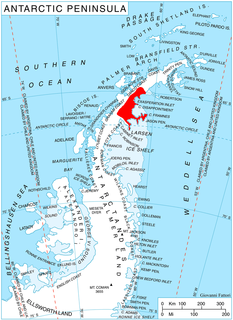
Crane Glacier, is a narrow glacier which flows 30 miles (50 km) in an east-northeasterly direction along the northwest side of Aristotle Mountains to enter Spillane Fjord south of Devetaki Peak, on the east coast of the Antarctic Peninsula. Sir Hubert Wilkins photographed this feature from the air in 1928 and gave it the name "Crane Channel", after C.K. Crane of Los Angeles, reporting that it appeared to be a channel cutting in an east-west direction across the peninsula. The name was altered to "Crane Inlet" following explorations along the west coast of the peninsula in 1936 by the British Graham Land Expedition, which proved that no through channel from the east coast existed as indicated by Wilkins. Comparison of Wilkins' photograph of this feature with those taken in 1947 by the Falklands Islands Dependencies Survey shows that Wilkins' "Crane Channel" is this glacier, although it lies about 75 miles (120 km) northeast of the position originally reported by Wilkins.
Daspit Glacier is a glacier 6 nautical miles (11 km) long, flowing east-northeast along the south side of Mount Shelby to the head of Trail Inlet, on the east coast of Graham Land, Antarctica. It was discovered by members of the East Base of the United States Antarctic Service, 1939–41, and was originally named Fleming Glacier after Rev. W.L.S. Fleming. It was photographed from the air in 1947 by the Ronne Antarctic Research Expedition under Finn Ronne, and charted in 1948 by the Falkland Islands Dependencies Survey. It was renamed by Ronne for Captain Lawrence R. Daspit, U.S. Navy, who assisted in obtaining Navy support for the Ronne expedition, the original name being transferred to Fleming Glacier on the Rymill Coast.
Bildad Peak is a conspicuous snow-capped peak 5 nautical miles (9 km) west of Spouter Peak on the south side of Flask Glacier in eastern Voden Heights, on Oscar II Coast in Graham Land. It was surveyed by the Falkland Islands Dependencies Survey in 1955, and named by the UK Antarctic Place-Names Committee after the fictional Captain Bildad, part-owner of the whaling ship Pequod in Herman Melville's Moby-Dick.
Bulkington Pass is a pass on the south side of Flask Glacier and west of Bildad Peak in Voden Heights on the east side of Graham Land. The pass trends northeast–southwest for 4 nautical miles (7 km) and provides a route from the ice piedmont north of Adit Nunatak to Flask Glacier. The toponym is one in a group applied by the UK Antarctic Place-Names Committee that reflects a whaling theme, Bulkington being a crewman on the vessel Pequod in Herman Melville's Moby Dick.
Dallmeyer Peak is a peak, 1,105 metres (3,625 ft) high, standing 2 nautical miles (4 km) southwest of Steinheil Point on the south side of Andvord Bay, on the west coast of Graham Land. The peak appears on an Argentine government chart of 1952. It was named by the UK Antarctic Place-Names Committee in 1960 for John H. Dallmeyer, an English optician who independently developed the "rectilinear" photographic lens.
Earnshaw Glacier is a glacier 10 nautical miles (19 km) long, flowing northward to the east of Norwood Scarp and entering Maitland Glacier to the south of Werner Peak, in the eastern Antarctic Peninsula. It was photographed from the air by the United States Antarctic Service on September 28, 1940. It was surveyed by the Falkland Islands Dependencies Survey in January 1961, and was named by the UK Antarctic Place-Names Committee after Thomas Earnshaw, an English watchmaker who made innovations leading to the modern marine chronometer.
Eisner Peak is a peak rising to 1,525 metres (5,003 ft) at the west side of the terminus of Sumner Glacier, 2 nautical miles (4 km) south-southeast of Mount Blunt, on the east coast of the Antarctic Peninsula. The peak was photographed from the air by the Ronne Antarctic Research Expedition in 1947 and the U.S. Navy in 1966, and it was surveyed from the ground by the Falkland Islands Dependencies Survey of 1960–61. It was named in 1977 by the Advisory Committee on Antarctic Names for Glen Eisner, a United States Antarctic Research Program biologist at Palmer Station in 1975.
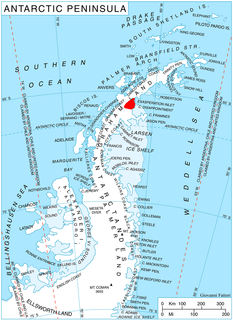
Mount Fedallah is a mountain approximately 1,250 metres (4,100 ft) high, situated east of the Pip Cliffs, on the north side of Flask Glacier, in the south-east foothills of Madrid Dome in Aristotle Mountains, eastern Graham Land Antarctica. It was named by the UK Antarctic Place-Names Committee in 1987, after a crewman of the Pequod in association with other names from Moby-Dick in this area.
Fluke Ridge is a narrow rock ridge rising to about 300 metres (1,000 ft) in southern Aristotle Mountains, on the north side of Flask Glacier near the terminus, on Oscar II Coast, Graham Land, Antarctica. It was named by the UK Antarctic Place-Names Committee in 1987; it is one of several names in the area from Herman Melville's Moby-Dick which reflect a whaling theme.
Herrin Peak is a large snow-covered peak, 1,755 metres (5,760 ft) high, standing 6 nautical miles (11 km) south of Landmark Peak on the east side of Gowan Glacier, in the Heritage Range of Antarctica. It was named by the University of Minnesota Geological Party of 1963–64 for John M. Herrin, a helicopter crew chief with the 62nd Transportation Detachment, who assisted the party.
Matthews Glacier is a glacier on the east side of the Wilkins Mountains, Antarctica, draining south to enter the Ronne Ice Shelf just west of Dodson Peninsula. It was mapped by the United States Geological Survey from surveys and U.S. Navy air photos, 1961–67, and was named by the Advisory Committee on Antarctic Names for J.D. Matthews, an engineman at South Pole Station in 1963.
The Mayer Crags form a rugged V-shaped massif in Antarctica. The feature is 10 nautical miles (19 km) long, surmounted by several sharp peaks, and located at the west side of the mouth of Liv Glacier, where the latter enters the Ross Ice Shelf. It was named by the Advisory Committee on Antarctic Names for Lieutenant Robert V. Mayer, U.S. Navy, a pilot of Hercules aircraft in four Antarctic seasons, and plane commander for a mid-winter evacuation flight on June 26, 1964.
Seaquist Peak is a peak, 800 m, surmounting the northwest end of the Meyer Hills in the Heritage Range. It was mapped by the United States Geological Survey (USGS) from surveys and U.S. Navy air photos from 1961-66. It was named by the Advisory Committee on Antarctic Names (US-ACAN) for Larry R. Seaquist, a United States Antarctic Research Program (USARP) meteorologist at Ellsworth Station in 1961.
Spouter Peak is a conspicuous rock peak, 615 m, standing in eastern Voden Heights 4.5 nautical miles (8 km) south-southwest of Daggoo Peak at the south side of the mouth of Flask Glacier, on the east coast of Graham Land, a portion of the Antarctic Peninsula. Surveyed and partially photographed by the Falkland Islands Dependencies Survey (FIDS) in 1947. Named by the United Kingdom Antarctic Place-Names Committee (UK-APC) in 1956 after the Spouter Inn, New Bedford, where Herman Melville's story Moby-Dick opens.
Mount Rorqual is a peak between Starbuck and Stubb Glaciers in southeastern Aristotle Mountains, 5 nautical miles (9 km) west of Mount Queequeg, on the east side of Graham Land. The feature is rocky and precipitous, rises to 1,110 m and is separated from Cachalot Peak by a narrow ridge. The name is one of a group in the area applied by United Kingdom Antarctic Place-Names Committee (UK-APC) that reflects a whaling theme, the Rorquals being a species of baleen whales.