
Corfe Castle is a village and civil parish in the English county of Dorset. It is the site of a ruined castle of the same name. The village and castle stand over a gap in the Purbeck Hills on the route between Wareham and Swanage. The village lies in the gap below the castle and is around four miles (6.4 km) south-east of Wareham, and four miles (6.4 km) north-northwest of Swanage. Both the main A351 road from Lytchett Minster to Swanage and the Swanage Railway thread their way through the gap and the village.

Clay Cross is a town and a civil parish in the North East Derbyshire district of Derbyshire, England. It is a former industrial and mining town, about 5 miles (8.0 km) south of Chesterfield. It is directly on the A61. Surrounding settlements include North Wingfield, Tupton, Pilsley and Ashover.

Bradfield is a village and civil parish in Berkshire, England. Aside from farms and a smaller amount of woodland its main settlements are Bradfield Southend, its medieval-founded nucleus and the hamlet of Tutts Clump. Bradfield village is the home of the public school Bradfield College.

St Peter's Church is in Church Road, Woolton, Liverpool, Merseyside, England. It is an active Anglican parish church in the deanery of Liverpool South Childwall, the archdeaconry of Liverpool, and the diocese of Liverpool. The church is recorded in the National Heritage List for England as a designated Grade II* listed building. It is one of the largest parish churches in Liverpool, and its bell tower stands at the highest point of the city. The church also has connections with The Beatles.

St Wilfrid's Church stands to the north of the village of Mobberley, Cheshire, England. The church is recorded in the National Heritage List for England as a designated Grade I listed building. It is an active Anglican parish church in the diocese of Chester, the archdeaconry of Macclesfield and the deanery of Knutsford. Alec Clifton-Taylor includes it in his list of 'best' English parish churches.

The Machine Gun Corps Memorial, also known as The Boy David, is a memorial to the casualties of the Machine Gun Corps in the First World War. It is located on the north side of the traffic island at Hyde Park Corner in London, near the Wellington Arch, an Equestrian statue of the Duke of Wellington, the Royal Artillery Memorial, the New Zealand War Memorial, and the Australian War Memorial.

Tregonning Hill is the westerly of two granite hills overlooking Mount's Bay in west Cornwall, England, United Kingdom, the other being Godolphin Hill. They are approximately 6 kilometres (3.7 mi) west of the town of Helston. The Plymouth chemist William Cookworthy mixed china stone with kaolin, mined from the hill to make Plymouth porcelain in 1768; which was the first time hard-paste porcelain was made in Britain. Part of the hill is designated as a Site of Special Scientific Interest (SSSI) and at the date of notification (1994) was the only known site of western rustwort in Great Britain.

The Guards Memorial, also known as the Guards Division War Memorial, is an outdoor war memorial located on the west side of Horse Guards Road, opposite Horse Guards Parade in London, United Kingdom. It commemorates the war dead from the Guards Division and related units during the First World War, and of the Household Division in the Second World War and other conflicts since 1918.

The Chindit Memorial is a war memorial in London, England, that commemorates the Chindit special forces, which served in Burma under Major General Orde Wingate in the Second World War. The memorial was erected in Victoria Embankment Gardens in 1990, near the Ministry of Defence headquarters, and also commemorates Wingate, who died on active service in Burma in 1944. It became a Grade II listed building in August 2020.

St Bartholomew's Church, Clay Cross is a Grade II listed parish church in the Church of England in Clay Cross, Derbyshire.

The York City War Memorial is a First World War memorial designed by Sir Edwin Lutyens and located in York in the north of England. Proposals for commemorating York's war dead originated in 1919 but proved controversial. Initial discussions focused on whether a memorial should be a monument or should take on some utilitarian purpose. Several functional proposals were examined until a public meeting in January 1920 opted for a monument. The city engineer produced a cost estimate and the war memorial committee engaged Lutyens, who had recently been commissioned by the North Eastern Railway (NER) to design their own war memorial, also to be sited in York.
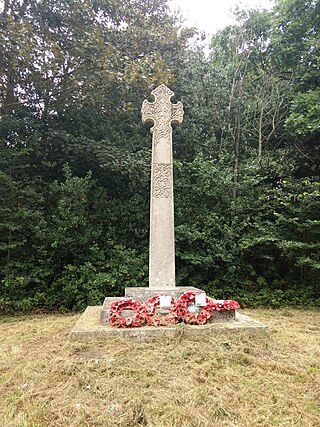
The Monken Hadley War Memorial is located immediately to the north of Monken Hadley at the western end of Camlet Way in Monken Hadley Common. It commemorates the men of the district who died in the First and Second World Wars and is in the form of a tapered decorated column with a celtic cross at the top and the names of the dead shown on the shaft. It was unveiled by Francis Fremantle, Member of Parliament for St Albans, in December 1920. It became a Grade II listed building in April 2017.

Hartburn War Memorial is a First World War Memorial in the village of Hartburn, Northumberland, in the north-east of England. The memorial, designed by Sir Edwin Lutyens, was unveiled in 1921 and is today a grade II listed building.
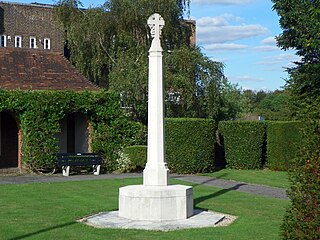
The Hatfield War Memorial is a war memorial beside the Great North Road in Hatfield, Hertfordshire. It was one of 24 war memorials in England designed by Sir Herbert Baker, that were designated as a national collection by Historic England in 2017. The memorial is located near the gates of Hatfield House, and close to Hatfield railway station. It was unveiled in 1921, to commemorate 139 men from Hatfield killed on service during the First World War. A brick pavilion records the names of the dead, with further names added after the Second World War.
Clay Cross is a civil parish in the North East Derbyshire district of Derbyshire, England. The parish contains 13 listed buildings that are recorded in the National Heritage List for England. All the listed buildings are designated at Grade II, the lowest of the three grades, which is applied to "buildings of national importance and special interest". The parish contains the town of Clay Cross and the surrounding area. The listed buildings consist of houses, cottages and associated structures, a church, a milepost, the portals of a railway tunnel, items in a cemetery, and a war memorial.
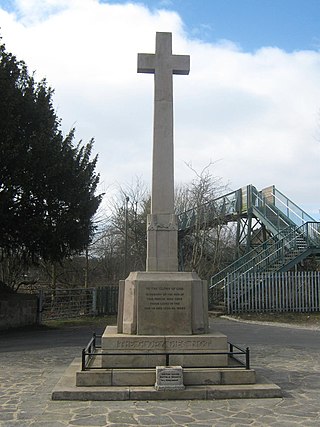
Duffield War Memorial is a 20th-century grade II listed war memorial in Duffield, Derbyshire.


