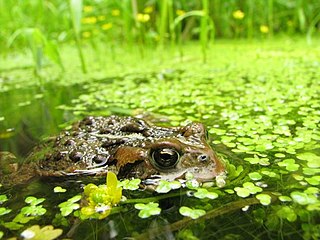
Ecology is the natural science of the relationships among living organisms, including humans, and their physical environment. Ecology considers organisms at the individual, population, community, ecosystem, and biosphere levels. Ecology overlaps with the closely related sciences of biogeography, evolutionary biology, genetics, ethology, and natural history.

An ecosystem is a system that environments and their organisms form through their interaction. The biotic and abiotic components are linked together through nutrient cycles and energy flows.
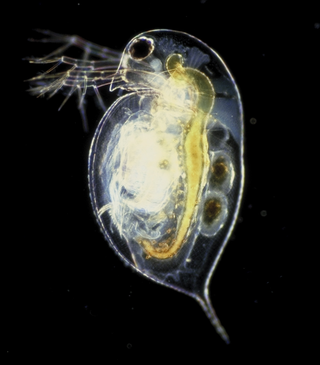
Daphnia is a genus of small planktonic crustaceans, 0.2–6.0 mm (0.01–0.24 in) in length. Daphnia are members of the order Anomopoda, and are one of the several small aquatic crustaceans commonly called water fleas because their saltatory swimming style resembles the movements of fleas. Daphnia spp. live in various aquatic environments ranging from acidic swamps to freshwater lakes and ponds.
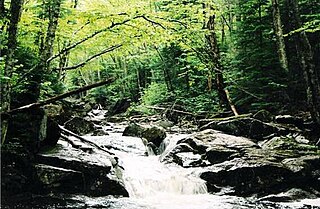
Ecosystem ecology is the integrated study of living (biotic) and non-living (abiotic) components of ecosystems and their interactions within an ecosystem framework. This science examines how ecosystems work and relates this to their components such as chemicals, bedrock, soil, plants, and animals.

Ecological restoration, or ecosystem restoration, is the process of assisting the recovery of an ecosystem that has been degraded, damaged, or destroyed. It is distinct from conservation in that it attempts to retroactively repair already damaged ecosystems rather than take preventative measures. Ecological restoration can reverse biodiversity loss, combat climate change, and support local economies.
The storage effect is a coexistence mechanism proposed in the ecological theory of species coexistence, which tries to explain how such a wide variety of similar species are able to coexist within the same ecological community or guild. The storage effect was originally proposed in the 1980s to explain coexistence in diverse communities of coral reef fish, however it has since been generalized to cover a variety of ecological communities. The theory proposes one way for multiple species to coexist: in a changing environment, no species can be the best under all conditions. Instead, each species must have a unique response to varying environmental conditions, and a way of buffering against the effects of bad years. The storage effect gets its name because each population "stores" the gains in good years or microhabitats (patches) to help it survive population losses in bad years or patches. One strength of this theory is that, unlike most coexistence mechanisms, the storage effect can be measured and quantified, with units of per-capita growth rate.
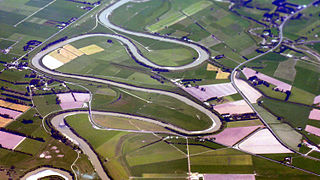
Floodplain restoration is the process of fully or partially restoring a river's floodplain to its original conditions before having been affected by the construction of levees (dikes) and the draining of wetlands and marshes.

The Diplostraca or Cladocera, commonly known as water fleas, is a superorder of small, mostly freshwater crustaceans, most of which feed on microscopic chunks of organic matter, though some forms are predatory.
Carla Cáceres is a professor at the University of Illinois Urbana-Champaign known for her research in population, community and evolutionary ecology, focusing on the origins, maintenance, and functional significance of biodiversity within ecosystems. She is a Fellow of the American Association for the Advancement of Science, the Ecological Society of America, and the Association for the Sciences of Limnology and Oceanography
Niwot Ridge is an alpine ecology research station located 65 km northwest of Denver in north-central Colorado. It is on the Front Range of the southern Rocky Mountains and lies within the Roosevelt National Forest. Niwot Ridge is 2,900 metres (9,500 ft) high.
Nancy Huntly is an American ecologist based at Utah State University, where she is a Professor in the Department of Biology and director of the USU Ecology Center. Her research has been on biodiversity, herbivory, and long-term human ecology. She started her position at USU in 2011, after serving as a Program Officer in the Division of Environmental Biology at the National Science Foundation. Prior to that she was a faculty member in the Department of Biological Sciences at Idaho State University (Pocatello).
Wendy Yang is an associate professor of Plant Biology and Geology at the University of Illinois Urbana-Champaign where she works on soil biogeochemistry and ecosystem ecology.
Whendee Silver is an American ecosystem ecologist and biogeochemist.

Erika Marín-Spiotta is a biogeochemist and ecosystem ecologist. She is currently Professor of Geography at the University of Wisconsin-Madison. She is best-known for her research of the terrestrial carbon cycle and is an advocate for underrepresented groups in the sciences, specifically women.
Jana Compton is a research ecologist for the United States Environmental Protection Agency's (EPA) office of research and development. Her work focuses on identifying sources of nitrogen pollution and connecting those issues to how they effect our ecosystem services.
Zoe G. Cardon is an American ecosystems ecologist focused on observing and understanding ecosystem interactions in the rhizosphere. She has also played an integral role in developing systems to better study the rhizosphere without digging it up and interfering with the ecosystems using stable isotopes and mathematical modeling. Cardon is currently a senior scientist at the Marine Biology Laboratory at the Ecosystems Center and an adjunct professor of ecology and evolutionary biology at Brown University. She is credited with helping to establish the National Microbiome Initiative at the White House Office of Science and Technology Policy in Washington, D.C.
Anna Amelia Sher is an American plant ecologist who is a professor at the University of Denver. She works on conservation and the restoration of areas invaded by Tamarix. She is the author of two textbooks, Ecology:Concepts and Applications and Introduction to conservation biology.
Kate Lajtha is an ecologist known for her use of stable isotopes to examine biogeochemical cycling in soils.
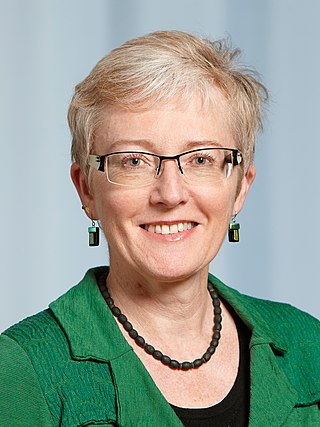
Nina Buchmann is a German ecologist known for her research on the physiology of plants and the impact of plants on biogeochemical cycling. She is a member of the German National Academy of Sciences Leopoldina and an elected fellow of the American Geophysical Union.
Travis E. Huxman is an American plant physiological ecologist.

