
Degradation may refer to:
Degradation may refer to:


A knight is a person granted an honorary title of knighthood by a head of state or representative for service to the monarch, the church or the country, especially in a military capacity. Knighthood finds origins in the Greek hippeis and hoplite (ἱππεῖς) and Roman eques and centurion of classical antiquity.
Non-judicial punishment is a disciplinary measure that may be applied to individual military personnel, without a need for a court martial or similar proceedings.
In the United Kingdom and the British Overseas Territories, personal bravery, achievement, or service are rewarded with honours. The honours system consists of three types of award:
A general officer is an officer of high rank in the armies, and in some nations' air forces, space forces, and marines or naval infantry.

The Most Excellent Order of the British Empire is a British order of chivalry, rewarding contributions to the arts and sciences, work with charitable and welfare organisations, and public service outside the civil service. It was established on 4 June 1917 by King George V and comprises five classes across both civil and military divisions, the most senior two of which make the recipient either a knight if male or dame if female. There is also the related British Empire Medal, whose recipients are affiliated with, but not members of, the order.
Sir is a formal honorific address in English for men, derived from Sire in the High Middle Ages. Both are derived from the old French "Sieur" (Lord), brought to England by the French-speaking Normans, and which now exist in French only as part of "Monsieur", with the equivalent "My Lord" in English. Traditionally, as governed by law and custom, Sir is used for men who are knights and belong to certain orders of chivalry, as well as later applied to baronets and other offices. As the female equivalent for knighthood is damehood, the suo jure female equivalent term is typically Dame. The wife of a knight or baronet tends to be addressed as Lady, although a few exceptions and interchanges of these uses exist.
Commander is a common naval officer rank as well as a job title or "billet" in many armies. Commander is also used as a rank or title in other formal organizations, including several police forces. In several countries this naval rank is termed frigate captain.

A police officer is a warranted law employee of a police force. In most countries, "police officer" is a generic term not specifying a particular rank. In some, the use of the rank "officer" is legally reserved for military personnel.

The Most Honourable Order of the Bath is a British order of chivalry founded by George I on 18 May 1725. The name derives from the elaborate medieval ceremony for appointing a knight, which involved bathing as one of its elements. The knights so created were known as "Knights of the Bath". George I "erected the Knights of the Bath into a regular Military Order". He did not revive the Order of the Bath, since it had never previously existed as an Order, in the sense of a body of knights who were governed by a set of statutes and whose numbers were replenished when vacancies occurred.
In the United States Navy, officers have various ranks. Equivalency between services is by pay grade. United States Navy commissioned officer ranks have two distinct sets of rank insignia: On dress uniform a series of stripes similar to Commonwealth naval ranks are worn; on service khaki, working uniforms, and special uniform situations, the rank insignia are identical to the equivalent rank in the US Marine Corps.

A military discharge is given when a member of the armed forces is released from their obligation to serve. Each country's military has different types of discharge. They are generally based on whether the persons completed their training and then fully and satisfactorily completed their term of service. Other types of discharge are based on factors such as the quality of their service, whether their service had to be ended prematurely due to humanitarian or medical reasons, whether they had been found to have drug or alcohol dependency issues and whether they were complying with treatment and counseling, and whether they had demerits or punishments for infractions or were convicted of any crimes. These factors affect whether they will be asked or allowed to re-enlist and whether they qualify for benefits after their discharge.
CPO may refer to:

The Equestrian Order of the Holy Sepulchre of Jerusalem, also called Order of the Holy Sepulchre or Knights of the Holy Sepulchre, is a Catholic order of knighthood under the protection of the Holy See. The pope is the sovereign of the order.
Ennoblement is the conferring of nobility—the induction of an individual into the noble class. Currently only a few kingdoms still grant nobility to people; among them Spain, the United Kingdom, Belgium and the Vatican. Depending on time and region, various laws have governed who could be ennobled and how. Typically, nobility was conferred on individuals who had assisted the sovereign. In some countries, this degenerated into the buying of patents of nobility, whereby rich commoners could purchase a title of nobility.

The accolade was the central act in the rite of passage ceremonies conferring knighthood in the Middle Ages. From about 1852, the term accolade was used much more generally to mean "praise" or "award" or "honour".
Commander, or Knight Commander, is a title of honor prevalent in chivalric orders and fraternal orders.
Administration may refer to:
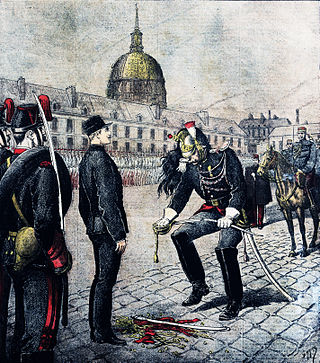
Reduction in rank may refer to three separate concepts:
"Dressing down" or "dressing-down" is an English-language idiom that may refer to:

The Royal Phalanx was a military body composed of veteran officers of the Greek War of Independence, established on 18 September 1835. The Phalanx entailed military garrison duties, but mostly it was an honorific appointment, and a means to sustain veteran soldiers who had no other means of upkeep.