Related Research Articles

Tiruchirappalli, also called Tiruchi or Trichy, is a major tier II city in the Indian state of Tamil Nadu and the administrative headquarters of Tiruchirappalli district. The city is credited with being the best livable city, the cleanest city of Tamil Nadu, as well as the fifth safest city for women in India. It is the fourth largest city as well as the fourth largest urban agglomeration in the state. Located 322 kilometres (200 mi) south of Chennai and 374 kilometres (232 mi) north of Kanyakumari, Tiruchirappalli sits almost at the geographic centre of Tamil Nadu state. The Cauvery Delta begins 16 kilometres (9.9 mi) west of the city where the Kaveri river splits into two, forming the island of Srirangam which is now incorporated into the Tiruchirappalli City Municipal Corporation. The city occupies an area of 167.23 square kilometres (64.57 sq mi) and had a population of 916,857 in 2011.
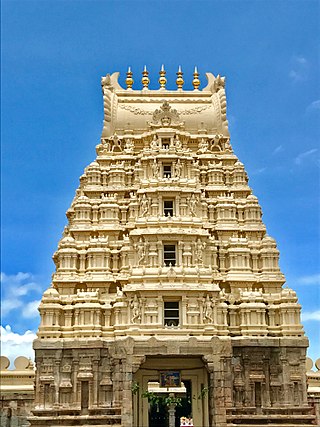
Srirangapatna is a town and headquarters of one of the seven Taluks of Mandya district, in the Indian State of Karnataka. It gets its name from the Ranganthaswamy temple consecrated around 984 CE. Later, under the British rule, the city was renamed to Seringapatnam. Located near the city of Mandya, it is of religious, cultural and historic importance.
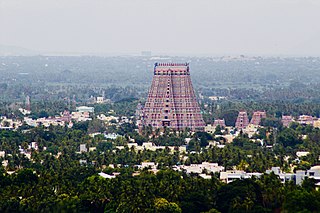
Srirangam is a neighbourhood in the city of Tiruchirappalli in the Indian state of Tamil Nadu. A river island, Srirangam is bounded by the Kaveri River on one side and its distributary Kollidam on the other side. Considered as the first among the 108 Divya Desams, a group of Vishnu temples, it is famous for the Sri Ranganathaswamy Temple, the largest temple complex in India and the biggest functioning Hindu temple in the world. Srirangam is also home to a significant population of Sri Vaishnavas.

Namakkal is a City and the headquarters of Namakkal district in the Indian state of Tamil Nadu. It is the first ISO 14001-2004 certified municipality in Asia for environmental management, specifically the provision and maintenance of water supply, solid waste and sewage management, town planning, lighting and other social services. Namakkal is known as the Egg City due to its large egg production and Transport city.

Saurashtra is an Indo-Aryan language spoken primarily by the Saurashtrians of Southern India who migrated from the Lata region of present-day Gujarat to south of Vindhyas in the Middle Ages.
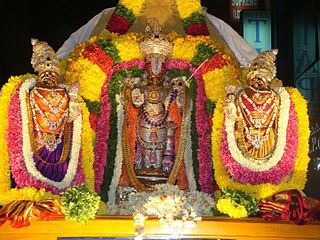
Ranganatha, also known as Ranganathar, Rangan, Aranganathar, SriRanga, and Thenarangathan, is a Hindu deity with his origin in southern India, serving as the chief deity of the Sri Ranganathaswamy Temple, Srirangam. The deity is a resting form of Vishnu, recumbent on the great form of the serpent god Adishesha, the king of the serpents. His primary consort is the goddess Lakshmi, also known as Ranganayaki. The two other consorts seen next to his recumbent figure are Bhudevi and Nila Devi. Most of the deities portray a 'smiling' lord in a sleeping or reclining position over the celestial serpent Adishesha in the sea of cosmic dissolution (pralaya). This is the form in which he is open to listening to all of his devotees' woes, and blesses them. Apart from being worshipped by all Hindus, this form is of particular importance to the Sri Vaishnava community. His name in Sanskrit means "leader of the place of assembly", coined from the two Sanskrit words ranga (place) and natha.

Kallanai is an ancient dam built by Karikala of Chola dynasty in 150 CE. It is built across the Kaveri river flowing from Tiruchirapalli District to Thanjavur district, Tamil Nadu, India. The dam is located in Thanjavur district, 15 km from Tiruchirapalli and 45 km from Thanjavur. It is the fourth oldest water-diversion or water-regulator structure in the world and the oldest in India that is still in use. Because of its spectacular architecture, it is one of the prime tourist spots in Tamil Nadu.

Chola Nadu is a cultural region of the Tamil Nadu state in southern India. It encompasses the lower reaches of the Kaveri River and its delta, and formed the cultural homeland and political base of the Chola Dynasty which ruled large parts of South India and parts of Sri Lanka between the 9th and 13th centuries CE. Uraiyur served as the early Chola capital, then medieval Cholas shifted to Thanjavur and later cholas king Rajendra Chola I moved the capital to Gangaikonda Cholapuram in Ariyalur in the 11th century CE.

Tiruchirappalli District is one of the 38 districts, located along the Kaveri River, in Tamil Nadu, India. The headquarters of the district is the city of Tiruchirappalli.

Ucchi Pillayar Temple is a 7th-century Hindu temple, one dedicated to Lord Ganesha located a top of Rock Fort, Trichy, Tamil Nadu, India. According to legend, this rock is the place where Lord Ganesha ran from King Vibishana, after establishing the Ranganathaswamy deity in Srirangam. Tiruchirapalli Rock Fort is also fondly called as Malaikottai in Tamil.
Tamil Nadu is one of the 28 states of India. Its capital and largest city is Chennai. Tamil Nadu lies in the southernmost part of the Indian Peninsula and is bordered by the States of Puducherry, Kerala, Karnataka and Andhra Pradesh. It is the tenth-largest state in India and the seventh most populous state.

The Tiruchirappalli City Municipal Corporation is the municipal corporation which looks after the city administration of Tiruchirappalli in Tamil Nadu, India. It consists of a legislative and an executive body. The legislative body is headed by the city mayor while the executive body is headed by a Chief Commissioner.
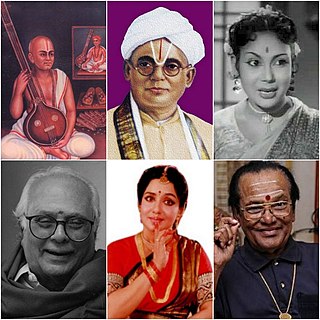
The Saurashtra people, or Saurashtrians, are an Indo-Aryan ethno-linguistic Gujarati Hindu Brahmin community of South India who speak the Saurashtra language, an Indo-Aryan Gujarati language, and predominantly reside in the Indian states of Tamil Nadu, Kerala, Andhra Pradesh and Karnataka.
The Trichinopoly district was a district of the erstwhile Madras Presidency of British India. It covered the present-day districts of Tiruchirappalli, Karur, Ariyalur and Perambalur in the Indian state of Tamil Nadu. The administrative headquarters was the town of Trichinopoly, Trichy or Tiruchi, now known as Tiruchirappalli. The district covered an area of 2,632 square miles (6,820 km2) in 1907. It was bound by the districts of South Arcot to the north, Salem to the west, Coimbatore to the west and north-west, Tanjore to the east and Madurai to the south. The princely state of Pudukkottai remained within the jurisdiction of Trichinopoly district from 1865 to 1947.

Tiruchirappalli is believed to be of great antiquity and has been ruled by the Early Cholas, Mutharaiyars Early Pandyas, Pallavas, Medieval Cholas, Later Cholas, Later Pandyas, Delhi Sultanate, Ma'bar Sultanate, Vijayanagar Empire, Nayak Dynasty, the Carnatic state and the British at different times. The archaeologically important town of Uraiyur which served as the capital of the Early Cholas is a Neighborhood of Tiruchirapalli.

Tiruchirappalli has a well-developed transport infrastructure. Being located almost at the geographic centre of the state Tamil Nadu India, Tiruchirappalli is well connected by Road, Rail and Air with most cities.

Tiruchirappalli (Tamil: திருச்சிராப்பள்ளி, also called Tiruchi or Trichy, is a city in the Indian state of Tamil Nadu and the administrative headquarters of Tiruchirapalli District. It is the fourth largest municipal corporation in Tamil Nadu and also the fourth largest urban agglomeration in the state. It is located almost at the geographic centre of the state.

Thuvarankurichi is a town in Tiruchirappalli district in the Chola Nadu region of the Indian state of Tamil Nadu. It is situated 65 kilometers away from both Tiruchirappalli and Madurai. The town is located within the drainage basin of the Vellar River.
The Tiruchirappalli Metropolitan Area, or Tiruchirappalli Urban Agglomeration, is the 51st largest urban agglomeration in India and is the fourth largest metropolitan city in the state of Tamil Nadu next to Chennai, Coimbatore and Madurai. The Tiruchirappalli Metropolitan Area consists of the city of Tiruchirappalli and its suburbs in Tiruchirappalli district.
References
- ↑ "Primary Census Abstract Data of Tamil Nadu". Directorate of Census Operations. Archived from the original on 17 February 2011. Retrieved 12 May 2011.
- 1 2 "Table C-01 Population by Religion: Tamil Nadu". censusindia.gov.in. Registrar General and Census Commissioner of India. 2011.
- 1 2 3 Imperial Gazetteer of India 1908, p. 43.
- 1 2 3 4 Census of India 1941.
- 1 2 Ministry of Health and Family Welfare 1966, p. 226.
- ↑ Rajendran, Arumugam & Chandrasekaran 2002, p. 3.
- ↑ Malayala Manorama 2007, p. 707.
- ↑ "Table 2: Cities having population 1 lakh and above" (PDF). Provisional Population Totals. Government of India. Retrieved 19 October 2011.
- ↑ Francis 1989, p. 26.
- ↑ Hunter 1908, p. 257.
- ↑ Johnson 2001, p. 257.
- ↑ Palanithurai 2007, p. 80.
- ↑ Census of India 1971, p. 88.
- ↑ "Bakrid celebrated in Trichy with gaiety". The Hindu . India. 10 December 2008. Archived from the original on 14 December 2008. Retrieved 11 May 2011.
- ↑ "Lt. Governor felicitated". The Hindu . India. 29 December 2010. Archived from the original on 3 January 2011. Retrieved 11 May 2011.
- ↑ "Jain Sangh celebrates Mahaveer Jayanthi". The Hindu . India. 17 April 2011. Archived from the original on 23 April 2011. Retrieved 11 May 2011.
- ↑ "Tiruchirapalli Diocese – History". Catholic Bishops Conference of India. 12 May 2011. Archived from the original on 4 May 2012.
- ↑ "Provincial Directory: Trichy-Tanjore". Anglican Consultative Council. Retrieved 11 May 2011.
- ↑ Deefholts, & Acharya 2006, p. 205.
- ↑ "Table C-16 Population by Mother Tongue: Tamil Nadu". Census of India . Registrar General and Census Commissioner of India.
- ↑ Sen 1991, p. 606.
- ↑ Ramappa & Singh 1984, p. 116.
- ↑ Ramesh, T. A. (15 January 2006). "The Unwritten History of the Saurashtrians of South India". boloji.com. Archived from the original on 14 January 2010. Retrieved 18 August 2013.
- ↑ Muthanna 1962, p. iii.
- ↑ Agesthialingom & Gowda 1976, p. 264.
- ↑ "Language Variation in Tamil". Language Information Service. Retrieved 12 May 2011.
- ↑ Thurston 1913, p. 123.
- ↑ "Sri Lankan Tamil refugees wish for Indian citizenship". The Hindu. India. 3 November 2009. Retrieved 11 May 2011.