Related Research Articles
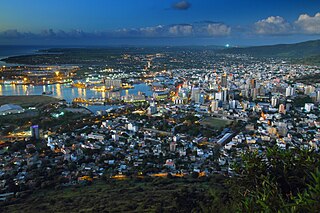
The economy of Mauritius is a mixed developing economy based on agriculture, exports, financial services, and tourism. Since the 1980s, the government of Mauritius has sought to diversify the country's economy beyond its dependence on just agriculture, particularly sugar production.
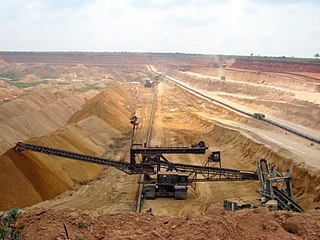
The economy of Togo has struggled greatly. The International Monetary Fund (IMF) ranks it as the tenth poorest country in the world, with development undercut by political instability, lowered commodity prices, and external debts. While industry and services play a role, the economy is dependent on subsistence agriculture, with industrialization and regional banking suffering major setbacks.

The International Bank for Reconstruction and Development (IBRD) is an international financial institution, established in 1944 and headquartered in Washington, D.C., United States, that is the lending arm of World Bank Group. The IBRD offers loans to middle-income developing countries. The IBRD is the first of five member institutions that compose the World Bank Group. The initial mission of the IBRD in 1944, was to finance the reconstruction of European nations devastated by World War II. The IBRD and its concessional lending arm, the International Development Association (IDA), are collectively known as the World Bank as they share the same leadership and staff.
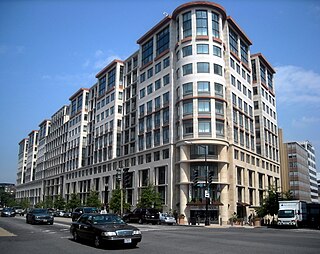
The International Finance Corporation (IFC) is an international financial institution that offers investment, advisory, and asset-management services to encourage private-sector development in less developed countries. The IFC is a member of the World Bank Group and is headquartered in Washington, D.C. in the United States.

The International Development Association (IDA) is an international financial institution which offers concessional loans and grants to the world's poorest developing countries. The IDA is a member of the World Bank Group and is headquartered in Washington, D.C. in the United States. It was established in 1960 to complement the existing International Bank for Reconstruction and Development by lending to developing countries which suffer from the lowest gross national income, from troubled creditworthiness, or from the lowest per capita income. Together, the International Development Association and International Bank for Reconstruction and Development are collectively generally known as the World Bank, as they follow the same executive leadership and operate with the same staff.
The United States Agency for International Development (USAID) is an independent agency of the United States federal government that is primarily responsible for administering civilian foreign aid and development assistance. With a budget of over $27 billion, USAID is one of the largest official aid agencies in the world and accounts for more than half of all U.S. foreign assistance—the highest in the world in absolute dollar terms.

The Overseas Private Investment Corporation (OPIC) was the United States government's development finance institution until it merged with the Development Credit Authority (DCA) of the United States Agency for International Development (USAID) to form the U.S. International Development Finance Corporation (DFC). OPIC mobilized private capital to help solve critical development challenges and, in doing so, advanced the foreign policy of the United States and national security objectives.

The Bank of Korea is the central bank of the Republic of Korea and issuer of Korean Republic won. It was established on 12 June 1950 in Seoul, South Korea.
Structural adjustment programs (SAPs) consist of loans provided by the International Monetary Fund (IMF) and the World Bank (WB) to countries that experience economic crises. Their purpose is to adjust the country's economic structure, improve international competitiveness, and restore its balance of payments.

Development aid is aid given by governments and other agencies to support the economic, environmental, social, and political development of developing countries. Closely-related concepts include: foreign aid,international aid, overseas aid, developmental aid, developmentassistance, official development assistance (ODA), development cooperation and technical assistance. It is distinguished from humanitarian aid by aiming at a sustained improvement in the conditions in a developing country, rather than short-term relief. Development aid is thus widely seen as a major way to meet Sustainable Development Goal 1 for the developing nations.

The Economic Development Board (EDB) is a statutory board under the Ministry of Trade and Industry of the Government of Singapore that plans and executes strategies to sustain Singapore as a leading global hub for business and investment.
An export credit agency or investment insurance agency is a private or quasi-governmental institution that acts as an intermediary between national governments and exporters to issue export insurance solutions, guarantees for financing. The financing can take the form of credits or credit insurance and guarantees or both, depending on the mandate the ECA has been given by its government. ECAs can also offer credit or cover on their own account. This does not differ from normal banking activities. Some agencies are government-sponsored, others private, and others a combination of the two.
A community development financial institution (US) or community development finance institution (UK) - abbreviated in both cases to CDFI - is a financial institution that provides credit and financial services to underserved markets and populations, primarily in the USA but also in the UK. A CDFI may be a community development bank, a community development credit union (CDCU), a community development loan fund (CDLF), a community development venture capital fund (CDVC), a microenterprise development loan fund, or a community development corporation.
Nepal relies heavily on foreign aid, and donors coordinate development aid policy through the Nepal Development Forum, whose members include donor countries, international financial institutions, and inter-governmental organizations. The United Kingdom is Nepal's largest bilateral aid donor, and the World Bank and Asian Development Bank are the largest multilateral donors. Donors have been reported as losing confidence in Nepal as a result of political interference and corruption in poverty relief efforts as well as the country's apparently poor capacity to utilize aid. According to World Bank figures, official development assistance increased from US$8.2 million in 1960 to US$369 million in 2003 and then fell to US$177 million in 2004. According to Nepal's Ministry of Finance, total foreign aid committed in fiscal year (FY) 2003 was US$555 million, with 63.3 percent in grants and 36.7 percent in loans. In FY2004, total foreign aid committed was US$320 million, of which 37.7 percent was grants and 62.3 percent, loans. In June 2004, active World Bank credits totaled US$302 million, with the greatest portions allocated to the financial sector and to energy and mining. By the end of 2012, the outstanding World Bank IDA loan totaled $ 1.48 billion.
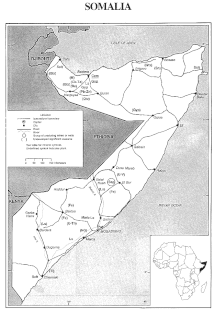
Economic history of Somalia is related to the development of Somalia's economy in the last two centuries.

The Kuwait Fund for Arab Economic Development (KFAED), commonly known as the Kuwait Fund, is the State of Kuwait’s agency for the provision and administration of financial and technical assistance to developing countries.
Conservation finance is the practice of raising and managing capital to support land, water, and resource conservation. Conservation financing options vary by source from public, private, and nonprofit funders; by type from loans, to grants, to tax incentives, to market mechanisms; and by scale ranging from federal to state, national to local.

The World Bank is an international financial institution that provides loans and grants to the governments of low- and middle-income countries for the purpose of pursuing capital projects. It comprises two institutions: the International Bank for Reconstruction and Development (IBRD), and the International Development Association (IDA). The World Bank is a component of the World Bank Group.
The U.S. Russia Investment Fund (TUSRIF) was an investment fund from 1995 to 2008. It was established by the United States government to make private investments in the Russian economy. By 2005, it had invested $300 million in 44 Russian companies, including DeltaBank, the first bank to sell credit cards in Russia, and DeltaCredit, the first bank to sell residential mortgages in Russia. TUSRIF was replaced by the U.S. Russia Foundation (USRF) in 2008, while its financial arm, Delta Private Equity Partners, was purchased by Deutsche Bank in 2009.

Malaysia's independence in 1957 was a catalyst for growth. As the nation took charge of managing its own affairs, it continued to develop the goals and means necessary for a financial structure conducive to the economic growth observed today. Critical to the transition of Malaysia from a low-income country to one of high-income status has been the expansion of its economy. From a commodity and agricultural-based economy, the Southeast Asian nation is transitioning to a leading exporter of more complex goods. As the nation opens up to trade and investment, the World Bank and the International Bank for Reconstruction and Development (IBRD) and International Development Association (IDA) continue to assist with its development.
References
- ↑ Osmańczyk, Edmund Jan; Anthony Mango (2003). Anthony Mango (ed.). Encyclopedia of the United Nations and International Agreements: T to Z (3 ed.). Taylor & Francis. pp. 2546–2547. ISBN 978-0-415-93924-9.
- ↑ Wood, Robert Everett (1986). From Marshall Plan to debt crisis: foreign aid and development choices in the world economy. Studies in international political economy. 15. University of California Press. p. 120. ISBN 978-0-520-05868-2.
- ↑ Operations of the Development Loan Fund;. Washington. 1960-01-01. hdl:2027/mdp.39015070439073.


