
The IAI Heron (Machatz-1) is a medium-altitude long-endurance unmanned aerial vehicle (UAV) developed by the Malat (UAV) division of Israel Aerospace Industries. It is capable of Medium Altitude Long Endurance (MALE) operations of up to 52 hours' duration at up to 10.5 km (35,000 ft). It has demonstrated 52 hours of continuous flight, but the effective operational maximal flight duration is less, according to payload and flight profile. An advanced version, the Heron TP, is also known as the IAI Eitan.

Elbit Systems Ltd. is an Israel-based international military technology company and defense contractor. Founded in 1966 by Elron, Elbit Systems is the primary provider of the Israeli military's land-based equipment and unmanned aerial vehicles. It is an important company within the defense industry of Israel.

The Thales Watchkeeper WK450 is an unmanned aerial vehicle (UAV) for all weather, intelligence, surveillance, target acquisition, and reconnaissance (ISTAR) used by the British Army. It is provided under an £800 million contract with UAV Tactical Systems (U-TacS), a joint venture of Elbit Systems UK and Thales UK, and is based on Elbit's Hermes 450.

RANGER is a tactical UAV system (TUAV) built as a Swiss-Israeli joint venture between Swiss aerospace enterprise RUAG Aviation and Israeli aerospace company Israel Aerospace Industries. Its design and some of its technology is based on the Scout UAV system by Israel Aerospace Industries.

The Elbit Hermes 450 is an Israeli medium-sized multi-payload unmanned aerial vehicle (UAV) designed for tactical long endurance missions. It has an endurance of over 20 hours, with a primary mission of reconnaissance, surveillance and communications relay. Payload options include electro-optical/infrared sensors, communications and electronic intelligence, synthetic-aperture radar/ground-moving target indication, electronic warfare, and hyperspectral sensors.

The Elbit Systems Skylark I and Skylark II are miniature UAVs developed by Elbit Systems. Initial models of the Skylark entered service in 2008.

The IAI Searcher is a reconnaissance UAV developed in Israel in the 1980s. In the following decade, it replaced the IMI Mastiff and IAI Scout UAVs then in service with the Israeli Army.

The IAI Eitan is an unmanned reconnaissance aircraft developed in Israel in the early 21st century by the Malat division of Israel Aerospace Industries. The aircraft is a newer version of the IAI Heron. Along with intelligence, surveillance, target acquisition, and reconnaissance (ISTR), Israeli IAI Eitan also capable of holding armed roles. All exports of the aircraft are unarmed.

Tata Advanced Systems Limited (TASL) is an Indian aerospace manufacturing, military engineering and defense technology company. It is a fully owned subsidiary of Tata Sons, a holding company for the Tata Group.
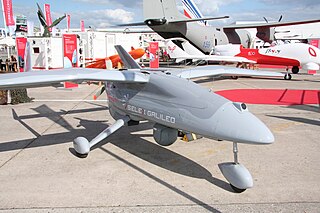
The Falco is a tactical unmanned aerial vehicle (UAV) designed and produced by Selex ES. The UAV is designed to be a medium-altitude, medium-endurance surveillance platform capable of carrying a range of payloads, including several types of high-resolution sensors. A larger variant, the Falco EVO, is capable of carrying larger payloads is also available. Neither system is designed to carry weapons, The launch customer, Pakistan, reportedly wanted the Falco armed, a request that Italy rejected.
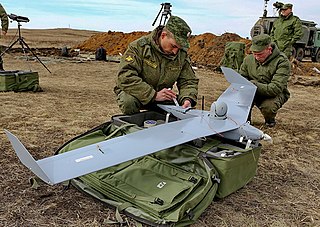
IAI Bird-Eye is a family of mini-UAVs developed by Israel Aerospace Industries (IAI) Malat division. Designed for military and paramilitary intelligence, surveillance and reconnaissance missions.

The Elbit Systems Hermes 900 Kochav ("Star") is an Israeli medium-size, multi-payload, medium-altitude long-endurance unmanned aerial vehicle (UAV) designed for tactical missions. It is a successor to the Hermes 450 series of drones, one of the most widely used military drones in the world.
The Indian Air Force has been undergoing a modernization program to replace and upgrade outdated equipment since the late 1990s to meet modern standards. For that reason, it has started procuring and developing aircraft, weapons, associated technologies, and infrastructures. Some of these programs date back to the late 1980s. The primary focus of current modernization and upgrades is to replace aircraft purchased from the Soviet Union that currently form the backbone of the air force.
The "Pawan" is a joint venture unmanned aerial vehicle (UAV) project being developed by India's ADE, a division of DRDO and the Israel Aircraft Industries, for the Indian Armed Forces which began in 2006. The Pawan will be comparable in size and capabilities to Israel's Elbit Hermes 180, EyeView and Silver Arrow drones. The 120-kilogram Pawan will have day-and-night surveillance capability, an endurance of five hours and a range of 150 kilometers.

Adani Enterprises Limited (AEL) is an Indian multinational publicly-listed holding company and a part of Adani Group. It is headquartered in Ahmedabad and primarily involved in mining and trading of coal and iron ore. Through its various subsidiaries, it also has business interests in airport operations, edible oils, road, rail and water infrastructure, data centers, and solar manufacturing, among others.
IAI-HAL NRUAV is a unmanned rotorcraft project being co-developed by Malat Solutions, a unit of IAI of Israel, and HAL of India for the Indian Navy.

The Tactical Airborne Platform for Aerial Surveillance Beyond Horizon-201 or TAPAS BH-201(Sanskrit: तपस् ; lit. Heat) is a medium-altitude long-endurance (MALE) unmanned aerial vehicle (UAV) being developed in India by Aeronautical Development Establishment (ADE) on the lines of General Atomics MQ-1 Predator.


