
Geomorphology is the scientific study of the origin and evolution of topographic and bathymetric features generated by physical, chemical or biological processes operating at or near Earth's surface. Geomorphologists seek to understand why landscapes look the way they do, to understand landform and terrain history and dynamics and to predict changes through a combination of field observations, physical experiments and numerical modeling. Geomorphologists work within disciplines such as physical geography, geology, geodesy, engineering geology, archaeology, climatology, and geotechnical engineering. This broad base of interests contributes to many research styles and interests within the field.

The Geological Society of America (GSA) is a nonprofit organization dedicated to the advancement of the geosciences.
Kirk Bryan was an American geologist on the faculty of Harvard University from 1925 until his death in 1950.
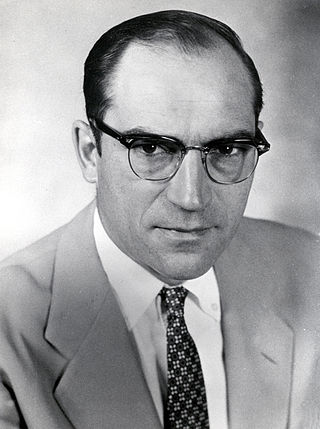
Luna Bergere Leopold was a leading U.S. geomorphologist and hydrologist, and son of Aldo Leopold. He received a B.S. in civil engineering from the University of Wisconsin in 1936; an M.S. in physics-meteorology from the University of California, Los Angeles in 1944; and a Ph.D. in geology from Harvard University in 1950.
The G. K. Gilbert Award is presented annually by the Planetary Geology Division of the Geological Society of America for outstanding contributions to the solution of fundamental problems in planetary geology in the broadest sense, which includes geochemistry, mineralogy, petrology, geophysics, geologic mapping, and remote sensing. Such contributions may consist either of a single outstanding publication or a series of publications that have had great influence in the field. The award is named for the pioneering geologist G. K. Gilbert. This award is not to be confused with the G. K. Gilbert Award for Excellence in Geomorphological Research given by the American Association of Geographers, or the G.K. Gilbert Award in Surface Processes given by the Earth and Planetary Surface Processes Section of the American Geophysical Union.
The Kirk Bryan Award is the annual award of the Quaternary Geology and Geomorphology Division of the Geological Society of America. It is named after Kirk Bryan, a pioneer in geomorphology of arid regions. The award was established in 1951 and is bestowed upon the author or authors of a published paper of distinction advancing the science of geomorphology or some related field.
Robert Phillip Sharp was an American geomorphologist and expert on the geological surfaces of the Earth and the planet Mars. Sharp served as the chairman of the Division of Geological Sciences at California Institute of Technology (Caltech) from 1952 to 1968. He built the modern department and especially recruited new faculty in geochemistry, tectonic geomorphology, planetary science, and field geology.
Marie Morisawa was an American geomorphologist. Morisawa was an integral part of the revolution in the field that began in the 1950s. She studied the geomorphology of rivers, active fault zones, plate tectonics, coastal geomorphology, geological hazards, and environmental geomorphology.
James W. Head III is the Louis and Elizabeth Scherck Distinguished Professor of Geological Sciences at Brown University. He studies the roles of volcanism in planetary crusts as well as the geological evolution of Mars, and has served as the investigator on many major international planetary investigation missions.
John Thomas Andrews is a British-American geologist and professor emeritus of geological and atmospheric and oceanic sciences at the University of Colorado Boulder's Institute of Arctic and Alpine Research (INSTAAR), in Boulder, Colorado, USA.

Christopher Aiden-Lee Jackson is a British geoscientist, science communicator and Director of Sustainable Geoscience at Jacobs Engineering Group. He was previously Professor of Sustainable Geoscience at the University of Manchester, and before that held the Equinor Chair of Basin Analysis at Imperial College, London. He is known for his work in geoscience, especially in the use of 3D seismic data to understand dynamic processes in sedimentary basins.
Legacy sediment (LS) is depositional bodies of sediment inherited from the increase of human activities since the Neolithic. These include a broad range of land use and land cover changes, such as agricultural clearance, lumbering and clearance of native vegetation, mining, road building, urbanization, as well as alterations brought to river systems in the form of dams and other engineering structures meant to control and regulate natural fluvial processes (erosion, deposition, lateral migration, meandering). The concept of LS is used in geomorphology, ecology, as well as in water quality and toxicological studies.
Caroline Masiello is a biogeochemist who develops tools to better understand the cycling and fate of globally relevant elemental cycles. She is a professor at Rice University in the Department of Earth, Environmental and Planetary Sciences and holds joint appointments in the Chemistry and Biochemistry Departments. Masiello was elected as a Fellow of the Geological Society of America in 2017. She currently leads an interdisciplinary team of scientists who are developing microbial sensors for earth system science.
Laurel G. Larsen is an associate professor of earth systems science for the Department of Geography and Civil and Environmental Engineering at the University of California, Berkeley where she also heads the Environmental Systems Dynamics Laboratory. Her areas of expertise include hydroecology, geomorphology, complex systems, and environmental modeling.
Ashok Kumar Singhvi is an Indian geoscientist and former Dean of Physical Research Laboratory. His field of expertise is Geophysics, Quaternary Sciences and Quantitative Geomorphology.
Carmala Nina Garzione is an American geologist who is Professor of Geosciences and Dean of the College of Science at the University of Arizona. Previously, she was Associate Provost for Faculty Affairs at the Rochester Institute of Technology, and prior to that she was a professor at the University of Rochester. She was awarded the 2009 Blavatnik Awards for Young Scientists.
Dörthe Tetzlaff is a German hydrologist who is Professor of Ecohydrology at Humboldt University zu Berlin and Head of Department at the Leibniz-Institute of Freshwater Ecology and Inland Fisheries, Berlin, Germany, since 2017. Tetzlaff was appointed Fellow of the Royal Society of Edinburgh in 2017, Fellow of the American Geophysical Union in 2018, Honorary Fellow of the Geological Society of America in 2019, Fellow of the European Academy of Sciences in 2022 and Member of the Berlin-Brandenburg Academy of Sciences and Humanities in 2023.
Teresa (Terry) Jordan is a sedimentary geologist known for her research on the geology and hydrology of the Atacama Desert and the use of water and geothermal heat from sedimentary rocks.
Suzanne Prestrud Anderson is an American geophysicist who is a professor at the University of Colorado Boulder. Her research considers chemical weathering and erosion, and how it shapes the architecture of critical zones. She is a Fellow of the Geological Society of America and the American Geophysical Union.
Kevin M. Scott is an American geologist, author, and fellow of the Geological Society of America (GSA). Scott is a Scientist Emeritus for the United States Geological Survey (USGS). The Kevin Islands of Antarctica are named after him.

