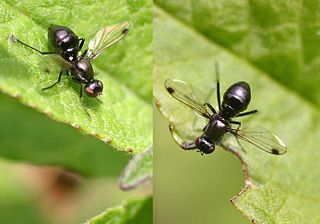
The Sepsidae are a family of flies, commonly called the black scavenger flies or ensign flies. Over 300 species are described worldwide. They are usually found around dung or decaying plant and animal material. Many species resemble ants, having a "waist" and glossy black body. Many Sepsidae have a curious wing-waving habit made more apparent by dark patches at the wing end.

The Tephritidae are one of two fly families referred to as fruit flies, the other family being the Drosophilidae. The family Tephritidae does not include the biological model organisms of the genus Drosophila, which is often called the "common fruit fly". Nearly 5,000 described species of tephritid fruit fly are categorized in almost 500 genera of the Tephritidae. Description, recategorization, and genetic analyses are constantly changing the taxonomy of this family. To distinguish them from the Drosophilidae, the Tephritidae are sometimes called peacock flies, in reference to their elaborate and colorful markings. The name comes from the Greek τεφρος, tephros, meaning "ash grey". They are found in all the biogeographic realms.

The Lauxaniidae are a family of acalyptrate flies. They generally are small flies with large compound eyes that often are brightly coloured in life, sometimes with characteristic horizontal stripes, such as in Cestrotus species. Many species have variegated patterns on their wings, but in contrast they generally do not have variegated bodies, except for genera such as Cestrotus, whose camouflage mimics lichens or the texture of granitic rocks.

The Chamaemyiidae are a small family of acalyptrate flies with less than 200 species described worldwide. The larvae of these small flies are active and predatory and are often used for biological control of aphids, scale insects, and similar pests. Chamaemyiid fossils are poorly represented in amber deposits, but a few examples are known from the Eocene epoch onwards.

Canacidae, incorrectly Canaceidae, or beach flies, surf or surge flies, is a family of Diptera. There are 113 species in 12 genera. The family now includes Tethininae as a subfamily.

Clusiidae or "druid flies" is a family of small, thin, yellow to black acalyptrate flies with a characteristic antenna and with the wing usually partially infuscated. They have a cylindrical body. The head is round, the vertical plate reaches the anterior margin of the frons and the vibrissae on the head are large. The costa is interrupted near subcosta and the latter developed throughout length. Larvae are found in the bark of trees, the flies on trunks. The larvae are notable for their ability to jump. Males of many species in the subfamily Clusiodinae have been observed while engaged in lekking behaviour. There are hundreds of species in 14 genera found in all the Ecoregions, although most species occur in tropical regions. The type genus is Clusia Haliday, 1838.

The Coelopidae or kelp flies are a family of Acalyptratae flies, they are sometimes also called seaweed flies, though both terms are used for a number of seashore Diptera. Fewer than 40 species occur worldwide. The family is found in temperate areas, with species occurring in the southern Afrotropical, Holarctic, and Australasian regions.
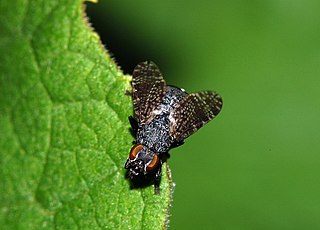
The Platystomatidae are a distinctive family of flies (Diptera) in the superfamily Tephritoidea.

The Celyphidae, commonly known as beetle flies or beetle-backed flies, are a family of flies. About 115 species in about 9 genera are known chiefly from the Oriental and Afrotropic biogeographic regions with one lineage in the New World.

The subfamily Pseudopomyzinae comprises minute to small (1.7-5.5 mm), dark coloured acalyptrate flies; formerly ranked as a family, they have been treated as a subfamily of Cypselosomatidae since 2007.
Euaresta is a genus of flies in the family Tephritidae that live in plants of the closely related genera Ambrosia, Xanthium, and Dicoria, and feed on their flowers and seeds.
The broad-headed flies is a subfamily of flies. Until 2010, they were known from only one species based on four specimens and placed in the family Eurychoromyiidae.

Neogriphoneura is a genus of flies in the family Lauxaniidae. There are about 11 described species in Neogriphoneura.
Xenopterella is a genus of flies in the family Lauxaniidae. There are at least two described species in Xenopterella.

Plastotephritinae is a subfamily of flies (Diptera) in the family Platystomatidae, which currently includes 18 genera.

Exsul singularis, the bat-winged fly, is a species of fly that is endemic to New Zealand, first described by Frederick Hutton in 1901. The males have enormously expanded wings. The species is found in the south-western South Island and occurs mostly in high-altitude meadows near streams. It preys on soft-bodied flying insects and is believed to uses its wings to increase its body temperature to offset the cool temperatures of its alpine habitat.
Tauridion shewelli is a species of flies in the subfamily Eurychoromyiinae.
Choryeuromyia xenisma is a species of flies in the subfamily Eurychoromyiinae.
Euryhendelimyia schlingeri is a species of flies in the subfamily Eurychoromyiinae.
Roryeuchomyia tigrina is a species of flies in the subfamily Eurychoromyiinae.

