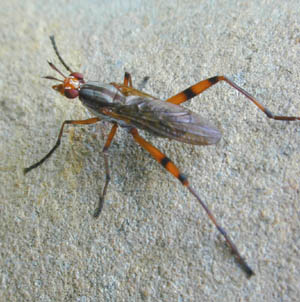
Eurychoromyia mallea, the broad-headed fly, is a species of flies in the subfamily Eurychoromyiinae.
The Acalyptratae or Acalyptrata are a subsection of the Schizophora, which are a section of the order Diptera, the "true flies". In various contexts the Acalyptratae also are referred to informally as the acalyptrate muscoids, or acalyptrates, as opposed to the Calyptratae. All forms of the name refer to the lack of calypters in the members of this subsection of flies. An alternative name, Acalypterae is current, though in minority usage. It was first used by Pierre-Justin-Marie Macquart in 1835 for a section of his tribe Muscides; he used it to refer to all acalyptrates plus scathophagids and phorids, but excluding Conopidae.

The Lauxanioidea are a superfamily of flies that includes the two large families, the Lauxaniidae and Chamaemyiidae, and the small family Celyphidae. Generally, they are small to medium, densely populated, coloured flies. The Chamaemyiidae and Cremifaniidae live as parasites on insects. The family Celyphidae look like beetles.

The Lauxaniidae are a family of acalyptrate flies. They generally are small flies with large compound eyes that often are brightly coloured in life, sometimes with characteristic horizontal stripes, such as in Cestrotus species. Many species have variegated patterns on their wings, but in contrast they generally do not have variegated bodies, except for genera such as Cestrotus, whose camouflage mimics lichens or the texture of granitic rocks.

The Chamaemyiidae are a small family of acalyptrate flies with less than 200 species described worldwide. The larvae of these small flies are active and predatory and are often used for biological control of aphids, scale insects, and similar pests. Chamaemyiid fossils are poorly represented in amber deposits, but a few examples are known from the Eocene epoch onwards.
Odiniidae is a small family of flies. There are only 58 described species but there are representatives in all the major biogeographic realms.

The Celyphidae, commonly known as beetle flies or beetle-backed flies, are a family of flies. About 115 species in about 9 genera are known chiefly from the Oriental and Afrotropic biogeographic regions with one lineage in the New World.

Ocydromia is a genus of hybotid flies.

Sapromyza (Sapromyzosoma) quadricincta, is a species of small flies of the family Lauxaniidae present in Europe.
Sciasminettia is a genus of small Palearctic flies of the family Lauxaniidae.
Parapachycerina is a genus of small African flies of the family Lauxaniidae. They are mostly yellow-orange in colour.
The broad-headed flies is a subfamily of flies. Until 2010, they were known from only one species based on four specimens and placed in the family Eurychoromyiidae.
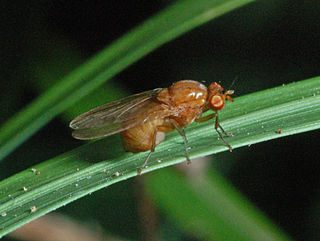
Sapromyza halidayi is a species of small flies of the family Lauxaniidae.

Cestrotus is a genus of brachyceran flies in the family Lauxaniidae.

Neogriphoneura is a genus of flies in the family Lauxaniidae. There are about 11 described species in Neogriphoneura.
Exalla is a genus of flies in the family Lauxaniidae.
Choryeuromyia xenisma is a species of flies in the subfamily Eurychoromyiinae.
Euryhendelimyia schlingeri is a species of flies in the subfamily Eurychoromyiinae.
Roryeuchomyia tigrina is a species of flies in the subfamily Eurychoromyiinae.
Physegeniopsis is a genus of flies in the family Lauxaniidae.

