
The Syrena was a Polish automobile model first exhibited at the Poznań Trade Fair in 1955 and manufactured from 1957 to 1972 by the Fabryka Samochodów Osobowych (FSO) in Warsaw and from 1972 until 1983 by Fabryka Samochodów Małolitrażowych (FSM) in Bielsko-Biała. 177,234 were manufactured by FSO and 344,077 by FSM, a total of 521,311. During its remarkably long production run it underwent only minor modifications.

The MacPherson strut is a type of automotive suspension system that uses the top of a telescopic damper as the upper steering pivot. It is widely used in the front suspension of modern vehicles. The name comes from American automotive engineer Earle S. MacPherson, who invented and developed the design.

Suspension is the system of tires, tire air, springs, shock absorbers and linkages that connects a vehicle to its wheels and allows relative motion between the two. Suspension systems must support both road holding/handling and ride quality, which are at odds with each other. The tuning of suspensions involves finding the right compromise. The suspension is crucial for maintaining consistent contact between the road wheel and the road surface, as all forces exerted on the vehicle by the road or ground are transmitted through the tires' contact patches. The suspension also protects the vehicle itself and any cargo or luggage from damage and wear. The design of front and rear suspension of a car may be different.
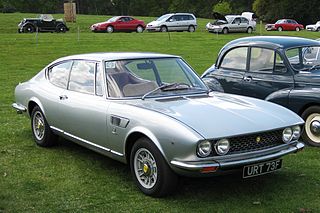
The Fiat Dino was a front-engine, rear-wheel-drive sports car produced by Fiat from 1966 to 1973. The Dino name refers to the Ferrari Dino V6 engine, produced by Fiat and installed in the cars to achieve the production numbers sufficient for Ferrari to homologate the engine for Formula 2 racing.

Independent suspension is any automobile suspension system that allows each wheel on the same axle to move vertically independently of the others. This is contrasted with a beam axle or deDion axle system in which the wheels are linked. "Independent" refers to the motion or path of movement of the wheels or suspension. It is common for the left and right sides of the suspension to be connected with anti-roll bars or other such mechanisms. The anti-roll bar ties the left and right suspension spring rates together but does not tie their motion together.

FSO Warszawa is an automobile manufactured in FSO factory in Warsaw, Poland between 1951 and 1973, based on GAZ-M20 Pobeda.

The Chapman strut is a design of independent rear suspension used for light cars, particularly sports and racing cars. It takes its name from, and is best known for its use by, Colin Chapman of Lotus.

A swingarm, originally known as a swing fork or pivoted fork, is a single or double sided mechanical device which attaches the rear wheel of a motorcycle to its body, allowing it to pivot vertically. The main component of the rear suspension of most modern motorbikes and ATVs, it holds the rear axle firmly, while pivoting to absorb bumps and suspension loads induced by the rider, acceleration, and braking.

The Fiat 131 is a mid-size family car manufactured and marketed by Fiat from 1974 to 1984 after its debut at the 1974 Turin Motor Show. Available as a two-door and four-door saloon and 5-door estate across a single generation, the 131 succeeded the Fiat 124.

The Fiat 125 is a large family car manufactured and marketed by Italian company Fiat from 1967 to 1972. Derivatives were built under license outside Italy until the 1990s. As launched the car was unusual in blending saloon car passenger accommodation with sports car performance, a combination which would be more widely adopted by the European volume auto-makers in the decade ahead.

Fabryka Samochodów Osobowych, commonly known as FSO, is a Polish automobile parts manufacturer, and formerly an automobile producer of historic significance, located in Warsaw.

The FSO Polonez is a motor vehicle that was developed in Poland in collaboration with Fiat and produced by Fabryka Samochodów Osobowych from 1978 to 2002. It was based on the Polski Fiat 125p platform with a new hatchback design by Zbigniew Watson, Walter de Silva and Giorgetto Giugiaro. It was available in body styles that included two- and four-door compact-sized cars, station wagons, as well as commercial versions as pickup truck, cargo van, and ambulance. Production totaled more than one million units, excluding the pickup truck and van variants. The Polonez was marketed in other nations and was popular in its domestic market until Poland joined the European Union in 2004.

The Fiat 124 Sport Spider is a convertible sports car marketed by Fiat for model years 1966–1985. Designed by and manufactured at the Italian carrozzeria Pininfarina factory, the monocoque, front-engined, rear-drive Sport Spider debuted at the November 1966 Turin Auto Show with styling by Tom Tjaarda.

Polski Fiat was a Polish car brand. Under this brand, cars under licence of the Italian manufacturer FIAT were manufactured or assembled in Poland.

Polski Fiat 125p is a motor vehicle manufactured between 1967 and 1991 in Poland under a Fiat license by the state-owned manufacturer Fabryka Samochodów Osobowych (FSO). It was a simplified and altered variation of the original, Italian-made Fiat 125, with engines and mechanicals from the Fiat 1300/1500. To distinguish between the models, Fiat and FSO revived the marque Polski Fiat. After termination of the license, the car was branded as FSO 1300, FSO 1500 and FSO 125p.

The Fiat 1300 and Fiat 1500 are a series of front-engine, rear-drive automobiles manufactured and marketed by Fiat from 1961 to 1967, replacing the Fiat 1400 and Fiat 1200 coupé, spyder and cabriolet. The 1300 and 1500 were essentially identical to each other except for their engine displacement, as indicated by their model names, and were offered in sedan/saloon, station wagon, convertible and coupé body styles which shared little mechanically with the other body styles except the 1500 engine.
Sylva Autokits is a kit car manufacturer based in Lincolnshire, England. Sylva was founded in 1981 by Jeremy Phillips and has developed and produced a number of small and lightweight sports cars. Sylva cars have won a number of 750 Motor Club Kit Car championships.

FSO Polonez 2000 Rally is a Polish rally car produced by the FSO and OBRSO in Warsaw during Communist rule in Poland. It was first created in 1978 following the release of its production counterpart: the FSO Polonez. It competed in Group IV, Group II, Group B, and other events.
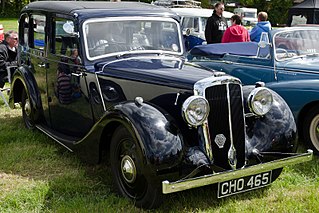
The Lanchester Fourteen Roadrider is a six-cylinder automobile introduced by the Lanchester Motor Company in the beginning of September 1936. It was named "Roadrider" for its special suspension features, and billed as the lowest-priced six-cylinder Lanchester ever offered. This car replaced the previous 12 hp Light Six model with a larger six-cylinder engine again in the Lanchester Eleven chassis and body.

The Syrena 110 was a Polish automobile prototype from the mid-1960s, manufactured by the Fabryka Samochodów Osobowych (FSO) in Warsaw. It was one of the first hatchbacks in the world.


